
SEMANTIC SEO • KEYWORD RESEARCH • AI SEARCH
Searching for one keyword is no longer enough.
Modern search systems understand topics through meaning, context, entities, relationships, and user intent.
That is where semantic keywords become useful.
Semantic keyword research helps you discover the concepts surrounding your main topic.
It can reveal:
- Related concepts.
- Important entities.
- Entity attributes.
- Common questions.
- Searcher problems.
- Relevant comparisons.
- Related actions.
- Contextual terminology.
However, semantic keywords are often misunderstood.
They are not keywords you must stuff into an article.
They are not Google's secret ranking checklist.
They are also not simply another name for LSI keywords.
This guide explains semantic keywords from a practical SEO perspective.
You will learn how to research, classify, map, use, and measure them.
Quick Answer: What Are Semantic Keywords?
Semantic keywords are words, concepts, and entities meaningfully connected with a page's main topic.
They help writers cover a subject with stronger context and useful depth.
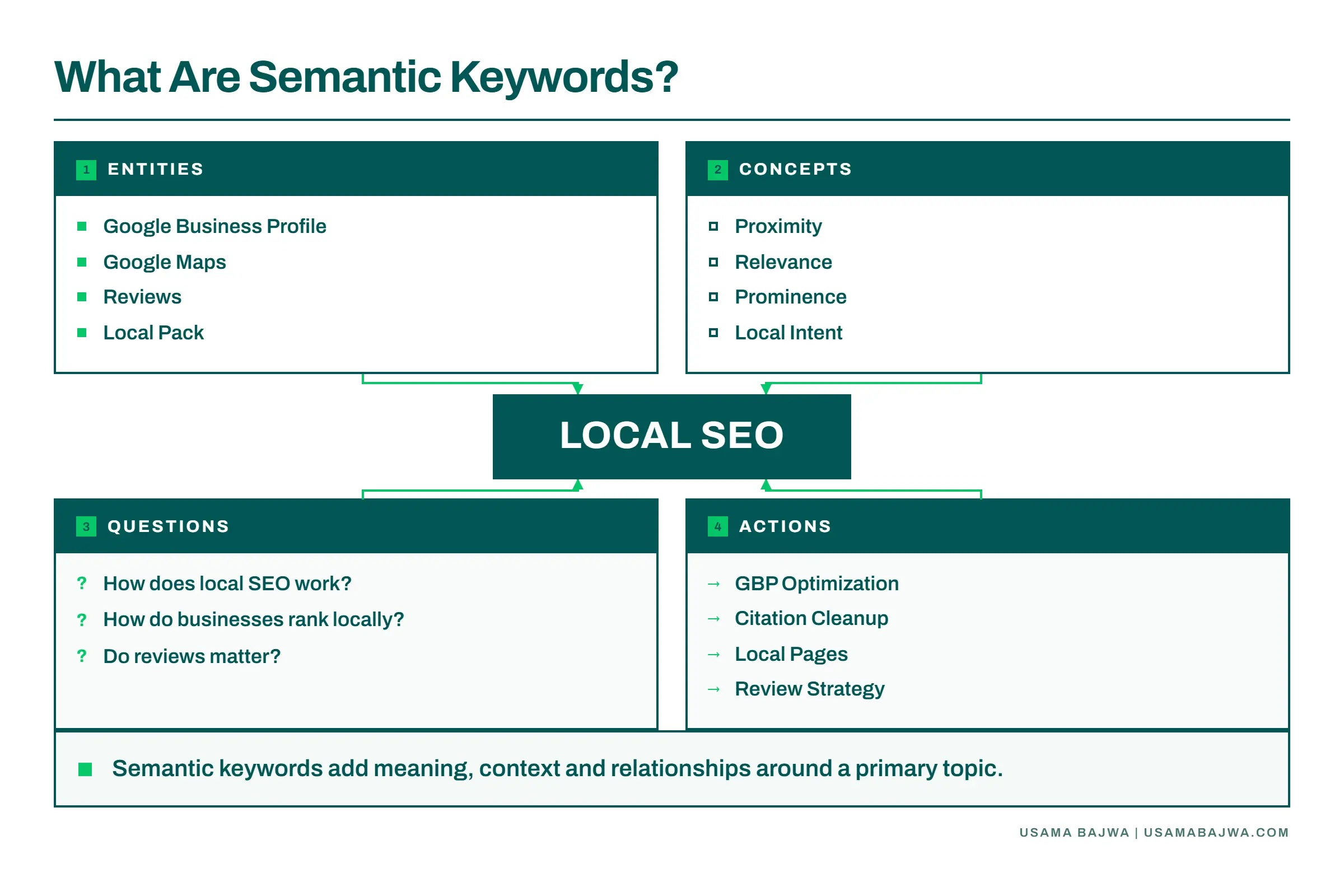
For example, imagine your primary topic is local SEO.
Related semantic concepts could include Google Maps, reviews, citations, proximity, and Google Business Profile.
Their value comes from meaning, not repetition.
Semantic Keywords: September 2026 Search Data
I reviewed current Semrush data before preparing this guide.
The research used the United States desktop database.
The snapshot was collected during September 2026.
| Metric | Current Data |
|---|---|
| Main keyword | semantic keywords |
| U.S. search volume | 2,900 |
| Global search volume | 4,300 |
| Keyword Difficulty | 32% |
| CPC | $3.87 |
| Search intent | Informational |
| Keyword variations | 431 |
| Combined variation volume | 9,500 |
| Related questions | 44 |
| Question search volume | 310 |
Important Related Search Queries
| Keyword | U.S. Volume | KD |
|---|---|---|
| semantic keywords | 2,900 | 32 |
| semantic keyword | 1,300 | 27 |
| semantic keywords SEO | 390 | 30 |
| semantic keyword research | 210 | 20 |
| semantic search vs keyword search | 140 | 33 |
| how to find semantic keywords | 50 | 20 |
| what are semantic keywords | 40 | Low |
| LSI keywords | 4,400 | 41 |
| LSI keywords meaning | 880 | 40 |
| latent semantic indexing keywords | 590 | 58 |
Important: Keyword tools provide estimates.
Search volumes and difficulty scores can change as databases update.
What Is a Semantic Keyword?
A semantic keyword provides useful context around another topic or search query.
However, the term can sometimes be misleading.
Google does not provide publishers with an official list called semantic keywords.
Think of semantic keywords as a content research concept.
They help identify information needed for complete topic coverage.
A Simple Technical SEO Example
Imagine the main topic is technical SEO.
Related concepts may include:
- Crawling.
- Indexing.
- Canonicalization.
- Robots.txt.
- XML sitemaps.
- Status codes.
- Redirects.
- JavaScript rendering.
- Structured data.
These concepts are connected through meaning.
They help explain technical SEO more completely.
A Simple Semantic Keyword Example
Consider the primary topic car dealership SEO.
A weak article might repeat that phrase many times.
A stronger article would explore the complete search problem.
| Semantic Area | Example |
|---|---|
| Core entity | Car dealership |
| Search platform | |
| Local entity | Google Business Profile |
| Inventory | Vehicle listings |
| Location | Dealership service area |
| Trust signal | Reviews |
| Page type | Vehicle detail pages |
| Technical concern | Inventory indexing |
| Conversion | Test drive enquiry |
| Local feature | Google Maps |
The page becomes stronger because the subject receives useful context.
The writer no longer needs unnecessary exact-match repetition.
What Semantic Keywords Are Not
This distinction matters.
Semantic optimization becomes ineffective when people misunderstand its purpose.
- ✓They are not a fixed list supplied by Google.
- ✓They are not a published direct ranking factor.
- ✓They are not words requiring fixed repetition.
- ✓They are not synonyms only.
- ✓They are not LSI keywords.
- ✓They are not replacements for keyword stuffing.
- ✓They are not a reason for hundreds of pages.
- ✓They are not substitutes for search intent.
- ✓They do not guarantee AI Overview visibility.
Start with user needs before using any keyword framework.
My guide to SEO keywords explains the wider keyword types and their purposes.
Semantic Keywords vs. Other SEO Concepts
Several SEO concepts sound similar.
They perform different jobs.
Semantic Keywords vs. Secondary Keywords
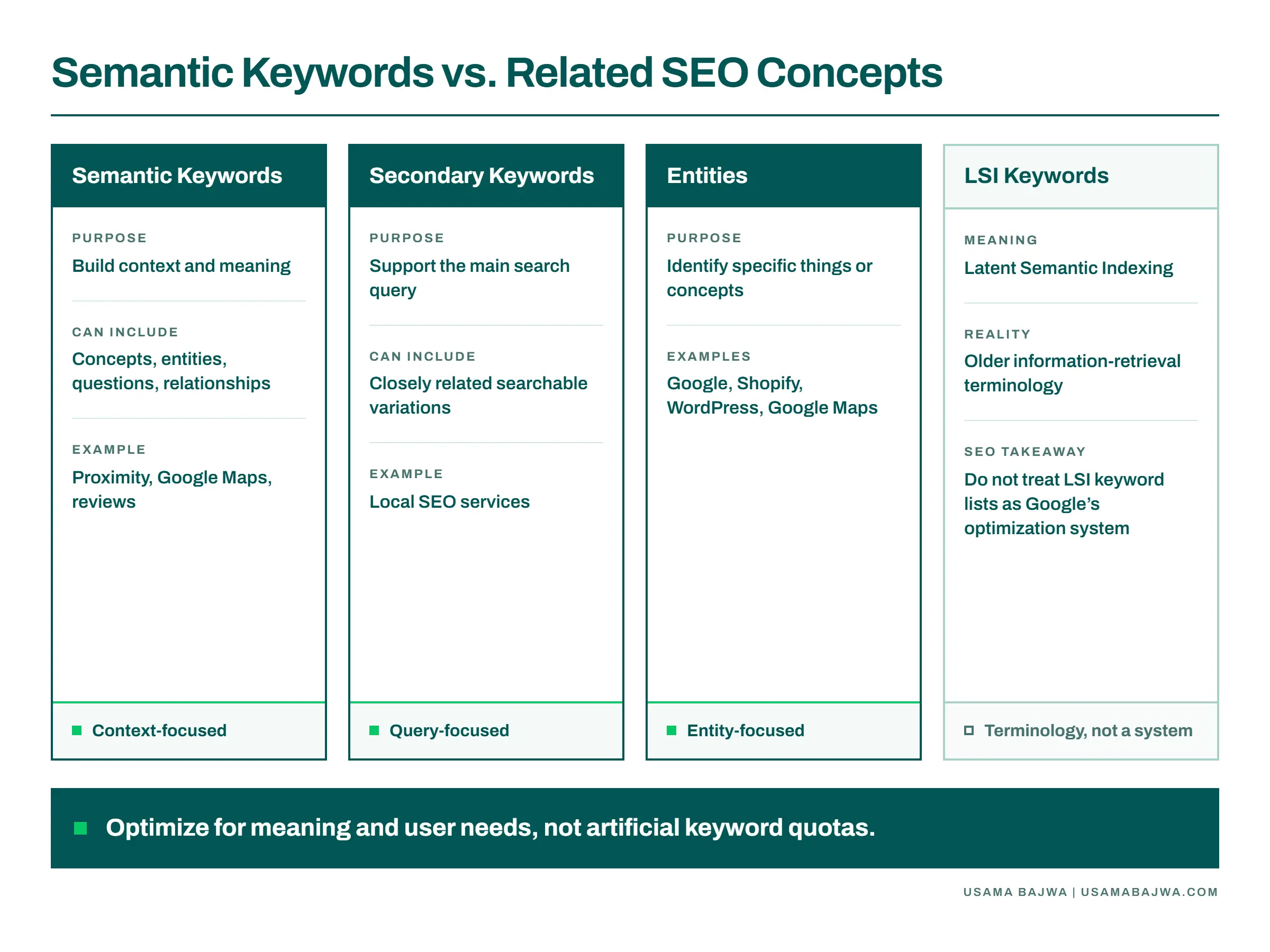
| Semantic Keywords | Secondary Keywords |
|---|---|
| Expand contextual understanding | Support the primary search query |
| Can include entities | Usually represent searchable queries |
| Can include attributes | Often have measurable demand |
| Can include concepts | Often target close variations |
| May have no search volume | Usually appear in keyword research tools |
| Help topic understanding | Help query coverage |
Semantic Keywords vs. Related Keywords
Related keywords usually come from keyword research tools.
They often share lexical or behavioral relationships.
Semantic concepts can go further.
They may include information users rarely search independently.
For example, ecommerce SEO may include faceted navigation and crawl budget.
These concepts can improve the quality of an ecommerce explanation.
Semantic Keywords vs. Entities
An entity is a uniquely identifiable thing or concept.
Examples include Google, WordPress, Shopify, Lahore, and Google Search Console.
Semantic research can uncover entities and their important relationships.
Example relationship: Google Search Console reports search performance data for verified websites.
This sentence connects an entity, action, information type, and website context.
Semantic Keywords vs. Topics
A topic is broader than one semantic keyword.
Semantic concepts help explain important parts of that topic.
For example, Local SEO contains reviews, citations, proximity, maps, and location pages.
Semantic Keywords vs. LSI Keywords
LSI means Latent Semantic Indexing.
It refers to an older information-retrieval technique.
It should not become your modern Google SEO strategy.
Some tools still use the term LSI keywords.
That does not make LSI an official Google keyword system.
Focus instead on meaning, entities, relationships, questions, and user intent.
Why Semantic Keywords Matter for SEO
Semantic keyword research improves the research process.
It does not magically improve rankings itself.
Its value comes from better content decisions.
Semantic Research Can Help You
- ✓Discover missing subtopics.
- ✓Understand search intent.
- ✓Identify important entities.
- ✓Find meaningful relationships.
- ✓Improve content briefs.
- ✓Reduce repetitive writing.
- ✓Build stronger topic clusters.
- ✓Create more natural internal links.
- ✓Avoid thin content.
- ✓Identify separate page opportunities.
These decisions also support stronger SEO topic clusters.
They can also reveal gaps during a content gap analysis.
Semantic Keywords and Search Intent
Search intent must come before keyword placement.
A keyword can be relevant but still belong on another page.
| Query | Likely Intent |
|---|---|
| what is semantic SEO | Informational |
| semantic keywords | Informational |
| semantic SEO services | Commercial |
| semantic SEO agency | Commercial |
| semantic keyword research tool | Informational / Commercial |
| semantic keyword generator | Tool-seeking |
| how to find semantic keywords | Informational |
These searches should not automatically target one URL.
Search intent and SERP overlap should guide page ownership.
Do Semantic Keywords Matter for AI Search?
Yes, but not through a secret AI optimization formula.
Google's generative search features still rely on core Search systems.
Google also describes a process called query fan-out.
Query fan-out can issue related searches for broader information gathering.
This makes complete topic understanding increasingly useful.
However, every related query does not need another page.
Useful coverage matters more than creating unnecessary URLs.
Key Takeaway
Do not create pages for every semantic variation.
Understand the information neighborhood around the user's main question.
Then cover relevant concepts where they genuinely help.
What Is Query Fan-Out?
Query fan-out expands a complex information need into related searches.
Imagine someone asks about improving a local dentist's search visibility.
Supporting searches may explore:
- Local dentist SEO.
- Google Business Profile optimization.
- Dental reviews.
- Dental service pages.
- Local citations.
- Structured data.
- Dental content.
- AI search visibility.
The system can gather information from several related retrievals.
This does not mean each retrieval deserves a separate webpage.
Semantic Keywords for SEO vs. AI Search
| Traditional SEO | AI Search |
|---|---|
| Search intent | Complex information needs |
| Topical relevance | Contextual completeness |
| Strong page structure | Extractable information |
| Entities | Entity relationships |
| Internal links | Connected information |
| Original evidence | Citation-worthy evidence |
| Crawlability | Retrieval eligibility |
| Quality content | Useful source selection |
The foundations overlap heavily.
Useful content still needs crawlability, clarity, relevance, and strong information quality.
How to Find Semantic Keywords
Finding semantic keywords requires more than exporting one keyword list.
I use a structured seven-layer process.
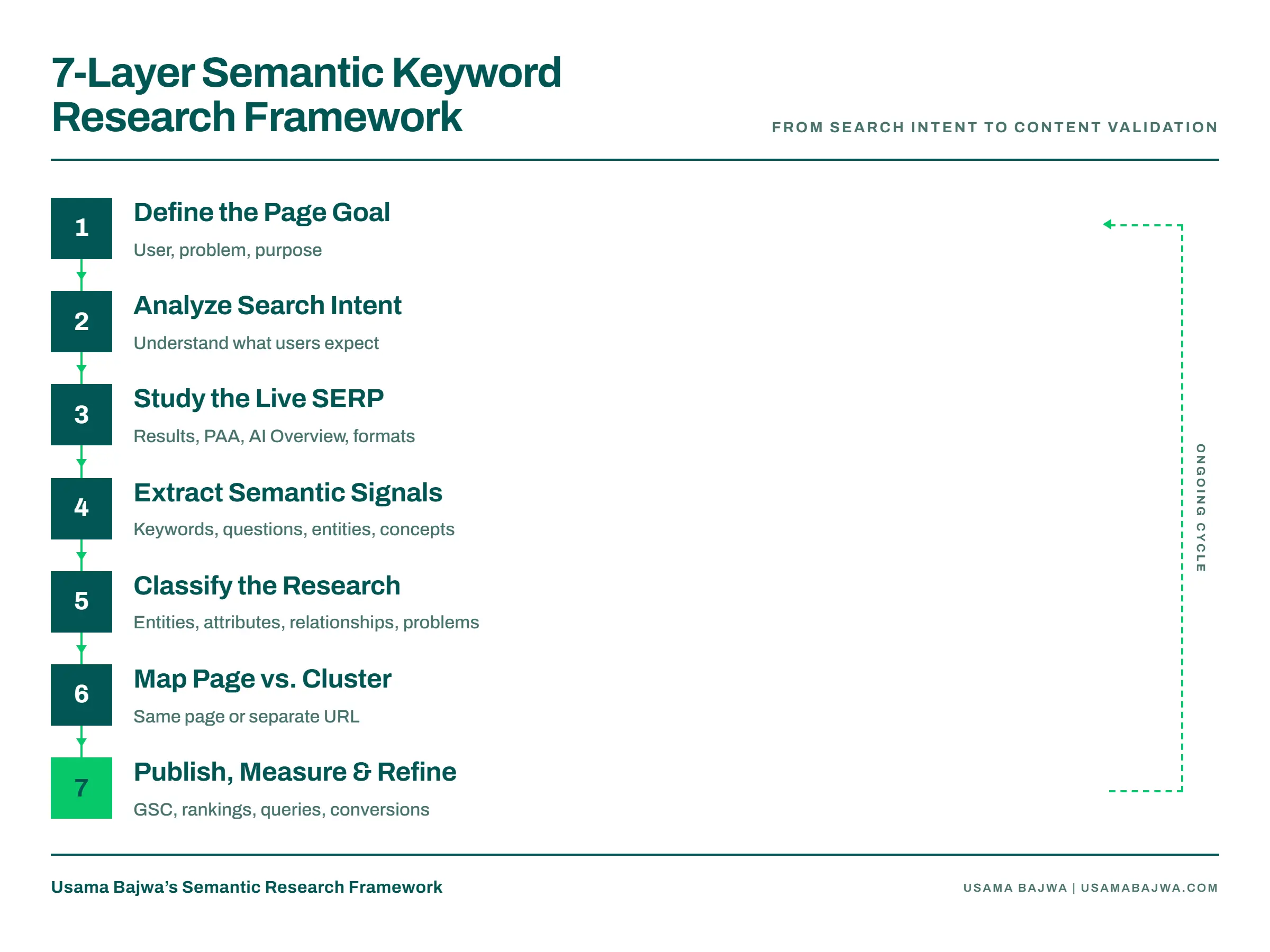
Step 1: Define the Page's Core Job
Every page needs one clear responsibility.
Ask these questions:
- What problem does this page solve?
- Who is searching?
- What decision are they making?
- What should they understand afterward?
- What action should follow?
For this article, the responsibility is clear.
It should help users understand, find, map, and use semantic keywords correctly.
Step 2: Analyze Search Intent
Study what the searcher expects before researching supporting terms.
Identify whether the intent is informational, commercial, transactional, local, or mixed.
My keyword research checklist provides a broader research workflow.
Step 3: Analyze the Live SERP
Search your main keyword.
Do not inspect titles only.
Review:
- Page types.
- Ranking formats.
- People Also Ask questions.
- AI Overview presence.
- Image packs.
- Videos.
- Tools.
- Forums.
- Repeated subtopics.
The current semantic keywords SERP contains educational pages and practical tools.
It also includes AI Overview and question-based search features.
Step 4: Extract Semantic Signals
Now collect useful signals from several sources.
- Google search results.
- People Also Ask.
- Related searches.
- Semrush.
- Competitor content.
- Google Search Console.
- Customer language.
Do not treat every discovered phrase as mandatory.
Step 5: Classify the Research
This step turns a keyword list into a useful content model.
Classify findings into concepts, entities, attributes, relationships, problems, actions, and questions.
Step 6: Map Page vs. Cluster
Decide whether each concept belongs on the existing page.
Some search intents deserve separate URLs.
This is where keyword mapping becomes important.
Use keyword clustering when several queries share similar SERPs.
Step 7: Publish, Measure, and Refine
SEO work does not end after publication.
Review Search Console data after Google processes the page.
Track impressions, clicks, query expansion, rankings, and conversions.
How to Find Semantic Keywords With Google
Google itself provides several useful research signals.
People Also Ask
People Also Ask reveals question patterns around the topic.
Use questions only when their answers improve the page.
Related Searches
Related searches can reveal query connections and alternative language.
They can also expose different search intents.
Ranking Pages
Study what repeatedly appears across top-ranking pages.
Then identify useful information competitors have missed.
Do not copy competitor headings word for word.
How to Find Semantic Keywords With Semrush
Semrush can expand your keyword research with measurable search data.
Useful reports include:
- Keyword variations.
- Related keywords.
- Questions.
- Search volume.
- Keyword difficulty.
- Search intent.
- SERP competitors.
- Ranking URLs.
Do not copy every exported keyword into your article.
First decide what each keyword represents.
Use Google Search Console for Existing Pages
Search Console becomes valuable after a page starts generating impressions.
It shows how Google already connects your page with queries.
Review:
- Queries generating impressions.
- New search variations.
- Ranking changes.
- High-impression queries.
- Low-CTR queries.
- Country performance.
- Device performance.
These signals can reveal missing semantic coverage.
Study Real Customer Language
Keyword tools measure search behavior.
Customers reveal actual problems and expectations.
Useful sources include:
- Sales calls.
- Client emails.
- Support tickets.
- Reviews.
- Forums.
- Reddit discussions.
- YouTube comments.
- Competitor reviews.
- Discovery calls.
This language can reveal valuable terminology missing from keyword databases.
Use AI Tools as a Secondary Research Source
AI tools can expand ideas quickly.
They should not replace live SERP research.
Ask AI systems to identify:
- Related entities.
- Possible attributes.
- Common questions.
- Comparisons.
- Missing concepts.
- User scenarios.
Validate important suggestions with search data and business knowledge.
How to Classify Semantic Keywords
Collecting keywords is easy.
Classification produces strategy.
| Category | Purpose | Local SEO Example |
|---|---|---|
| Core concepts | Define the subject | Local search |
| Entities | Identify important things | Google Business Profile |
| Attributes | Describe entities | Business category |
| Relationships | Connect concepts | Reviews influence trust |
| Problems | Reflect user pain | Not appearing in Maps |
| Actions | Reflect solutions | Citation cleanup |
| Questions | Reflect information needs | How does local SEO work? |
Core Concepts
Core concepts explain the wider subject.
Local SEO concepts may include proximity, relevance, prominence, and local intent.
Entities
Entities provide clear references within the topic.
Examples include Google Maps and Google Business Profile.
Attributes
Attributes describe important properties of an entity.
Business categories, services, hours, and reviews are simple examples.
Relationships
Relationships explain how concepts connect.
They often provide more value than isolated term inclusion.
Problems
Problem language reflects what users want to solve.
Examples include indexing problems, declining rankings, and weak local visibility.
Actions
Actions describe practical solutions.
Examples include fixing canonicals, optimizing pages, and improving internal links.
Questions
Questions reveal specific information needs.
Use them when the answers genuinely improve the article.
How to Build a Semantic Keyword Map
A semantic keyword map organizes research before writing.
It helps prevent random keyword placement.
| Column | Purpose |
|---|---|
| Primary topic | Main subject |
| Target keyword | Primary search query |
| Semantic concept | Related concept |
| Category | Concept classification |
| Entity | Named or identifiable entity |
| Attribute | Entity property |
| Relationship | Connection between concepts |
| Question | User information need |
| Intent | Search purpose |
| Volume | Estimated demand |
| KD | Estimated ranking difficulty |
| Source | Research source |
| Same page? | Mapping decision |
| Target section | Content location |
| Internal link | Supporting URL |
| Evidence needed | Source or proof |
| Status | Workflow stage |
Build Your Own Semantic Keyword Map
Want the semantic keyword mapping template used for this workflow?
Send me your topic or website.
I can help you organize:
- Concepts.
- Entities.
- Attributes.
- Relationships.
- Search intent.
- Keyword data.
- Page mapping.
- Internal links.
Complete Semantic Keyword Map Example: Local SEO
Now let us apply the method to a real SEO topic.
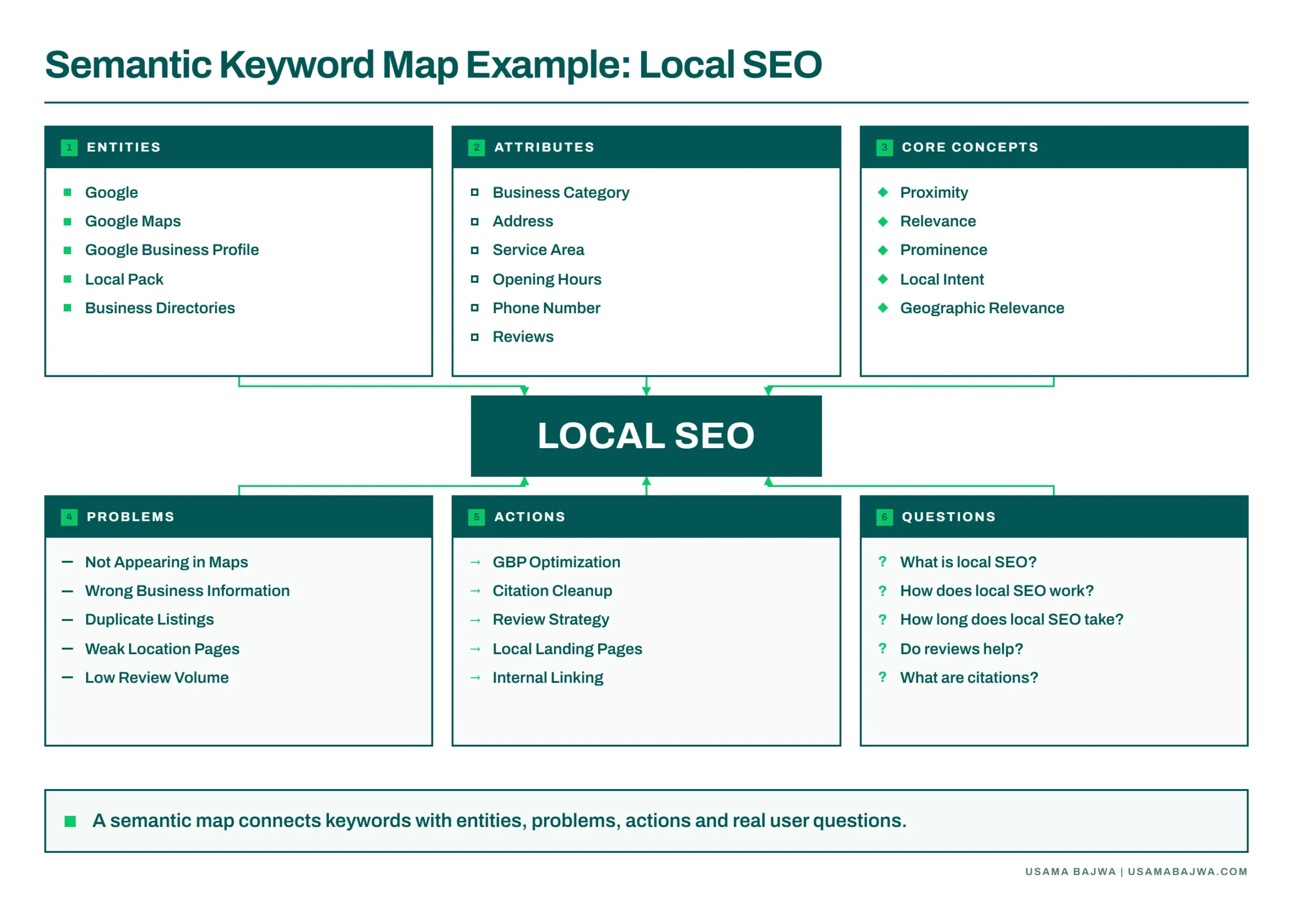
Core Topic
Local SEO
Core Concepts
- Local search.
- Geographic relevance.
- Proximity.
- Prominence.
- Local intent.
Entities
- Google.
- Google Maps.
- Google Business Profile.
- Local Pack.
- Business directories.
Attributes
- Business category.
- Address.
- Service area.
- Opening hours.
- Phone number.
- Reviews.
User Problems
- Not appearing in Google Maps.
- Incorrect business information.
- Low review volume.
- Duplicate listings.
- Weak location pages.
Actions
- Optimize Google Business Profile.
- Correct business information.
- Build relevant citations.
- Improve local landing pages.
- Earn customer reviews.
- Strengthen internal links.
Questions
- What is local SEO?
- How does local SEO work?
- How long does local SEO take?
- Do reviews affect local visibility?
- What are local citations?
- Does every location need a page?
Learn more in my Local SEO guide for small businesses.
Turning the Semantic Map Into Content
The semantic map should influence page structure.
It should never become a keyword dump.
Example H2: What Is Local SEO?
This section could explain local intent, businesses, locations, and search visibility.
Example H2: How Google Business Profile Supports Local Visibility
This section could cover categories, services, hours, and reviews.
Example H2: What Are Local Citations?
This section could explain directories and business information consistency.
Example H2: How Reviews Support Local Businesses
This section could explain reputation, trust, and customer decisions.
The structure follows user needs naturally.
Should a Semantic Keyword Use the Same Page?
Not every related keyword belongs on the same URL.
This decision can prevent keyword cannibalization.
Search intent and SERP overlap should lead the decision.
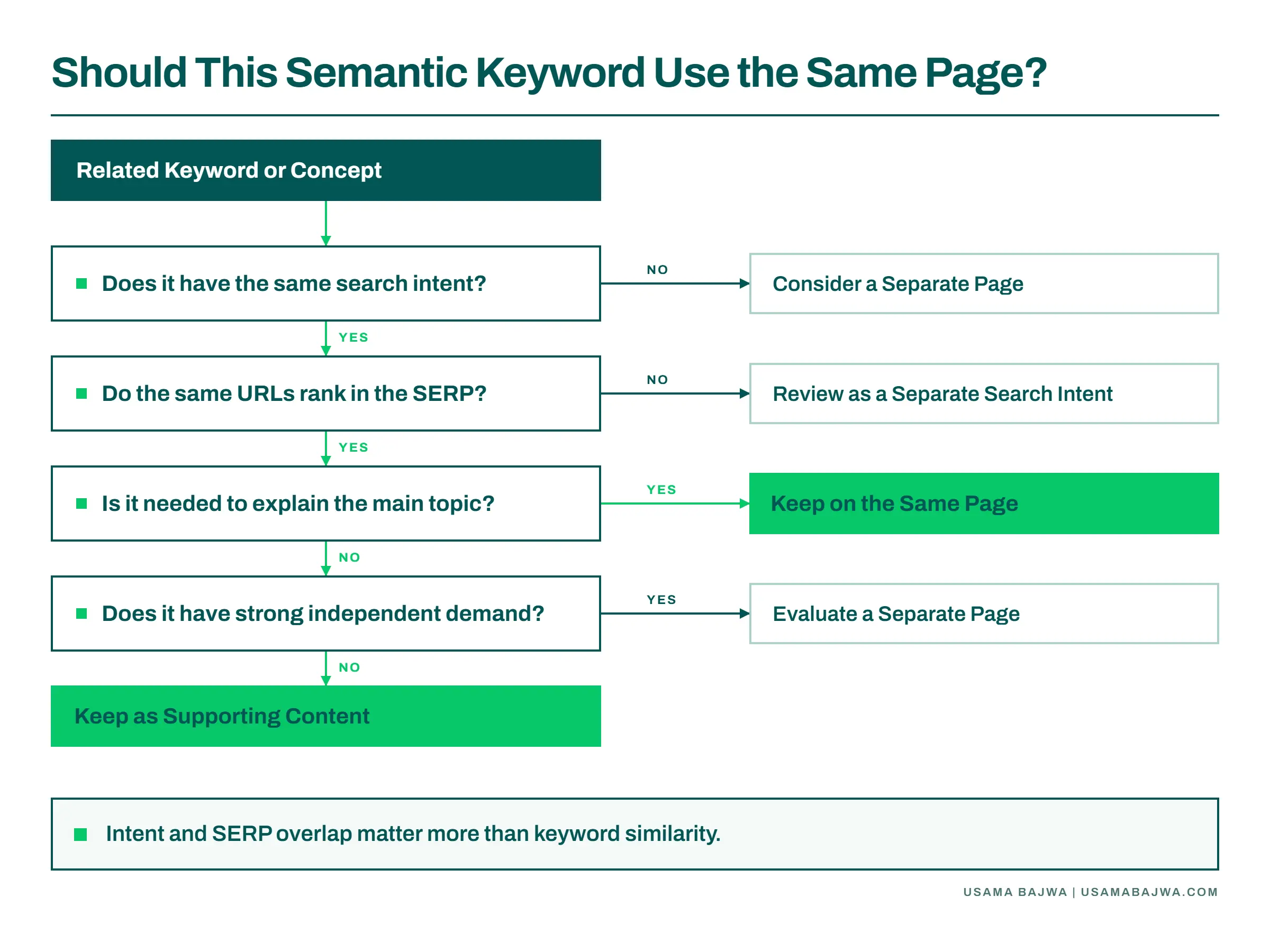
| Signal | Same Page | Separate Page |
|---|---|---|
| Same search intent | ✓ | |
| Same ranking competitors | ✓ | |
| Supporting concept | ✓ | |
| Needed for context | ✓ | |
| Small independent demand | ✓ | |
| Different search intent | ✓ | |
| Different SERP format | ✓ | |
| Strong independent demand | ✓ | |
| Different buyer stage | Often | |
| Needs a complete standalone answer | ✓ |
Read my detailed keyword cannibalization guide before splitting closely related pages.
How to Use Semantic Keywords on a Page
Finding semantic keywords is only the first step.
Placement should remain natural.
Page Title
Use the primary keyword when it accurately describes the page.
Do not force several variations into one title.
H1 Heading
The H1 should clearly explain the page's main purpose.
H2 and H3 Headings
Use related concepts when they represent useful sections.
Do not turn every keyword variation into a heading.
Opening Paragraphs
Answer the main question early.
Avoid long introductions before the definition.
Body Content
Use semantic concepts inside useful explanations.
Do not insert terms only because a tool recommends them.
Tables
Tables work well for comparisons, research data, and decision criteria.
Internal Links
Internal links should connect genuinely related information.
Read my internal linking guide for a complete implementation process.
Images
Use diagrams when visuals can explain a difficult relationship faster.
Do not add stock images simply to increase image count.
How Many Semantic Keywords Should You Use?
There is no universal number.
Do not target ten, twenty, or fifty terms automatically.
Do not optimize around an arbitrary keyword density percentage.
Use this question instead:
Does this concept help the user understand the subject better?
If the answer is yes, include it naturally.
If the answer is no, leave it out.
What Is Semantic Keyword Research?
Semantic keyword research identifies meaningful concepts surrounding a primary search topic.
Traditional keyword research usually starts with measurable search queries.
Semantic research adds another layer.
It examines:
- Meaning.
- Context.
- Entities.
- Attributes.
- Relationships.
- User questions.
- Search intent.
- Topic connections.
The strongest strategy combines both methods.
Semantic Keyword Research vs. Traditional Keyword Research
| Traditional Keyword Research | Semantic Keyword Research |
|---|---|
| Finds search queries | Finds contextual relationships |
| Measures volume | Maps concepts |
| Measures difficulty | Maps entities |
| Reviews CPC | Finds attributes |
| Groups keywords | Explains connections |
| Maps URLs | Improves topical depth |
| Prioritizes opportunities | Improves content understanding |
Neither approach should replace the other.
They work best together.
Semantic Search vs. Keyword Search
Keyword search traditionally focuses strongly on matching query terms.
Semantic search focuses more on meaning and context.
Modern search systems can combine both approaches.
| Keyword Search | Semantic Search |
|---|---|
| Focuses on terms | Focuses on meaning |
| Strong lexical matching | Contextual matching |
| Exact wording matters more | Relationships matter more |
| Limited ambiguity handling | Better contextual interpretation |
| Query-focused | Intent-focused |
Users still search with keywords.
Modern systems can understand much more around those words.
Best Sources for Semantic Keyword Research
No single tool provides a perfect semantic map.
Combine several evidence sources.
| Source | Best Use |
|---|---|
| Google SERP | Intent and result patterns |
| People Also Ask | User questions |
| Related Searches | Query relationships |
| Semrush | Volume, KD, keywords, competitors |
| Google Search Console | Existing query relationships |
| Customer interviews | Real language |
| Reviews | Problems and expectations |
| Forums | Natural discussions |
| AI tools | Idea expansion |
| Competitor pages | Coverage comparison |
Quantitative and qualitative evidence work best together.
Semantic Keyword Research Tools
Semrush
Semrush helps research variations, intent, questions, difficulty, and competing pages.
Google Search Console
Search Console reveals real queries associated with your existing pages.
Google Search
Google Search reveals SERP formats, questions, competitors, and related searches.
KeywordsPeopleUse
KeywordsPeopleUse can surface questions and topic relationships.
AI Tools
AI tools can help brainstorm entities, relationships, comparisons, and missing concepts.
Always validate important findings.
How Semantic Keywords Support Topical Authority
Topical authority does not come from mentioning many keywords.
It develops through consistent and useful topic coverage.
A strong topic cluster usually contains:
- A clear pillar page.
- Supporting subtopics.
- Logical internal links.
- Unique page responsibilities.
- Expert information.
- Relevant entities.
- Useful evidence.
Semantic research helps identify missing relationships.
Strong SEO site architecture then organizes those relationships across the website.
Semantic Keywords and Keyword Clustering
Keyword clustering groups similar search queries.
Semantic keyword research explores contextual relationships.
These tasks complement each other.
A keyword research cluster might include several distinct topics.
- Keyword clustering.
- Keyword mapping.
- Low competition keywords.
- Search intent.
- Semantic keywords.
- Competitor keyword analysis.
Each cluster can contain its own semantic concepts.
This keeps one page from targeting everything.
See my guide on finding low competition keywords for opportunity research.
Semantic Keywords and Keyword Mapping
Keyword mapping assigns search intent to URLs.
Semantic mapping assigns concepts to content sections.
Keyword mapping asks: Which page should target this query?
Semantic mapping asks: Which concepts should this page explain?
Use both during content planning.
Semantic Keywords and Content Gaps
Content gaps are not always missing keywords.
Sometimes the missing element is a concept.
Other gaps may include:
- A missing entity.
- A missing comparison.
- A missing question.
- A missing process.
- A missing example.
- Missing evidence.
- A missing relationship.
This is why semantic analysis can strengthen traditional content gap research.
How to Measure Semantic SEO Improvements
Measurement should happen after publishing.
Do not assume optimization worked because a content score increased.
Use real search performance.
| Metric | What It Reveals |
|---|---|
| Relevant ranking queries | Search footprint growth |
| Impressions | Visibility growth |
| Clicks | Traffic growth |
| CTR | Result attractiveness |
| Average position | Ranking movement |
| New long-tail queries | Query expansion |
| Conversions | Business value |
| Internal clicks | User exploration |
| Indexed status | Search eligibility |
Record a baseline before making major changes.
Then compare similar periods after Google processes the updates.
How to Approach AI Search Visibility
No publisher can guarantee an AI citation.
No semantic keyword count can guarantee AI Overview visibility.
Focus on information that deserves retrieval.
- ✓Answer important questions directly.
- ✓Use original research when possible.
- ✓Show first-hand experience.
- ✓Use specific examples.
- ✓Present statistics clearly.
- ✓Use descriptive headings.
- ✓Build useful tables.
- ✓Show clear authorship.
- ✓Explain entity relationships.
- ✓Create original visuals.
- ✓Keep important information current.
My Semantic SEO services apply these principles across complete websites.
Common Semantic Keyword Mistakes
1. Treating Semantic Keywords Like Keyword Stuffing
Do not replace one repeated keyword with twenty forced variations.
2. Calling Every Related Word an LSI Keyword
LSI terminology often creates unnecessary SEO confusion.
3. Ignoring Search Intent
Semantic relevance cannot fix mismatched search intent.
4. Copying Competitor Headings
Competitor research should reveal gaps and user expectations.
It should not create duplicate content.
5. Creating Separate Pages for Every Variation
This can create unnecessary overlap and cannibalization.
6. Depending Entirely on Tools
Tools provide useful data.
They cannot understand every business situation.
7. Ignoring Entities and Relationships
A keyword list provides limited context.
Relationships explain how concepts actually connect.
8. Adding Irrelevant Terms for Content Scores
A higher optimization score does not guarantee useful content.
9. Forgetting Internal Linking
Semantic relationships should continue across relevant website pages.
10. Publishing Without Measurement
SEO does not stop when the article goes live.
Semantic Keyword Research Checklist
- ✓Primary search intent is clear.
- ✓The main keyword has one page owner.
- ✓The live SERP has been reviewed.
- ✓People Also Ask questions were checked.
- ✓Related searches were reviewed.
- ✓Keyword variations were analyzed.
- ✓Important entities were identified.
- ✓Useful attributes were mapped.
- ✓Important relationships were explained.
- ✓Searcher problems were covered.
- ✓Relevant actions were included.
- ✓Same-page decisions were documented.
- ✓Separate-page opportunities were reviewed.
- ✓Internal links were planned.
- ✓Original examples were included.
- ✓Statistics have clear context.
- ✓Important claims are defensible.
- ✓Images provide useful information.
- ✓Author information is visible.
- ✓The main question is answered early.
- ✓Search Console measurement is prepared.
Frequently Asked Questions About Semantic Keywords
What are semantic keywords?
Semantic keywords are concepts, entities, and terms meaningfully related to a primary topic.
They provide useful context around that topic.
How do I find semantic keywords?
Start with the live Google SERP.
Review related searches, questions, competitors, Semrush data, and Search Console.
What is semantic keyword research?
Semantic keyword research identifies concepts, entities, attributes, relationships, and questions connected with a topic.
Are semantic keywords a Google ranking factor?
Google does not publish a ranking factor specifically called semantic keywords.
Semantic research is a practical SEO methodology.
Are semantic keywords the same as LSI keywords?
No.
LSI refers to an older information-retrieval technique.
Are semantic keywords the same as secondary keywords?
Not always.
Secondary keywords usually represent related search queries.
Semantic concepts can also include entities, attributes, and relationships.
How many semantic keywords should I use?
There is no universal number.
Use the concepts needed to answer the user's question properly.
Where should semantic keywords appear?
Use them wherever the context naturally requires them.
This may include headings, explanations, examples, tables, captions, and internal links.
Can semantic keywords improve AI Overview visibility?
Strong contextual coverage can help make content more useful.
However, no semantic keyword method guarantees AI Overview inclusion.
Do I need a semantic keyword generator?
No.
A generator can support research, but expert judgment remains important.
What is semantic search vs keyword search?
Keyword search focuses strongly on query terms.
Semantic search places greater emphasis on meaning, relationships, context, and intent.
Can ChatGPT find semantic keywords?
ChatGPT can suggest concepts, questions, entities, and relationships.
Validate important ideas with search data and real business context.
Final Takeaway
Semantic keywords are not an SEO shortcut.
They are part of a stronger research process.
The goal is not to mention more words.
The goal is to understand the topic better.
Start with search intent.
Study the current SERP.
Find useful concepts.
Identify important entities.
Map their attributes.
Explain meaningful relationships.
Separate independent search intents.
Then create content that genuinely helps users.
Need Help Building a Stronger Semantic SEO Strategy?
Semantic SEO requires more than adding related keywords.
It connects search intent, entities, content structure, internal links, and topic relationships.
I can review your website and identify the semantic gaps limiting organic visibility.
Continue Learning
These guides expand the research and content strategy used in this article.
Research Methodology
This guide includes manual SERP analysis and Semrush keyword research.
The primary research snapshot was collected in September 2026.
Search volumes and difficulty scores are estimates.
They can change as keyword databases update.