

Finding a content gap does not automatically mean you should publish another page.
That is one of the biggest mistakes in content strategy.
A competitor may rank for a keyword you do not.
Your article may be missing a section.
Customers may keep asking a question your website never answers.
Or you may already have the right topic but present it in the wrong format.
All of these can be content gaps.
But they require different solutions.
Sometimes you need a new page.
Sometimes you should improve an existing one.
Sometimes two pages should be merged.
And sometimes the best decision is to do nothing.
That is what a useful content gap analysis should help you decide.
Quick Answer: What Is a Content Gap Analysis?
A content gap analysis is the process of finding useful audience needs that your website does not cover, covers incompletely, answers with the wrong intent or format, or fails to explain better than existing alternatives.
The process should answer three questions:
- What is missing or weak?
- Does the gap actually matter?
- What is the right action?
The final action may be:
That last option matters.
A gap is evidence. It is not automatically a publishing opportunity.
What Is a Content Gap?
A content gap exists when there is a meaningful difference between:
For example, imagine a website has a detailed guide about technical SEO.
Users repeatedly want to know:
- how to audit internal links;
- how to identify orphan pages;
- what crawl depth means;
- how to fix broken internal links.
If the existing guide barely answers those questions, the problem may not be a missing topic.
It may be a depth gap.
If the website has no internal-linking resource at all, it may be a topic gap.
If it has an internal-linking article but Google mostly ranks tools and audit templates for the query being targeted, there may be a page-type or intent gap.
The diagnosis determines the solution.
Content Gap Analysis vs Keyword Gap Analysis
These terms are often used as if they mean the same thing.
They do not.
| Keyword Gap Analysis | Content Gap Analysis |
|---|---|
| Finds keywords competitors rank for | Finds unmet audience or content needs |
| Usually starts with SEO tools | Uses search, audience, content and business data |
| Focuses mainly on queries | Can include topics, questions, formats and journeys |
| Competitor-driven | Audience-driven |
| Often identifies missing rankings | Identifies missing or weak usefulness |
| Suggests opportunities | Helps decide whether the opportunity deserves action |
A keyword gap can reveal a possible content gap.
But it still needs validation.
For example:
Your competitor ranks for:
best enterprise SEO tools
You do not.
That does not automatically mean you should write an article.
First ask:
- Does your audience care?
- Does it fit your site?
- Do you already cover the intent?
- Would another URL overlap an existing page?
- Does the SERP expect a type of content you can genuinely produce?
- Can you add useful information that existing results do not?
Why Perform a Content Gap Analysis?
1. Answer More Useful Audience Questions
Your audience may need information your site never addresses.
Finding those questions can make existing pages more useful. It can also reveal new content opportunities.
2. Improve Organic Search Coverage
If people search for relevant topics that your site does not adequately cover, your site has fewer opportunities to appear.
A content gap analysis helps identify those missing areas.
3. Improve Existing Content
Not every SEO opportunity requires a new URL.
An existing page may already rank on page two.
It may simply need:
- a missing section;
- a clearer answer;
- current information;
- better examples;
- improved formatting;
- stronger evidence;
- a better match to intent.
Updating that page may be more effective than publishing another one.
4. Build More Complete Topical Coverage
A gap analysis can reveal:
- missing foundational topics;
- supporting subtopics;
- comparisons;
- problem-solving content;
- decision-stage content.
5. Reduce Content Cannibalization
Finding a gap does not mean creating another URL.
Sometimes analysis shows that two existing pages already compete for the same intent.
The correct solution may be to resolve keyword cannibalization rather than publish another page.
6. Support Business Goals
A business may have lots of informational articles but no content answering:
- pricing;
- timelines;
- comparisons;
- objections;
- selection criteria;
- implementation questions.
What Actually Counts as a Content Gap?
Content gaps are more varied than missing keywords.
| Gap Type | What Is Missing? | Typical Action |
|---|---|---|
| Topic Gap | Entire relevant subject | Create |
| Subtopic Gap | Important part of existing topic | Expand |
| Intent Gap | Page answers wrong need | Reposition |
| Page-Type Gap | Wrong type of content | Change/create |
| Depth Gap | Explanation too shallow | Expand |
| Freshness Gap | Information outdated | Refresh |
| Evidence Gap | Claims lack proof/data | Add evidence |
| Experience Gap | No first-hand examples | Add experience |
| Originality Gap | Same as everyone else | Add information gain |
| Format Gap | Missing table, tool, video, checklist | Reformat |
| Journey Gap | Funnel stage unanswered | Create/support |
| Entity/Context Gap | Important concepts or relationships missing | Improve coverage |
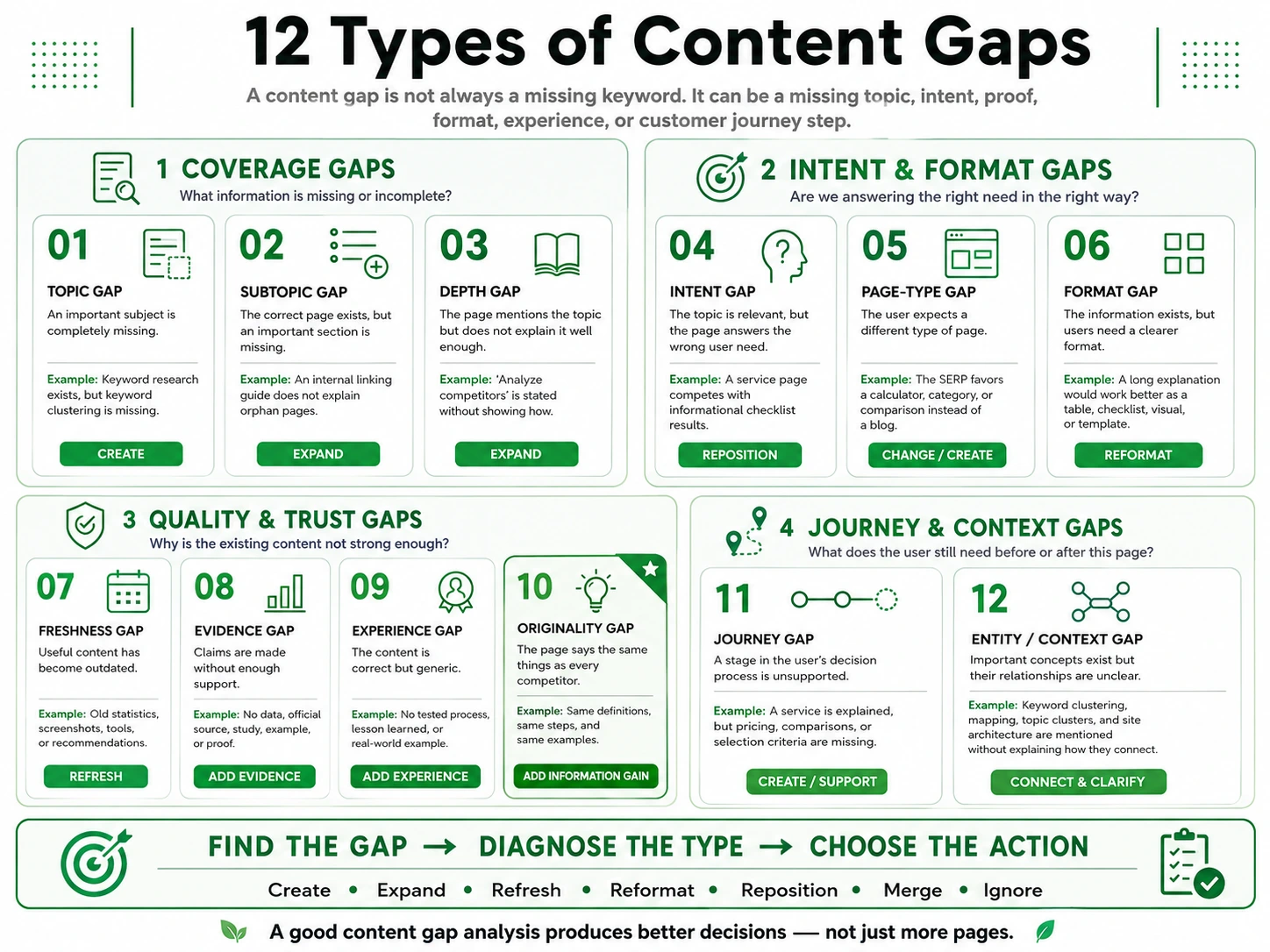
1. Topic Gap
A meaningful topic is completely missing.
Example: a website teaches keyword research but has no useful explanation of keyword clustering.
2. Subtopic Gap
The correct page already exists.
But something important is missing.
You may simply need to improve the existing guide.
3. Search Intent Gap
Your content talks about the right topic.
But it answers the wrong question.
The subject matches. The intent does not.
4. Page-Type Gap
Sometimes the issue is not the writing.
It is the type of page.
A SERP may favor calculators, templates, category pages, comparison pages, tools, or local results.
5. Depth Gap
Your page mentions the subject.
But the explanation is too thin to help.
That is a depth gap.
6. Freshness Gap
The information was once useful.
Now it is outdated.
7. Evidence Gap
The page makes claims without helping readers verify them.
Possible improvements include official sources, research, case examples, first-party data, screenshots, or expert commentary.
8. Experience Gap
Sometimes the content is technically correct but generic.
Useful first-hand examples can make the page substantially more valuable.
9. Originality Gap
This is one of the most overlooked problems.
If your page says the same thing as the top results with different wording, you have not really filled a content gap.
10. Format Gap
Sometimes users understand information better through a table, decision tree, checklist, spreadsheet, diagram, video, calculator, or template.
A longer article is not automatically a more useful article.
11. Customer Journey Gap
You may cover awareness extremely well.
But users may still need help evaluating and deciding.
12. Entity and Context Gap
Sometimes a page covers individual terms but fails to explain how they relate.
Helping readers understand relationships can be more useful than adding another keyword variation.
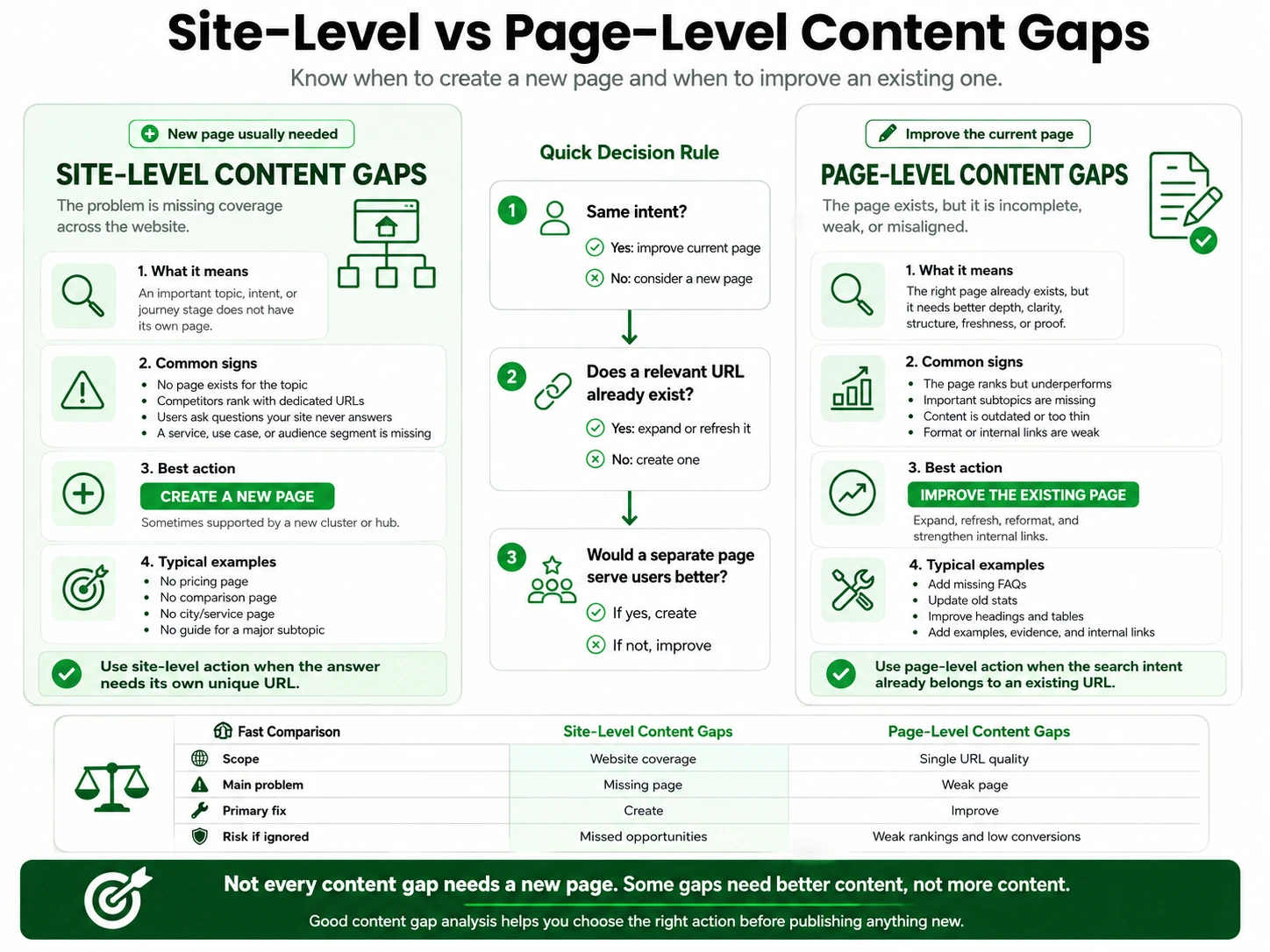
Site-Level vs Page-Level Content Gaps
This is one of the most important distinctions in content gap analysis.
Site-Level Gap
The whole website is missing a meaningful topic, journey stage, or category.
That may justify a new page.
Page-Level Gap
The correct URL already exists.
The page is incomplete. Improve the existing page instead of automatically creating another URL.
How to Do a Content Gap Analysis Step by Step
A practical content gap analysis can follow seven stages:
Discover → Validate → Diagnose → Ownership → Prioritize → Act → Measure
Step 1: Discover Potential Content Gaps
Start broad.
Use multiple sources.
Potential sources include:
- competitor rankings;
- competitor websites;
- Google Search Console;
- SERPs;
- People Also Ask;
- forums;
- Reddit;
- customer reviews;
- sales conversations;
- customer support questions;
- on-site search;
- AI answers;
- your existing content inventory.
Step 2: Validate the Gap
Do not publish yet.
First ask:
- Is the gap relevant to the audience?
- Is it relevant to the website?
- Does meaningful demand exist?
Step 3: Diagnose What Type of Gap It Is
Ask:
What exactly is missing?
Step 4: Check Page Ownership
Ask:
Does an existing page already own this intent?
For the deeper page-assignment process, review the Keyword Mapping guide.
Step 5: Prioritize the Gap
You may find hundreds of opportunities. They are not equally valuable.
| Factor | Question |
|---|---|
| Audience relevance | Does the audience care? |
| Business relevance | Does it support a meaningful business goal? |
| Search demand | Is demand visible? |
| Intent fit | Can we satisfy the need properly? |
| Topical fit | Does this belong on the site? |
| Competition | Can we realistically compete? |
| Existing authority | Do we already cover related topics? |
| Information gain | Can we contribute something useful and different? |
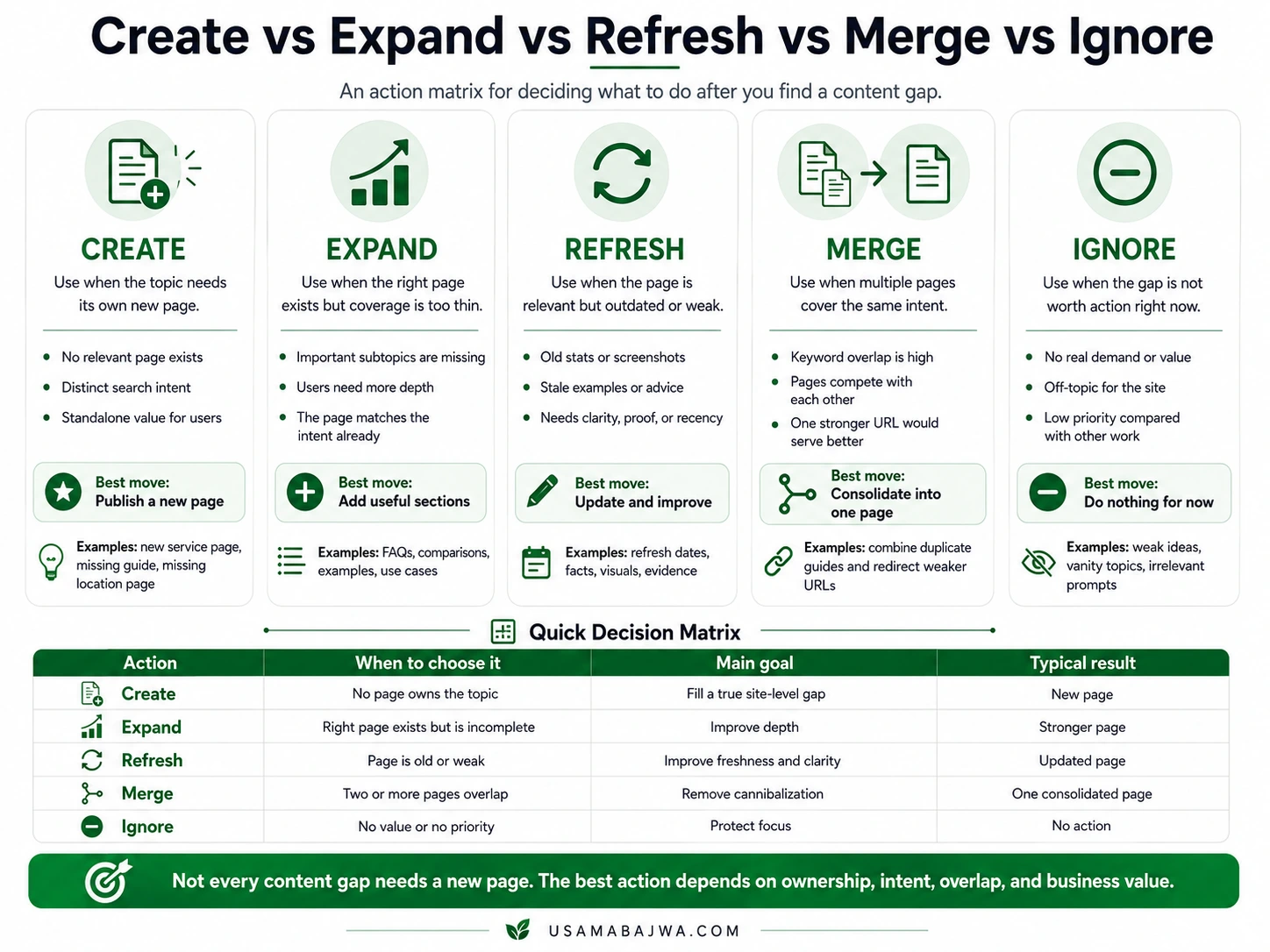
Step 6: Choose the Right Action
| Action | Use It When |
|---|---|
| Create | Distinct intent deserves its own page |
| Expand | Existing page owns the topic but lacks depth |
| Refresh | Information has become outdated |
| Reformat | Information exists but wrong format is used |
| Reposition | Page targets the wrong intent |
| Merge | Multiple URLs overlap |
| Ignore | Opportunity is not relevant or valuable |
Step 7: Measure the Result
A content gap analysis is not finished when the article is published.
- impressions;
- rankings;
- clicks;
- organic sessions;
- engaged sessions;
- conversions;
- leads;
- assisted conversions;
- backlinks;
- AI referral traffic.
Six Useful Sources of Content Gaps
1. Search Gaps
Keyword research, Search Console, SERPs, PAA, and related searches can reveal what people actively search.
2. Competitor Gaps
These show what competing websites cover that you do not.
3. Audience Gaps
Sales calls, emails, reviews, support tickets, forums, communities, and social comments can reveal problems keyword tools miss.
4. Existing-Content Gaps
Your biggest opportunities may already be on your site.
5. Customer Journey Gaps
Ask whether users have content for each stage: Learn → Compare → Evaluate → Decide → Act.
6. AI-Answer Gaps
AI systems can help reveal recurring questions, missing subtopics, comparisons, and concepts your own content fails to explain.
How to Do a Manual Content Gap Analysis Without Paid SEO Tools
You do not need an expensive tool to start.
A spreadsheet is enough.
Step 1: Choose 3–5 Relevant Competitors
Use actual search competitors. Not just famous companies in your industry.
Step 2: Review Their Main Sections
- navigation;
- service pages;
- category pages;
- blog categories;
- resource hubs.
Step 3: Search Important Queries Manually
- ranking page types;
- recurring subtopics;
- content formats;
- PAA questions;
- videos;
- forums;
- local results;
- current dates.
Step 4: Review Your Own Content
| URL | Topic | Intent | Performance | Missing? | Action |
|---|
Step 5: Review Audience Questions
Collect repeated questions from customers, emails, sales, support, forums, Reddit, and reviews.
Step 6: Compare and Prioritize
Select opportunities that best combine audience need + topic fit + business value + realistic opportunity.
Not Sure Which Content Gaps Are Actually Worth Filling?
A structured content review can help separate real opportunities from duplicate topics, weak pages, and low-value ideas.
Discuss Your Content Strategy →Content Gap Analysis Spreadsheet Template
You can use a simple sheet like this:
| Gap | Source | Gap Type | Existing Owner? | Search/Audience Evidence | Priority | Action |
|---|---|---|---|---|---|---|
| Example topic | SERP | Topic | No | Strong | High | Create |
| Missing FAQ | Customer calls | Subtopic | Yes | Strong | High | Expand |
| Outdated statistic | Existing page | Freshness | Yes | Medium | Medium | Refresh |
| Similar new keyword | Keyword tool | Duplicate intent | Yes | Low | Reject | Ignore |
How to Find Competitor Content Gaps
Competitor analysis is useful when done correctly.
Do:
- compare several competitors;
- identify recurring topics;
- review pages that rank;
- inspect headings;
- study page format;
- analyze intent;
- note unique examples;
- check gaps competitors themselves have.
Do Not:
- copy their article structure;
- copy their keywords blindly;
- reproduce their examples;
- create every page they have.
How to Analyze a Competitor Page for Gaps
What does the page answer?
What would a reader still need to know?
Which explanations are shallow?
Which claims lack proof?
Are there real examples?
Would a table or decision tree be easier?
Is information current?
Does the page say anything unique?
Does the user know what to do after reading it?
How to Find Gaps in Your Existing Content
Many websites focus too heavily on new articles.
Start with what you already have.
- declining traffic;
- page-two rankings;
- high impressions but low clicks;
- outdated sections;
- thin explanations;
- old screenshots;
- weak internal links;
- confusing page ownership;
- poor conversion.
You may discover that the fastest growth opportunity is an update.
How to Find Audience Gaps Competitors Miss
Search engines show what people search.
Customers show what people struggle with.
Sales conversations
What keeps prospects from making a decision?
Support tickets
What repeatedly confuses customers?
Reviews
What do customers praise or complain about?
Forums
What problems are people discussing in detail?
Customer interviews
What information did people need before buying?
On-site search
What are visitors looking for after they already reach your website?
How to Analyze SERPs for Content Gaps
A SERP is more than a list of ranking URLs.
| Signal | What to Look For |
|---|---|
| Page type | Blog, service, product, category, tool |
| Content format | Guide, list, comparison, calculator |
| Angle | Beginner, advanced, cheap, local, latest |
| PAA | Supporting questions |
| Video | Visual-learning demand |
| Forums | Need for experience/opinion |
| Freshness | Whether recency matters |
| AI Overview | Which subquestions appear |
| Repeated topics | Expected baseline coverage |
Content Gaps in AI Overviews and AI Search
There is no separate “AI content gap SEO formula.”
Google says its normal SEO best practices remain relevant to AI Overviews and AI Mode, and that there are no additional special optimizations required for inclusion.
- useful content;
- crawlability;
- internal discoverability;
- clear text;
- good page experience;
- accurate structured data where appropriate.
Does Google Ranking Guarantee AI Visibility?
No.
Different systems can surface different sources.
The practical takeaway is simple:
- organic rankings;
- Search Console;
- AI referrals;
- brand mentions;
- conversions.
Content Gap Analysis for ChatGPT Search
Public websites can appear in ChatGPT Search.
For content to be available for summaries and snippets, publishers should make sure OAI-SearchBot is not blocked.
That is a technical accessibility consideration. It does not guarantee placement.
The 7-Step Content Gap Decision Framework
Use this framework every time you find an opportunity.
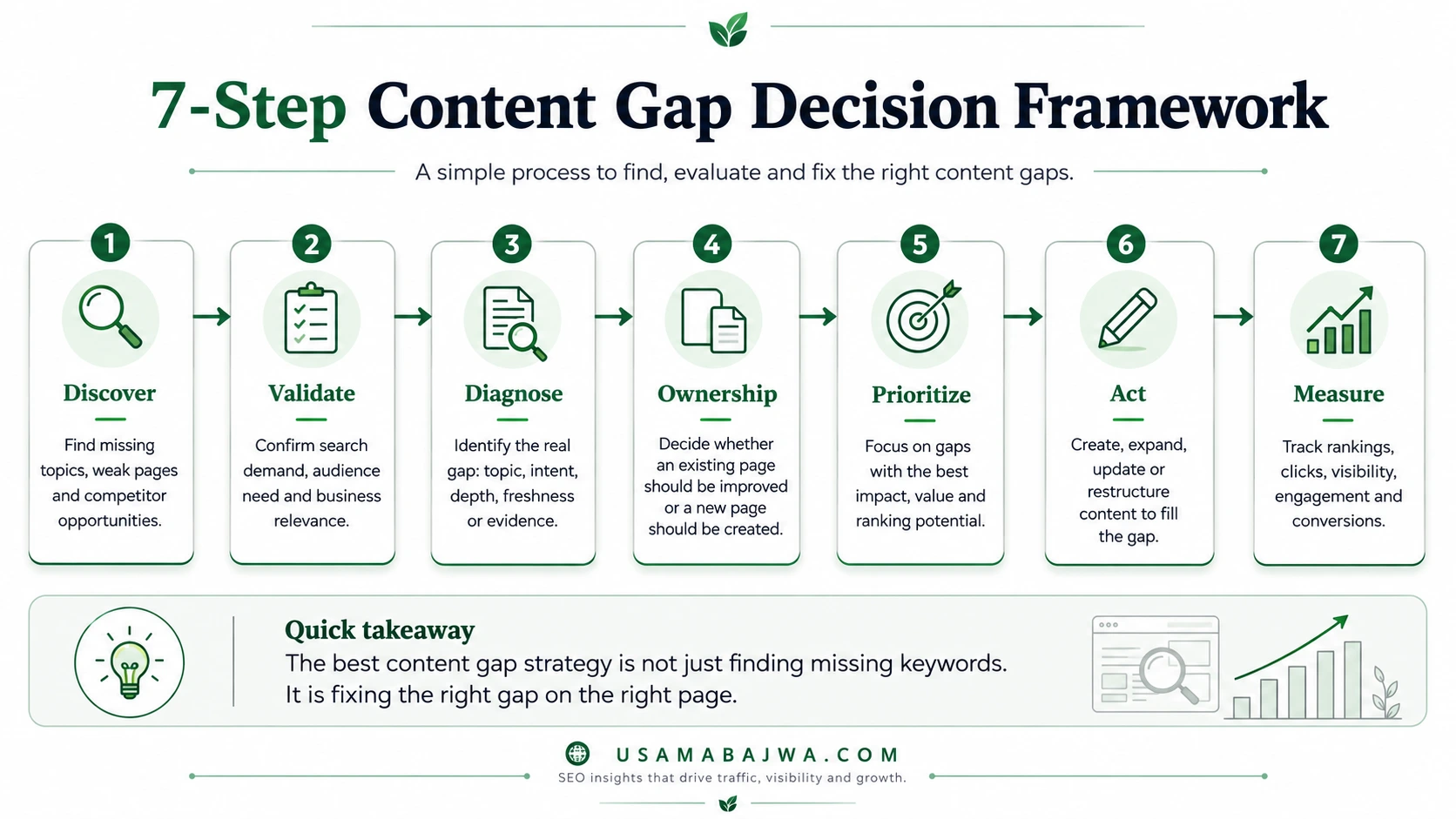
Find a possible gap.
Does this need actually matter?
Identify the gap type.
Which existing page should own it?
Compare value, demand and feasibility.
Create, expand, refresh, reformat, reposition, merge, or ignore.
Did the action improve usefulness, visibility, engagement or conversions?
Does This Content Gap Need a New Page?
Use this decision process.
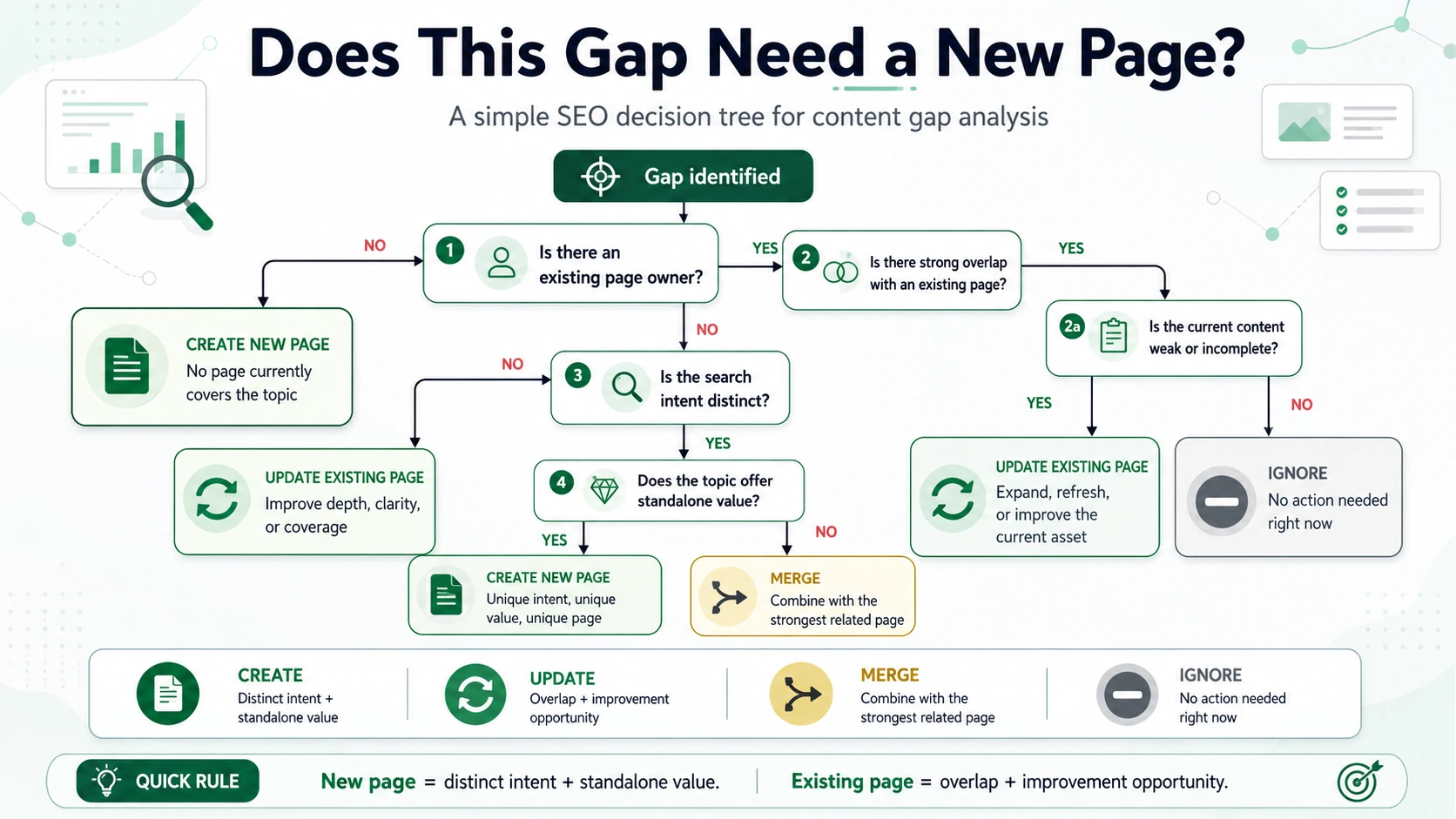
Is the topic relevant?
No → Ignore it.
Yes → Continue.
Does an existing page already own the intent?
Yes → Improve the existing page.
No → Continue.
Does another existing page significantly overlap?
Yes → Consider merging or repositioning.
No → Continue.
Does the gap have distinct intent and standalone value?
No → Add it to an existing page.
Yes → Consider a new page.
Can you add meaningful value?
No → Reconsider publishing.
Yes → Create it.
When a Content Gap Should NOT Become a New Page
Do not create a new page when:
- it is only a keyword variation;
- existing content already satisfies the need;
- the topic does not fit the site;
- search intent is identical to another page;
- the topic is too thin;
- the page would exist mainly to capture traffic;
- you cannot add useful value;
- it would create cannibalization.
Content Gap Analysis and Keyword Clustering
Content gap analysis finds possible opportunities.
Keyword clustering helps determine which related queries belong together.
Gap discovered → relevant queries found → queries clustered → page decision made
Content Gap Analysis and Keyword Mapping
After identifying a valid gap, decide:
Which URL should own it?
That is the role of Keyword Mapping.
Content Gap Analysis and Keyword Cannibalization
A gap analysis may reveal that the site is not actually missing content.
It may have too much overlapping content.
If the intent is essentially the same, creating another page will not solve the problem. Review the Keyword Cannibalization guide for the deeper diagnosis process.
Content Gap Analysis and Topic Clusters
A topic cluster can also be audited for gaps.
Ask:
- Is a foundational concept missing?
- Is one topic isolated?
- Is an important next step unanswered?
- Does the cluster support different user stages?
Content Gap Analysis and Site Architecture
Once you decide a new page is necessary, ask:
Where should it live?
That is a site architecture decision.
Content Gap Analysis for Local SEO
- missing service information;
- weak local FAQs;
- incomplete location information;
- missing comparison content;
- local customer questions;
- location-specific proof;
- incomplete service-area coverage.
Avoid producing near-identical city pages simply because keyword tools show city variations. For broader local strategy, see Local SEO.
Content Gap Analysis for Ecommerce
- product information;
- category descriptions;
- buying guides;
- comparisons;
- sizing;
- shipping;
- returns;
- compatibility;
- FAQs;
- reviews;
- use cases.
A missing buying guide may sometimes be more valuable than another category page. See Ecommerce SEO for the broader optimization context.
Content Gap Analysis for SaaS
- features;
- use cases;
- integrations;
- alternatives;
- comparisons;
- pricing;
- onboarding;
- implementation;
- security;
- support.
The mistake is creating a separate page for every keyword variation. Map each user need to the correct stage and page.
Common Content Gap Analysis Mistakes
1. Treating Every Competitor Keyword as an Opportunity
Competitor difference does not equal opportunity. Validate relevance first.
2. Creating New Pages Too Quickly
Check existing page ownership first.
3. Looking Only at Competitors
Competitors do not know everything your audience needs. Use customer data too.
4. Looking Only at Search Volume
Low-volume questions can be commercially important.
5. Ignoring Existing Content
Updating a page may be faster and safer.
6. Ignoring Search Intent
The right keyword on the wrong page type is still a mismatch.
7. Copying Competitor Structure
If everyone says the same thing, find what is still missing.
8. Skipping Prioritization
A list of 1,000 opportunities is not a strategy.
9. Measuring Only Rankings
Measure business outcomes too.
10. Filling Gaps With Thin AI Content
AI can help research and draft. But publishing many unoriginal pages simply to capture rankings does not create a useful content strategy.
How Often Should You Run a Content Gap Analysis?
For active content programs.
For smaller service websites.
To avoid unnecessary production.
When rankings or intent shift.
When customer needs change.
To identify freshness, quality, intent, or competition gaps.
How to Measure Whether Filling a Content Gap Worked
| Goal | Useful Metrics |
|---|---|
| Search visibility | Impressions, rankings, clicks |
| Content quality | Engagement, scroll depth |
| Lead generation | Form fills, calls, inquiries |
| Ecommerce | Revenue, assisted conversions |
| Cluster strength | Internal visibility, supporting rankings |
| Existing-page refresh | Traffic recovery, query growth |
| AI visibility | Referral traffic, mentions or citations where measurable |
Content Gap Analysis Checklist
Frequently Asked Questions About Content Gap Analysis
What is content gap analysis?
Content gap analysis is the process of identifying useful topics, questions, intents, formats, or information your website is missing or serving poorly, then deciding whether to create, improve, merge, reformat, or ignore content.
What is the difference between keyword gap and content gap analysis?
Keyword gap analysis finds search terms competitors rank for that you do not. Content gap analysis is broader and examines missing or weak audience needs across topics, intent, depth, format, freshness, journey stages, and existing content.
How do you perform a content gap analysis?
A useful process is: discover potential gaps, validate audience relevance, diagnose the gap type, check page ownership, prioritize opportunities, choose the correct action, and measure results.
Can I do a content gap analysis manually?
Yes. You can use Google, competitors, Search Console, People Also Ask, forums, reviews, customer questions, and spreadsheets. Paid SEO tools can speed up the process but are not required.
Does every content gap need a new article?
No. The right action may be to expand, refresh, merge, reformat, reposition, or ignore an opportunity.
How do I know if a content gap deserves a separate page?
A separate page usually makes sense when the intent is distinct, the topic has standalone value, no existing page owns it, it fits the site, and you can contribute meaningful value.
What are the main types of content gaps?
Common types include topic, subtopic, search intent, page type, depth, freshness, evidence, experience, originality, format, customer journey, and entity/context gaps.
Can content gap analysis help topical authority?
It can help identify missing pieces inside a broader topic ecosystem. Each page should still solve a genuine user need rather than exist only to make the site look comprehensive.
Can content gap analysis help AI visibility?
It can help identify questions, topics, and missing information your audience asks across search and AI interfaces. There is no special AI-only content-gap formula.
How often should content gaps be reviewed?
For active websites, quarterly or twice-yearly reviews are practical starting points. Review sooner when search intent changes, rankings decline, services change, new competitors appear, or important content becomes outdated.
Final Takeaway
A content gap analysis should not produce a giant list of keywords.
It should produce better decisions.
Discover → Validate → Diagnose → Ownership → Prioritize → Act → Measure
Start with the audience.
Use competitors, keyword tools, Search Console, SERPs, customer questions, existing content, and AI answers as inputs.
Then ask:
Does this gap actually deserve action?
If yes, choose the correct action:
Create. Expand. Refresh. Reformat. Reposition. Merge. Or Ignore.
The goal is not to fill every possible gap.
The goal is to fill the right gaps with the right content in the right place.
Ready to turn content gaps into a clear SEO strategy?
Turn Missing Opportunities Into a Clear Content Roadmap
Finding missing topics is only the beginning.
The bigger challenge is deciding what deserves a new page, what should be improved, what should be merged, how pages should connect, and which opportunities should be prioritized first.
For related strategy, explore Semantic SEO, Internal Linking, SEO Topic Clusters, and Site Architecture for SEO.