
Publishing more content does not automatically build SEO authority.
You can publish 100 articles and still have a weak website structure.
The problem is often not the number of pages.
It is how those pages are planned, separated, and connected.
That is where SEO topic clusters help.
A topic cluster organizes related pages around one broader subject.
But a good cluster is more than:
Pillar page → supporting blogs → internal links.
You also need to decide:
- Which topics deserve separate pages?
- Which keywords belong on the same page?
- Which page should own each search intent?
- How should pages connect?
- Where does the pillar page fit?
- Is existing content overlapping?
- Are important topics missing?
- Is the cluster helping users move naturally through the subject?
This guide explains that complete process.
Quick Answer: What Are SEO Topic Clusters?
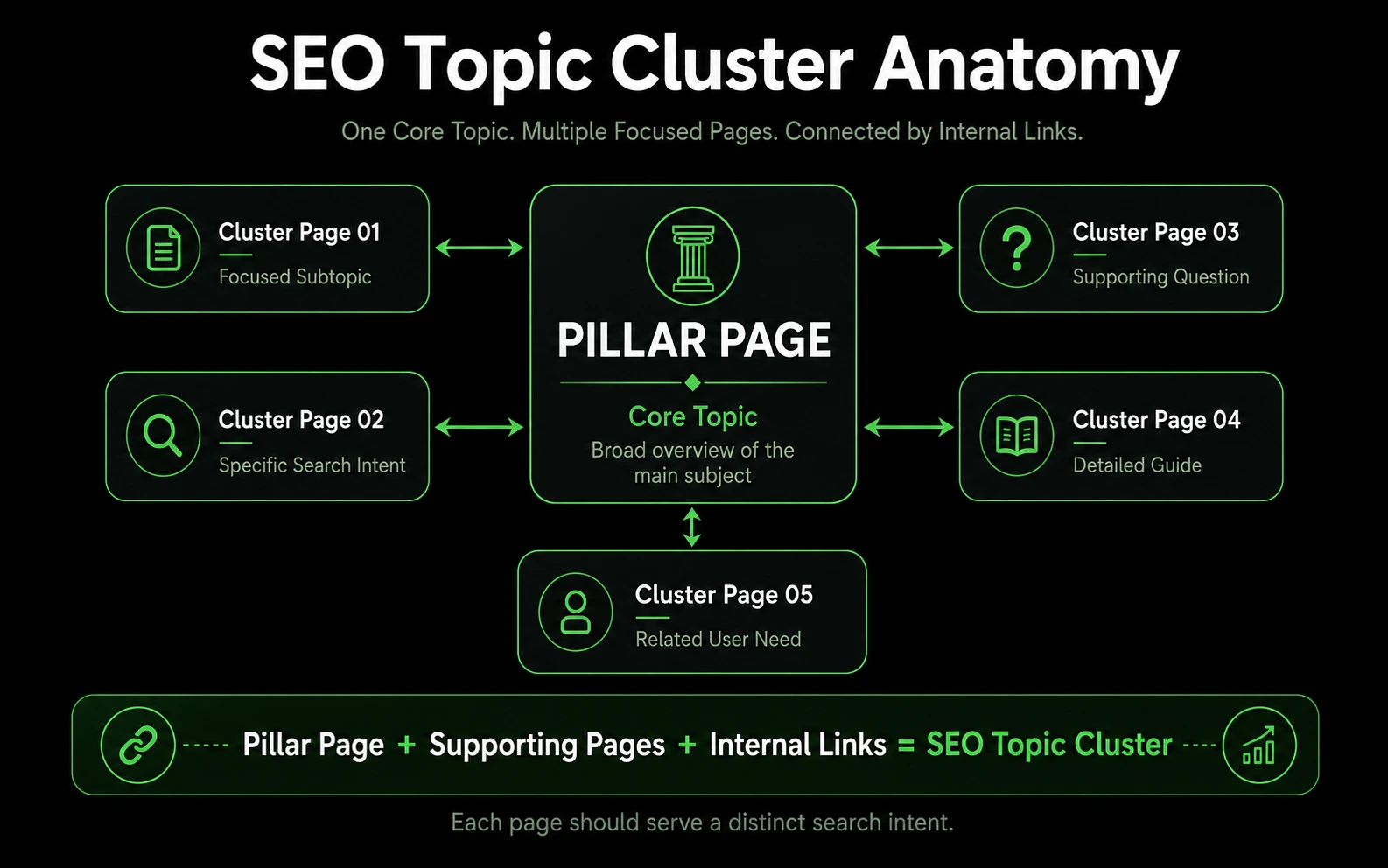
SEO topic clusters are groups of related pages organized around one broader subject.
A central pillar or hub page covers the main topic.
Supporting pages cover narrower and distinct subtopics.
Internal links connect those pages.
This structure helps users discover deeper information and helps search engines understand how related pages fit together.
A strong topic cluster should not simply contain many articles.
Each page should have a clear purpose.
What Are the Main Parts of an SEO Topic Cluster?
A simple topic cluster has three main components.
| Component | Purpose |
|---|---|
| Pillar Page | Covers the broader subject |
| Supporting Pages | Cover narrower, distinct topics or intents |
| Internal Links | Connect related pages into a useful structure |
But there is one more element that is easy to miss:
Page ownership
Every important search intent should have a clear owner.
Without page ownership, two supporting articles may compete for the same searches.
That can turn a topic cluster into a collection of overlapping pages.
How Do SEO Topic Clusters Work?
Think of a topic cluster as a knowledge system.
Suppose your broader subject is:
A cluster around it might include:
- Technical SEO
- Crawlability
- Indexing
- Internal Linking
- URL Structure
- XML Sitemaps
- Canonical Tags
- Core Web Vitals
These pages are related.
But they are not identical.
A user looking for an internal linking strategy has a different immediate need from someone troubleshooting canonical tags.
That difference matters.
A good cluster allows each page to solve its own problem while remaining connected to the broader subject.
SEO Topic Clusters vs Keyword Clusters
This is one of the most important distinctions in content planning.
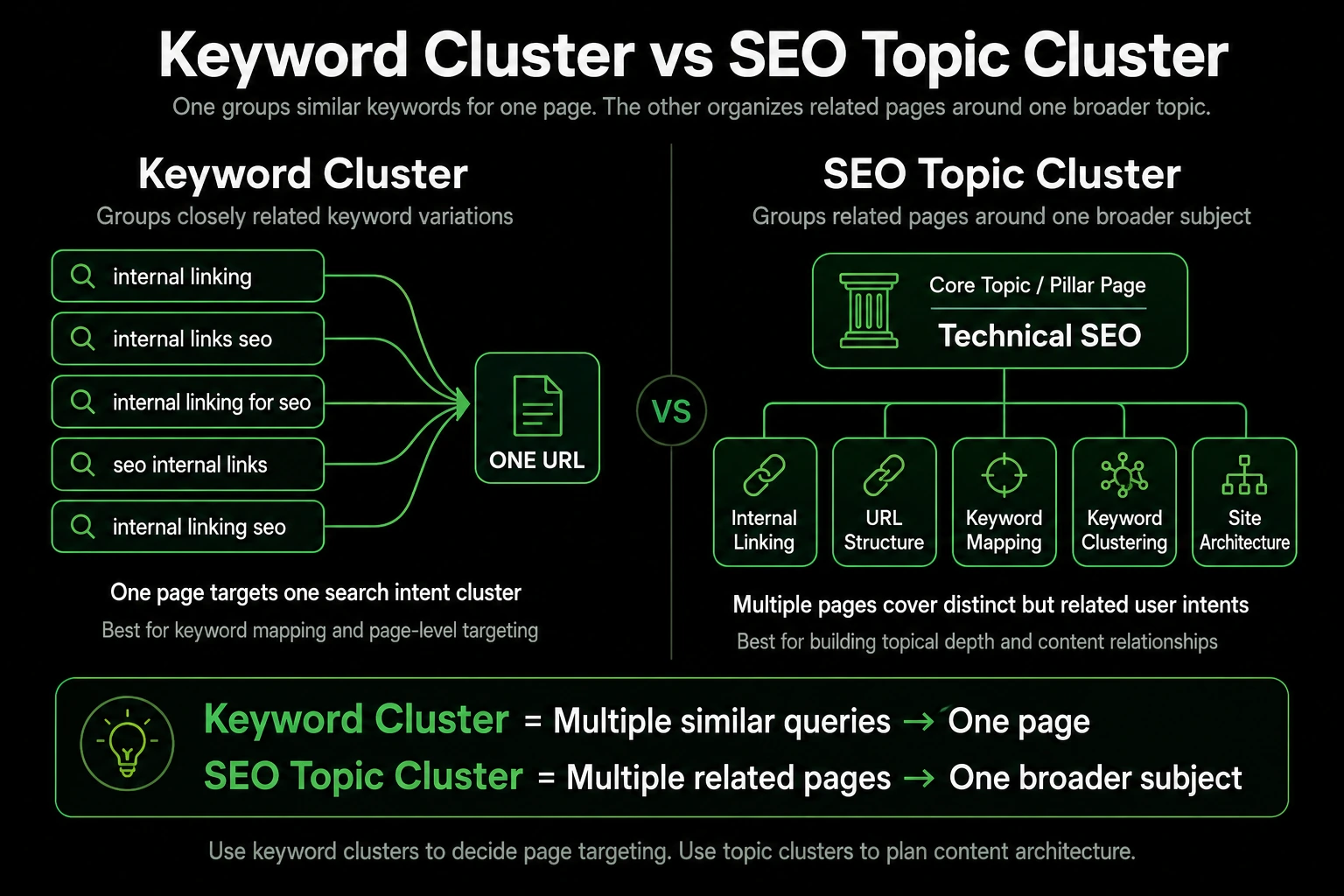
A keyword cluster and a topic cluster are not the same thing.
| Keyword Cluster | SEO Topic Cluster |
|---|---|
| Groups related search queries | Groups related pages and subtopics |
| Usually maps to one URL | Usually contains multiple URLs |
| Works mainly at page level | Works at subject/site level |
| Helps consolidate similar queries | Helps organize broader content coverage |
| Output is a keyword group | Output is a content architecture |
| Often uses intent + SERP similarity | Uses topic relationships + intent + page ownership |
Example of a keyword cluster
Consider:
- internal linking
- internal links SEO
- internal linking for SEO
- SEO internal links
- internal linking SEO
These phrases are closely related.
Creating five separate articles would likely create unnecessary overlap.
They can be covered by one strong page.
That is what we did with the Internal Linking guide.
Example of a topic cluster
Now consider:
- Keyword Clustering
- Keyword Mapping
- URL Structure
- Internal Linking
- SEO Topic Clusters
- Website Architecture
These topics are related.
But each solves a different problem.
They can therefore exist as separate pages within one broader SEO content architecture.
Why Does This Difference Matter?
Because one of the easiest SEO mistakes is:
One keyword = one page.
That approach can produce dozens of pages with nearly identical intent.
For example:
These are different phrases.
They do not automatically require different pages.
Before creating separate content, first determine whether the user expects a different answer.
Your existing Keyword Clustering process should happen before you expand a topic cluster.
Topic Cluster vs Content Cluster: Are They the Same?
Often, yes.
SEO tools and marketers frequently use:
topic cluster
and:
content cluster
interchangeably.
Some strategists make a distinction.
They may use:
Topic cluster to describe the underlying subject model.
And:
Content cluster to describe the actual collection of content assets built around it.
There is no need to overcomplicate this terminology.
The more useful questions are:
- Does each page have a clear job?
- Are related pages connected?
- Are important user needs covered?
- Are several pages competing for the same intent?
Topic Clusters vs Content Silos
A content silo usually emphasizes hierarchy.
For example:
SEO
└── Technical SEO
    ├── Crawlability
    ├── Indexing
    └── Internal Linking
A topic cluster can be more flexible.
Related pages may connect horizontally when the relationship is useful.
For example:
Internal Linking may connect to:
- Keyword Mapping
- Topic Clusters
- Website Architecture
- Technical SEO
even though those pages may live in different site sections.
The goal is not to trap content inside rigid folders.
The goal is to create understandable relationships.
How Do Pillar Pages and Topic Clusters Work Together?
A pillar page usually covers the broadest useful version of a subject.
Supporting pages go deeper.
For example:
Pillar
Technical SEO
Supporting content
- Crawlability
- Indexing
- Internal Linking
- Canonical Tags
- XML Sitemaps
- Website Architecture
The pillar can introduce these areas.
Then it can link users to deeper resources.
Supporting pages can also link back to the pillar when that relationship helps the reader.
What Should a Pillar Page Actually Do?
A useful pillar page should:
- Explain the broader topic.
- Cover its major components.
- Help beginners orient themselves.
- Link to deeper resources.
- Satisfy its own search intent.
- Remain useful even if nobody clicks another page.
A pillar page should not be:
- An artificial list of links.
- A copy of every supporting article.
- A 10,000-word page created only because an SEO tool recommended a pillar.
- A doorway to pages that provide little additional value.
Do you know?
A topic cluster does not need a pillar page simply because an SEO diagram says it does. The pillar should have a genuine user and search purpose.
Why Are Topic Clusters Important for SEO?
Topic clusters can improve several parts of a website.
1. They Create Clearer Content Organization
Without planning, blogs often become:
- random tutorials;
- overlapping articles;
- old content;
- unrelated categories;
- multiple pages targeting similar queries.
A cluster gives related content a structure.
2. They Help Users Explore a Subject
A reader may enter through a narrow question.
Then discover a broader resource.
For example:
Internal Linking
→ Topic Clusters
→ Website Architecture
The journey becomes logical.
3. They Help Important Pages Become Discoverable
Google recommends making important pages findable through crawlable internal links and says every page you care about should have a link from at least one other page on your site.
A topic cluster naturally creates opportunities for those relationships.
4. They Can Reveal Content Gaps
Once you map an entire topic, missing areas become easier to see.
You might discover:
- an unanswered beginner question;
- missing commercial content;
- a comparison users need;
- a technical guide;
- a missing use case;
- an outdated article.
That is more useful than randomly collecting keyword ideas.
5. They Can Reduce Unnecessary Content Overlap
Notice the wording:
can reduce.
Topic clusters do not automatically prevent cannibalization.
They only help when page ownership is clear.
6. They Can Support Broader Topic Coverage
If your website genuinely answers the major questions around a subject, users have more useful resources available.
But this does not mean:
publish everything remotely related to the topic.
Relevance still matters.
Do Topic Clusters Automatically Build Topical Authority?
No.
This is an important distinction.
Publishing 20 connected articles does not automatically make a website authoritative.
Internal links also do not turn weak content into expert content.
A strong cluster still requires:
- original value;
- accurate information;
- real expertise;
- complete answers;
- useful examples;
- clear page ownership;
- relevant supporting content;
- good user experience.
Google's current people-first guidance asks whether content provides original information, substantial coverage, insightful analysis, and value beyond other pages already appearing in search results.
So think of topic clustering as content architecture.
It organizes good content.
It does not replace good content.
Can Topic Clusters Prevent Keyword Cannibalization?
They can help.
But they can also cause cannibalization if you build them badly.
Bad example
Imagine publishing:
And all four pages answer:
What are SEO topic clusters and how do you create them?
You have created four URLs for almost the same job.
Internal links will not solve the core problem.
The problem is page ownership.
Better approach
Use one page:
SEO Topic Clusters
Then let supporting pages address distinct needs.
For example:
- Keyword Clustering
- Keyword Mapping
- Internal Linking
- Content Gap Analysis
- Website Architecture
How to Create SEO Topic Clusters
The easiest mistake is starting inside a keyword tool.
Start with the audience instead.
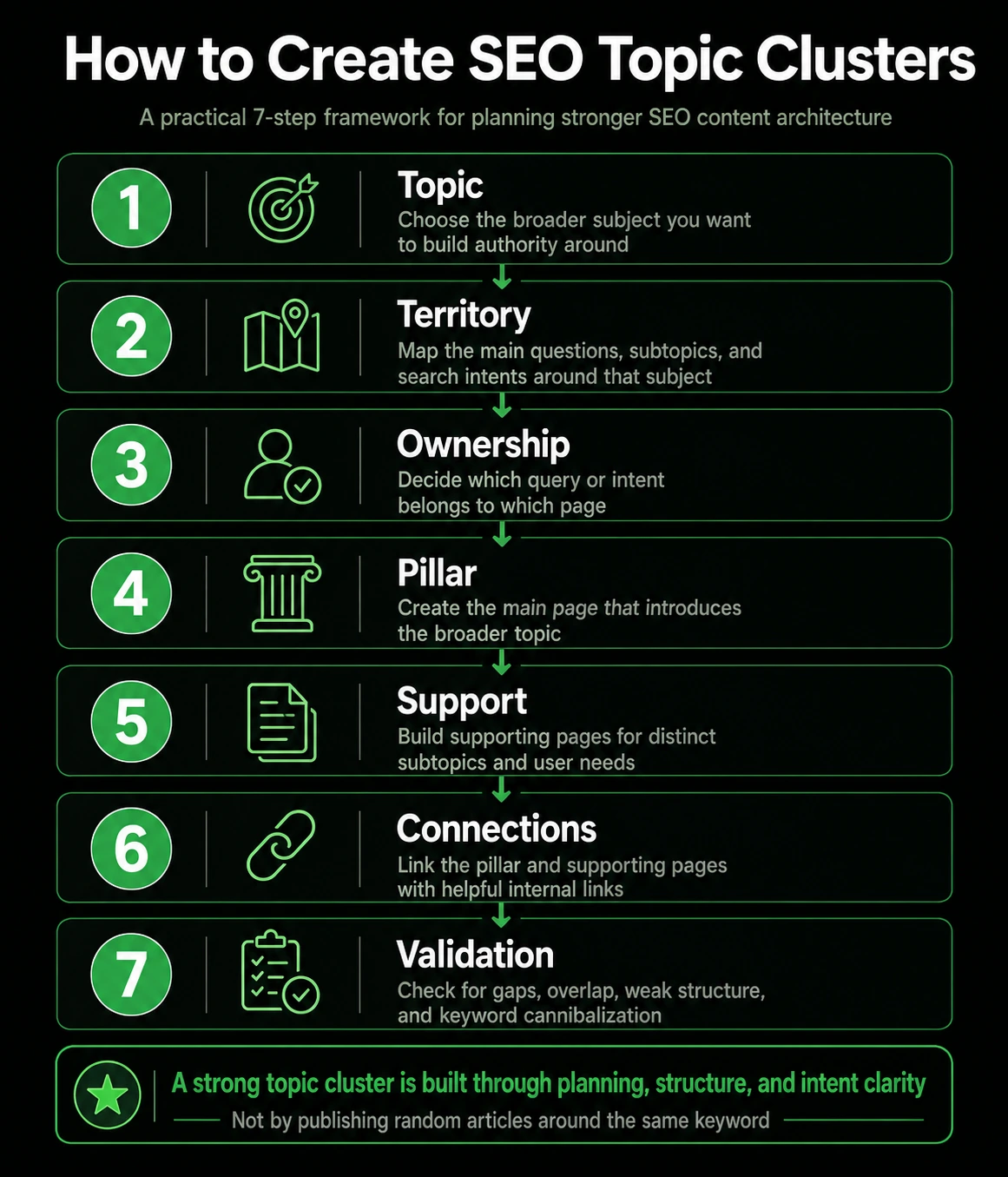
Here is the framework.
Step 1: Topic
Choose the broader subject you want to cover.
Ask:
- Does this matter to my audience?
- Is it relevant to my business?
- Do I have useful expertise?
- Is the subject broad enough to contain distinct subtopics?
For an SEO consultancy, examples may include:
- Technical SEO
- Local SEO
- Keyword Strategy
- Ecommerce SEO
- Semantic SEO
Step 2: Territory
Map the broader search territory.
Look for:
- questions;
- problems;
- comparisons;
- processes;
- tools;
- commercial needs;
- beginner concepts;
- advanced concepts.
Do not decide the URL structure yet.
At this stage you are understanding the subject.
Step 3: Ownership
Now determine which search intents belong together.
This is where Keyword Clustering and Keyword Mapping become important.
Ask:
Which page should own this need?
Possible result:
| Search Need | Page Owner |
|---|---|
| What is keyword clustering? | Keyword Clustering guide |
| How do I assign clusters to URLs? | Keyword Mapping guide |
| How should related pages connect? | Internal Linking guide |
| How do multiple pages form a subject system? | SEO Topic Clusters guide |
Clear ownership comes before publishing.
Step 4: Pillar
Identify the broad page that can act as the main resource.
The pillar should have its own purpose.
It should not exist simply to link to other pages.
Step 5: Support
Create supporting pages only for distinct needs.
Each page should be able to answer:
Why does this URL deserve to exist?
If the only answer is:
because the keyword is slightly different,
you may not need another page.
Step 6: Connections
Connect pages using relevant internal links.
Link when the reader benefits from moving to:
- a prerequisite;
- deeper explanation;
- related concept;
- next step;
- service;
- example.
Your Internal Linking guide explains this process in greater depth.
Step 7: Validation
Before calling the cluster complete, check:
- missing topics;
- overlapping URLs;
- orphan pages;
- weak internal links;
- unnecessary content;
- outdated pages;
- unclear page ownership.
Then improve it.
Need a clearer SEO content structure?
Turn scattered pages into a structured search journey.
If your website has overlapping content, unclear page ownership, or weak internal connections, a strategic SEO review can help identify what should stay, merge, move, or be created next.
Discuss Your SEO Strategy →How to Choose a Core Topic
A good core topic sits at the intersection of:
Audience relevance
People you want to help care about it.
Business relevance
It connects to what your business actually does.
Depth
It contains enough meaningful subtopics.
Expertise
You can contribute something useful.
Search opportunity
People actually search around the subject.
Avoid picking a topic only because:
“The search volume is high.”
If the topic has little relationship with your audience or expertise, it may not belong on your site.
Google's people-first guidance explicitly warns against producing content on many topics mainly because they might attract search traffic.
How to Find Supporting Topic Ideas
Use multiple sources.
Do not rely on one tool.
You can review:
- Google results;
- People Also Ask;
- related searches;
- Search Console queries;
- competitor coverage;
- keyword tools;
- customer questions;
- sales conversations;
- support questions;
- existing content;
- industry communities.
Then consolidate the ideas.
A list of 100 keywords is not a topic cluster.
It is raw research.
Does This Topic Need Its Own Page?
This is one of the most important topic-cluster decisions.
Before creating another URL, ask:
Is it the same core topic?
If not, a different page may make sense.
Is the search intent different?
Does the searcher expect a different outcome?
Do the SERPs differ?
Search both queries.
Look at the pages Google already rewards.
Is the user goal distinct?
Can the new page solve a real separate problem?
Would the content substantially repeat an existing page?
If yes, a new page may create overlap instead of value.
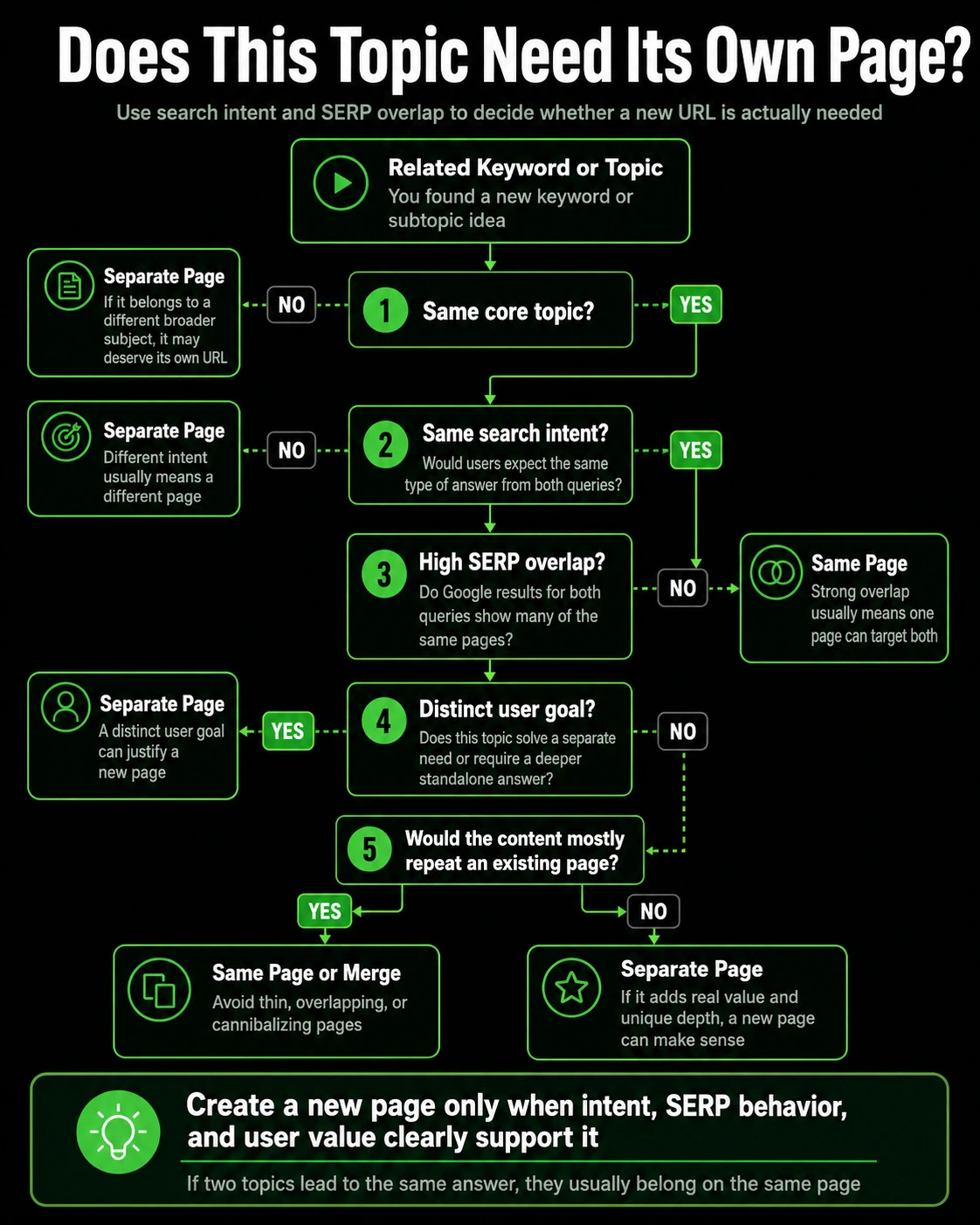
Same Intent + High SERP Overlap Usually Points Toward One Page
Suppose you research:
SEO topic clusters
and:
topic clusters SEO
If both queries:
- have the same intent;
- return similar ranking pages;
- require the same explanation;
- satisfy the same user goal;
one strong page is usually cleaner than two overlapping pages.
But SERP overlap is evidence.
It is not an automatic Google rule.
Use it to support judgment.
Search Intent Comes Before Content Volume
Two keywords may share words but have different jobs.
For example:
Query A
keyword clustering
The user may want to learn the concept.
Query B
keyword clustering tool
The user may want software.
Same broad topic.
Different immediate need.
That may justify a different experience or page type.
This is why topic clustering cannot be based only on:
- shared keywords;
- keyword difficulty;
- search volume;
- semantic similarity.
Intent matters.
How Keyword Mapping Fits Into Topic Clusters
Topic clustering tells you:
Which related pages should form the broader content system?
Keyword Mapping tells you:
Which URL owns each keyword cluster?
The practical flow is:
Research → Cluster → Map → Create or Improve → Internally Link → Measure
Skipping the mapping stage often creates unclear ownership.
That is where overlapping content begins.
Create, Update, Merge, Remap or Retire?
Topic clustering should not always mean:
publish another article.
Before creating anything, audit what already exists.
Use this decision table.
| Existing Situation | Best Action |
|---|---|
| No useful page exists | Create |
| Page exists but is weak/outdated | Update |
| Two pages answer the same intent | Merge |
| Wrong page owns the query | Remap |
| Page no longer serves a purpose | Retire / redirect where appropriate |
This is one of the biggest differences between content strategy and content production.
A strategist asks:
What should the website contain?
A publisher asks:
What should we publish next?
Those are not always the same question.
Do you know?
Sometimes the best way to improve a topic cluster is to delete or merge content, not publish more.
How to Structure a Pillar Page
A pillar page should make the broader topic easy to understand.
A useful structure may include:
Definition
What is the subject?
Major components
What does it contain?
Decisions
What does the user need to understand?
Supporting topics
Where should the reader go deeper?
Examples
How does the concept work in practice?
Next step
What should the user do after learning?
Avoid stuffing every supporting keyword into the pillar.
Let supporting pages do their jobs.
How to Structure Supporting Cluster Pages
Each supporting page should focus on one distinct need.
A good supporting page should have:
- a clear search intent;
- a clear primary question;
- enough unique depth;
- contextual links;
- useful examples;
- a logical place in the broader cluster.
Ask:
Could this page still provide substantial value if the rest of the cluster disappeared?
If not, it may be too thin.
Internal Linking for SEO Topic Clusters
Internal links connect the system.
But avoid a mechanical rule such as:
Every cluster page must link to every other cluster page.
That can create clutter.
Instead:
Pillar → Supporting Page
Link when the pillar introduces that subtopic.
Supporting Page → Pillar
Useful when the broader guide gives context.
Supporting Page → Supporting Page
Use when one concept naturally leads to another.
Informational Page → Commercial Page
Use when the service or solution represents a genuine next step.
Existing Strong Page → New Page
This is often forgotten.
A new article needs inbound internal links too.
Google recommends contextual, descriptive internal links and says important pages should have links from other pages on the site.
How Many Pages Should a Topic Cluster Have?
There is no universal number.
A cluster does not need:
10 articles
or:
20 articles
or:
30 articles
to qualify.
Some topics may need five strong pages.
A complex subject may justify dozens.
The better question is:
Have we covered the important distinct user intents without creating redundant URLs?
Stop measuring cluster quality by page count.
Measure it by coverage and usefulness.
A Real SEO Topic Cluster Example
Here is a practical content architecture example.
Core subject
SEO Content Architecture
Supporting pages
| Page | Main Job |
|---|---|
| Keyword Clustering | Decide which queries belong together |
| Keyword Mapping | Assign clusters to URLs |
| URL Structure | Organize page addresses |
| Internal Linking | Connect pages |
| SEO Topic Clusters | Organize related pages around subjects |
| Website Architecture | Organize the entire site hierarchy |
Notice what makes this cluster useful.
The pages are related.
But they do not duplicate each other.
Each has a clear job.
That is the goal.
Another Example: Local SEO Topic Cluster
A Local SEO cluster might contain:
Pillar
Supporting pages
- Google Business Profile Optimization
- Local Keyword Research
- Local SEO Audit
- Reviews and Reputation
- Local Citations
- Location Pages
- Local Link Building
A small business owner can start with the pillar.
Then move into the problem they actually need to solve.
Ecommerce Topic Cluster Example
A broader Ecommerce SEO cluster may include:
- Ecommerce SEO
- Category Page SEO
- Product Page SEO
- Ecommerce Keyword Research
- Product Schema
- Faceted Navigation
- Ecommerce Internal Linking
- Shopify SEO
Different user needs.
One connected commercial subject.
Free SEO Topic Cluster Planning Template
Use a table like this before creating content.
| Field | Example |
|---|---|
| Core Topic | Technical SEO |
| Audience | Site owners and SEO teams |
| Business Goal | Qualified SEO enquiries |
| Pillar Page | Technical SEO |
| Supporting Topic | Internal Linking |
| Search Intent | Informational |
| Keyword Cluster | internal linking variants |
| Existing or New? | Existing |
| Page Owner | Internal Linking guide |
| Linked From Pillar? | Yes |
| Links Back? | When useful |
| Related Pages | URL Structure, Topic Clusters |
| Status | Published |
| Primary KPI | Organic clicks / qualified leads |
This turns topic clustering into a repeatable process.
Do You Need a Topic Cluster Generator?
A topic-cluster generator can help.
AI and SEO tools can quickly surface:
- related terms;
- questions;
- entities;
- subtopics;
- competitor gaps;
- possible categories.
But a generator should create candidates, not make final architecture decisions.
A tool cannot always understand:
- your business priorities;
- existing page ownership;
- content quality;
- actual SERP overlap;
- conversion goals;
- cannibalization risk.
Use tools for expansion.
Use strategy for decisions.
How to Find Content Gaps Inside a Topic Cluster
A content gap is not simply:
Competitor wrote about it and we did not.
A useful gap exists when:
- The topic matters to your audience.
- The need is not already satisfied properly.
- It fits your broader subject.
- It can provide meaningful standalone value.
Review several sources.
Search data
What queries are appearing?
Search Console
What related queries are already generating impressions?
PAA
What follow-up questions keep appearing?
Competitors
What valuable needs do they cover?
Customers
What do people actually ask?
Existing content
What is weak, missing, or buried?
How to Measure Topic Cluster Performance
Do not measure only one ranking.
Treat the cluster as a portfolio.
| Metric | What It Tells You |
|---|---|
| Total organic clicks | Overall traffic contribution |
| Total impressions | Search footprint |
| Ranking queries | Breadth of visibility |
| Top-10 queries | Quality of visibility |
| Pillar performance | Strength of central resource |
| Supporting-page performance | Depth of coverage |
| Internal link health | Structural quality |
| Multiple URLs ranking for one query | Potential overlap/cannibalization |
| Organic conversions | Business value |
| Assisted conversions | Journey contribution |
| AI citations/mentions | Emerging discovery visibility |
Look for patterns.
Not isolated wins.
How Do You Know When a Topic Cluster Is Complete?
A topic cluster is rarely permanently “finished.”
Search behavior changes.
Products change.
New questions appear.
But a cluster can become mature.
Ask:
- Is the core topic clearly covered?
- Are major user intents represented?
- Does each intent have a page owner?
- Are important supporting topics covered?
- Are pages internally connected?
- Are there orphan pages?
- Are two URLs competing unnecessarily?
- Are major competitor/user questions still unanswered?
- Are commercial next steps present where appropriate?
A cluster is mature when new content ideas increasingly become edge cases rather than obvious missing needs.
Common SEO Topic Cluster Mistakes
Publishing Before Mapping
Creating first and organizing later often creates overlap.
One Keyword = One Page
Keyword variations are not automatically unique topics.
Forcing Every Topic Into a New URL
Some subtopics belong inside an existing page.
Creating Thin Supporting Articles
Cluster size does not equal quality.
Building a Pillar Only Because a Template Says So
The pillar must have a real job.
Linking Every Page to Every Page
Internal linking should follow useful relationships.
Ignoring Existing Content
Update and merge before endlessly creating.
Measuring Only the Pillar Ranking
A cluster can create value across many URLs and queries.
Treating Topical Authority as a Score
Content depth and architecture matter.
But there is no public Google “topic-cluster authority score” that automatically rises with every article.
Letting AI Generate the Architecture Without Review
AI can expand ideas.
It cannot replace business context and SERP judgment.
SEO Topic Clusters and AI Overviews
Topic clusters can also support modern search experiences.
But avoid the claim:
Topic clusters guarantee AI Overview visibility.
They do not.
Google says there are no additional technical requirements for appearing as a supporting link in AI Overviews or AI Mode beyond normal Search eligibility.
Existing SEO fundamentals still apply.
Google also says AI features may use query fan-out.
That means the system may issue multiple related searches across subtopics while building a response.
A well-developed topic ecosystem can therefore be useful because your website may contain several relevant resources across those related needs.
But:
The cluster is only the architecture.
The individual pages still have to deserve retrieval.
Do you know?
Google explicitly says you do not need special AI files, special AI schema, or separate “AI SEO” pages to become eligible for AI Overviews or AI Mode.
Should You Create Pages for Every AI Fan-Out Query?
No.
Google's current generative-AI guidance warns against creating separate pages for every possible search variation mainly to manipulate rankings or AI responses.
It emphasizes useful, unique, non-commodity content instead.
That is exactly why topic clustering requires page ownership.
Related questions may belong:
- on the same page;
- in a supporting section;
- in a FAQ;
- or on a separate page.
Let intent determine the structure.
Not the number of query variations.
Do SEO Topic Clusters Help With LLM Visibility?
They can support the underlying content architecture.
Clear topic coverage may help make related information easier to discover and understand.
But there is no universal LLM formula such as:
Create one pillar and ten cluster pages to get cited by AI.
Instead focus on:
- crawlable pages;
- original information;
- clear headings;
- concise direct answers;
- strong internal relationships;
- accurate facts;
- useful tables;
- real examples;
- first-party insights;
- external authority.
For Google specifically, foundational SEO remains the basis of generative-search visibility.
SEO Topic Cluster Checklist
Before launching a cluster, check:
Frequently Asked Questions About SEO Topic Clusters
What are SEO topic clusters?
SEO topic clusters are groups of related pages organized around one broader subject. A pillar or hub page covers the main topic, supporting pages cover narrower user needs, and internal links connect the content.
What is the difference between a keyword cluster and a topic cluster?
A keyword cluster groups related search queries that can often be targeted by one page.
A topic cluster organizes multiple related pages around a broader subject.
Keyword clustering works mainly at page level.
Topic clustering works mainly at content-architecture level.
Does every topic cluster need a pillar page?
Not necessarily.
A pillar page is useful when a broad topic deserves its own resource and can help users navigate deeper subtopics.
Do not create a pillar only because a framework says you need one.
How many pages should a topic cluster have?
There is no fixed number.
Use enough pages to satisfy the important distinct intents around the topic without creating thin or overlapping URLs.
A focused cluster may contain only a few strong pages.
A complex subject may require many more.
Can topic clusters cause keyword cannibalization?
Yes.
Cannibalization can happen when multiple pages within the same cluster target essentially the same search intent.
Clear keyword clustering and page ownership help reduce this risk.
How do topic clusters improve SEO performance?
Topic clusters can improve organization, internal discovery, topical coverage, user navigation, content-gap identification, and internal linking.
They do not guarantee rankings.
The underlying pages still need to be useful, relevant, trustworthy, and competitive.
Are topic clusters a Google ranking factor?
Google does not document “topic clusters” as a standalone ranking factor.
Topic clustering is an SEO and information-architecture method.
Its value comes from helping you create useful content, clearer site relationships, better internal linking, and stronger coverage of real user needs.
Do topic clusters help with AI Overviews?
They may support the same foundational SEO conditions that help content appear in Search and AI features.
However, there is no guarantee that a topic cluster will earn an AI Overview citation.
Google says normal SEO fundamentals still apply to AI Overviews and AI Mode.
Final Takeaway
A strong SEO topic cluster is not:
one pillar + as many supporting articles as possible.
It is a planned content system.
The process is:
Topic → Territory → Ownership → Pillar → Support → Connections → Validation
The most important step is ownership.
Before publishing a supporting page, ask:
Does this page solve a genuinely different user need?
If yes, it may deserve its own URL.
If not, strengthen the page that already owns the intent.
That approach helps you build topical depth without turning your website into a collection of overlapping pages.
Ready to Build a Stronger SEO Content Architecture?
Topic clusters work best when keyword research, page ownership, internal linking, and semantic relationships work together.
If your content has:
- overlapping pages;
- unclear page ownership;
- weak internal links;
- missing supporting topics;
- disconnected service pages;
the problem may be bigger than one article.
A Semantic SEO strategy can help organize topics, entities, supporting pages, and internal relationships.
For technical problems with crawling, indexing, architecture, or internal-link accessibility, review Technical SEO.
And before expanding any new cluster, use the Keyword Clustering, Keyword Mapping, and Internal Linking guides to define what should belong together first.