

Keyword difficulty looks simple.
Most SEO tools show one score from 0 to 100.
That number can be useful.
It can also mislead you.
A low KD does not guarantee rankings.
A high KD does not automatically make a keyword useless.
The score is only an estimate.
It helps you understand the competition around a search query.
It should not make the final keyword decision.
That decision needs more context.
You should also inspect search intent, SERP strength, relevance, authority, and business value.
Quick Answer: What Is Keyword Difficulty?
Keyword difficulty is an SEO metric that estimates how hard a keyword may be to rank for organically.
Most SEO tools express difficulty on a scale from 0 to 100.
A higher score usually represents stronger competition.
A lower score usually represents a more accessible SERP.
However, keyword difficulty is not a Google metric.
SEO tools calculate it using their own data and formulas.
That distinction matters.
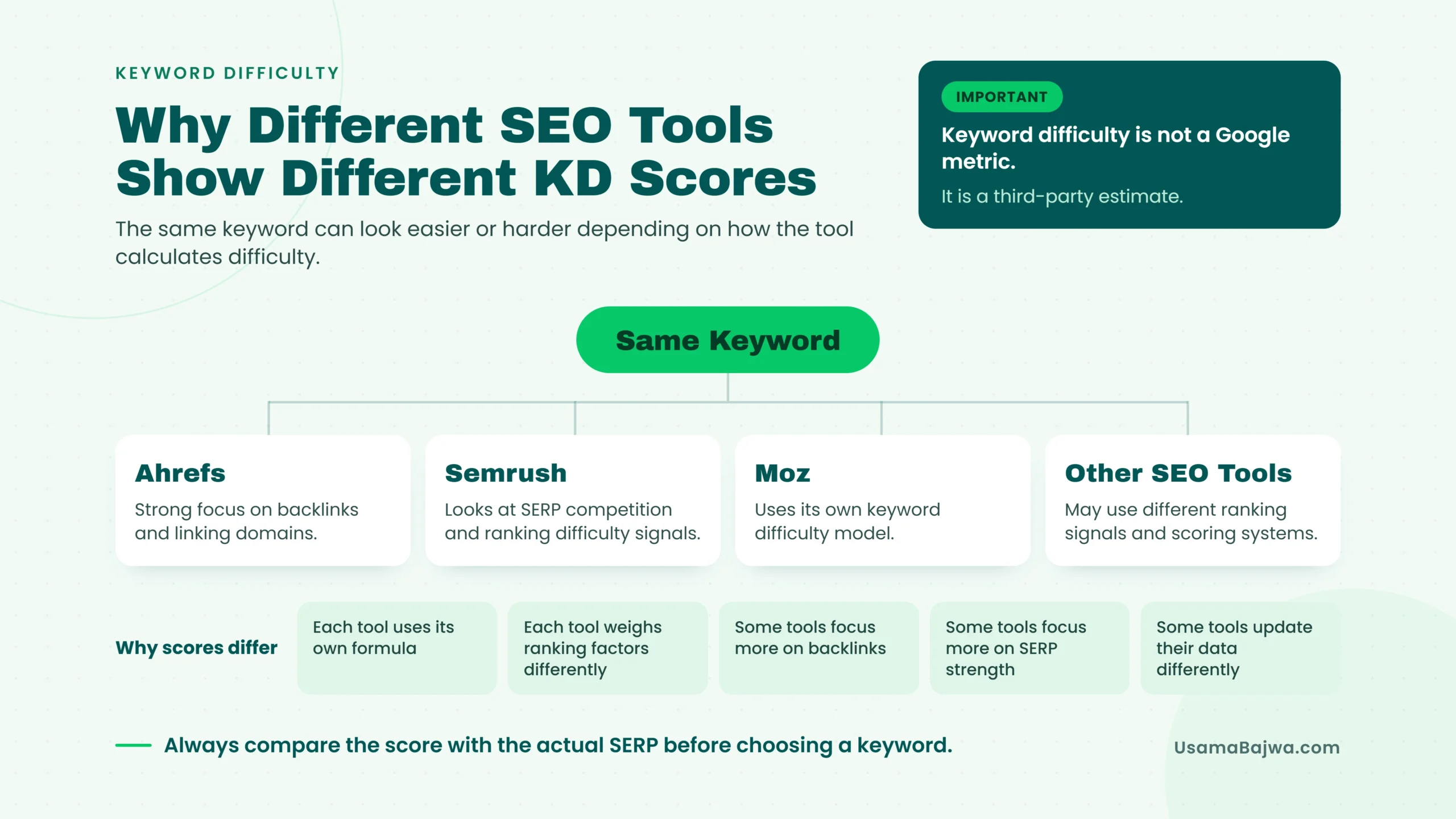
Two tools can analyze the same keyword and return different KD scores.
Neither score comes directly from Google.
Keyword Difficulty at a Glance
| Question | Short Answer |
|---|---|
| What does KD mean? | Keyword Difficulty |
| What does KD measure? | Estimated organic ranking difficulty |
| Does Google provide KD? | No |
| Is KD usually 0–100? | Yes |
| Does low KD guarantee rankings? | No |
| Does high KD mean avoid the keyword? | No |
| Can tools show different KD scores? | Yes |
| Should you inspect the SERP manually? | Yes |
The most important point is simple.
KD is a clue, not a verdict.
What Does Keyword Difficulty Actually Measure?
Keyword difficulty estimates the competition around an organic search query.
SEO tools normally analyze pages already ranking on Google.
They then convert that competitive environment into a score.
A higher score generally means stronger ranking pages.
A lower score generally means weaker competition.
But each platform defines difficulty differently.
Ahrefs focuses heavily on backlinks to top-ranking pages.
Semrush uses backlinks, authority, search demand, and SERP characteristics.
That is why KD should never be treated as an absolute truth.
Keyword Difficulty Is Not a Google Ranking Score
This is one of the most important things to understand.
Google does not give websites a Keyword Difficulty score.
Google uses many systems and signals to rank pages.
Those systems evaluate relevance, usefulness, quality, links, and other signals.
SEO platforms create KD to simplify competitive research.
Think of KD as a research shortcut.
It can help you filter thousands of keywords quickly.
It cannot fully predict whether your page will rank.
That requires actual SERP analysis.
Source: Google Search ranking systems
Keyword Difficulty vs Google Ads Competition
These metrics are often confused.
They measure different things.
| Metric | What It Measures |
|---|---|
| Keyword Difficulty | Organic SEO competition |
| PPC Competition | Competition between advertisers |
| CPC | Estimated paid advertising cost |
| Search Volume | Estimated monthly search demand |
| Search Intent | Why someone searched |
| Traffic Potential | Wider traffic opportunity around the topic |
Google Keyword Planner competition relates to paid advertising.
It should not be confused with organic Keyword Difficulty.
Ahrefs specifically warns about this distinction.
How Is Keyword Difficulty Calculated?
There is no universal KD formula.
Every SEO platform can create its own methodology.
That explains why scores often differ.
How Ahrefs Calculates Keyword Difficulty
Ahrefs takes a relatively focused approach.
It looks at the top 10 organic ranking pages.
Then it analyzes their referring domains.
More referring domains usually produce a higher KD.
Ahrefs plots the result on a logarithmic 0–100 scale.
Ahrefs also states an important limitation.
Its KD score does not include on-page SEO factors.
This makes Ahrefs KD useful for backlink competition.
It does not describe every possible ranking obstacle.
How Semrush Calculates Keyword Difficulty
Semrush uses a broader set of signals.
Its current methodology analyzes the top-ranking pages and keyword characteristics.
Major components include:
- Referring domains to ranking pages
- Authority of ranking domains
- Follow and nofollow link ratios
- Search volume
- SERP features
- Branded search characteristics
- Query length
- Regional search data
Semrush currently gives referring domains the largest individual weight at 41.22%.
Authority Score contributes 16.99%.
Search volume contributes 9.47%.
Follow-to-nofollow ratios contribute 9.17%.
This methodology is clearly different from Ahrefs.
So the scores should not be compared as identical measurements.
Why Do SEO Tools Show Different KD Scores?
Suppose one keyword shows:
KD 20 in Tool A
KD 35 in Tool B
One tool is not necessarily broken.
They may simply measure different signals.
Scores can differ because:
- Tools use different backlink databases.
- Their formulas are different.
- Ranking factors receive different weights.
- SERP databases can update at different times.
- Some tools include search demand.
- Some tools consider SERP features.
- Location can change the competitive SERP.
This leads to one important rule.
Compare keywords inside the same tool before comparing scores across different tools.
A KD 30 in Ahrefs is not automatically equivalent to KD 30 in Semrush.
How to Read a Keyword Difficulty Score
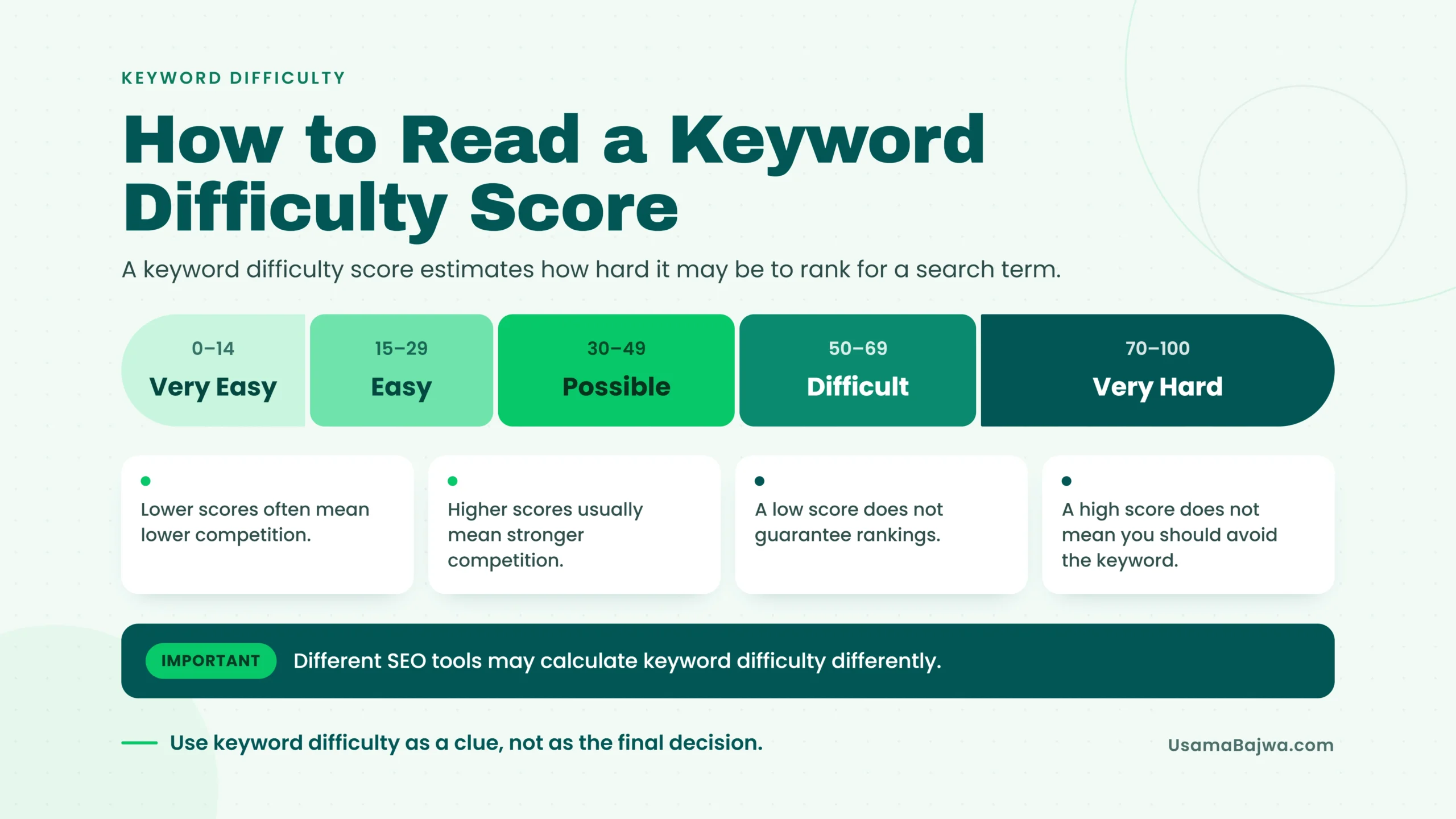
Semrush currently uses six broad difficulty ranges.
| KD | Semrush Label |
|---|---|
| 0–14 | Very Easy |
| 15–29 | Easy |
| 30–49 | Possible |
| 50–69 | Difficult |
| 70–84 | Hard |
| 85–100 | Very Hard |
These are Semrush ranges.
They are not universal SEO standards.
Do not build your strategy around the labels alone.
A “Possible” keyword can still be difficult for your website.
An established website may compete successfully in higher ranges.
Context changes everything.
What Is a Good Keyword Difficulty Score?
There is no universal good KD.
That answer depends on your website.
A newer site may struggle against established publishers.
An authoritative niche site may compete much more effectively.
Semrush also makes this distinction.
Its general KD measures difficulty across the market.
Its Personal Keyword Difficulty estimates difficulty for a specific domain.
So instead of asking:
“Is KD 30 good?”
Ask:
“Is KD 30 realistic for my website?”
That is a better SEO question.
A Better Way to Judge Keyword Difficulty
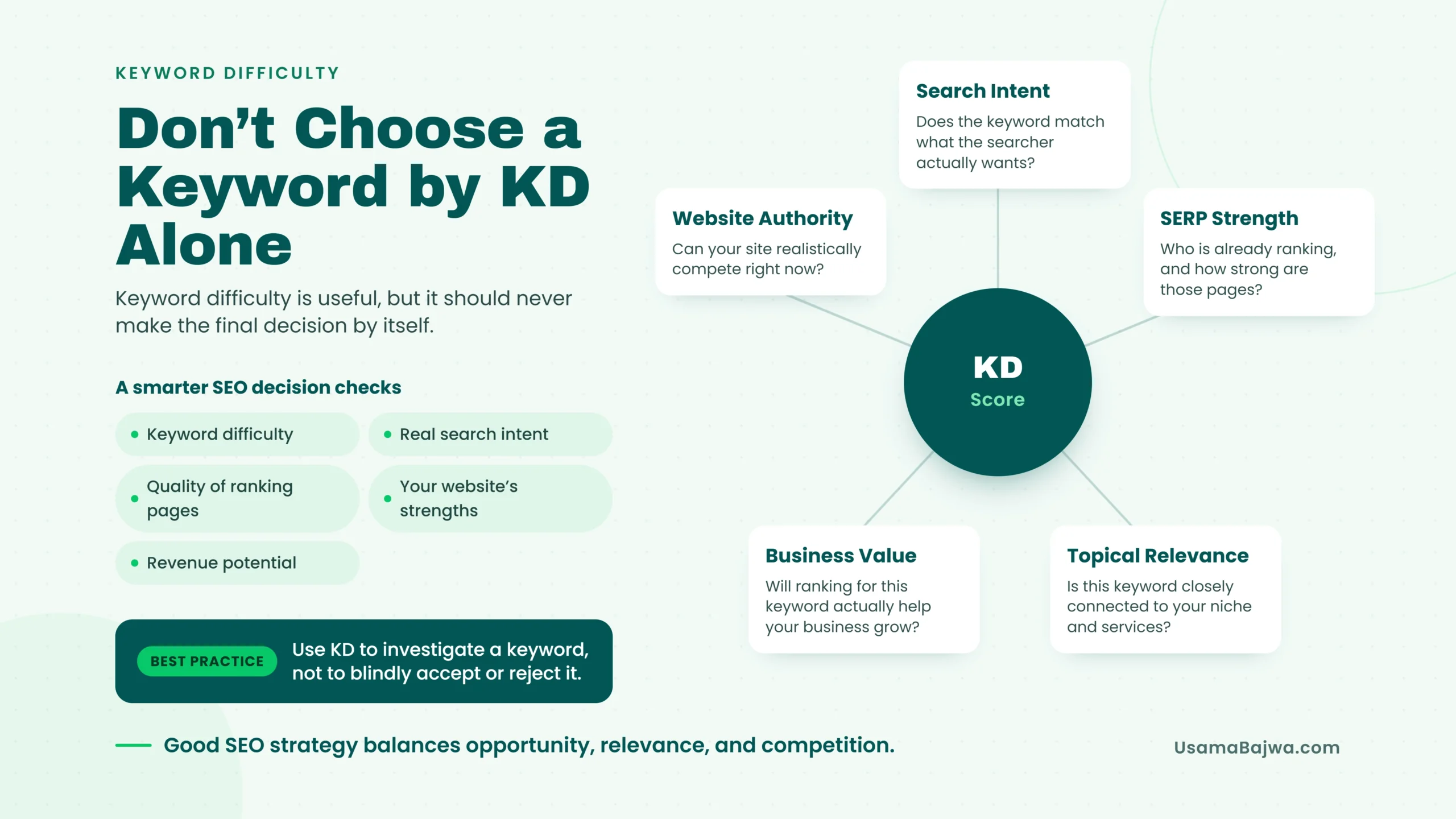
Use six checks before targeting a keyword.
1. Keyword Difficulty
Start with the KD score.
Use it as an initial competitive signal.
Do not stop there.
2. Search Intent
Ask what the searcher actually wants.
Are they trying to:
- Learn?
- Compare?
- Find a website?
- Buy?
- Hire someone?
- Use a tool?
Your page should match that expectation.
Read the complete guide to search intent for deeper examples.
3. SERP Strength
Search the keyword manually.
Inspect the top 10 results.
- Ranking domains
- Page types
- Backlinks
- Content quality
- Publication freshness
- SERP features
- Smaller websites ranking
You are not competing against a KD score.
You are competing against the pages currently ranking.
4. Website Strength
Compare your site with existing competitors.
Ask:
- Do I already rank within this topic?
- Does my site have relevant backlinks?
- Do related pages receive traffic?
- Is my internal linking strong?
- Does Google already understand this topic on my site?
This gives KD useful context.
5. Topical Relevance
A keyword can be easy but irrelevant.
That does not make it valuable.
Choose keywords connected with your business and existing expertise.
Relevant content also creates better internal-link opportunities.
6. Business Value
Ranking is not the final objective.
The keyword should support a useful business goal.
- Qualified traffic
- Leads
- Sales
- Product discovery
- Brand visibility
- Topic authority
An easy keyword with no value can still waste resources.
Not Sure Which Keywords Are Actually Worth Targeting?
Get a practical SEO review focused on intent, competition, content gaps, and realistic ranking opportunities.
Real Example: Similar Topic, Very Different Opportunity
Keyword research becomes interesting when we inspect the SERP.
During research for this article, two related terms looked very different.
| Keyword | U.S. Volume | Semrush KD | SERP Pattern |
|---|---|---|---|
| keyword difficulty | 6.6K | 54 | Strong tool-heavy SERP |
| what is keyword difficulty | 720 | 33 | Clear informational SERP |
Research snapshot: September 2026.
The first keyword offers much higher search demand.
It also contains stronger tool-based competition.
Ahrefs, Semrush, Moz, and other SEO platforms appeared prominently.
The second query has lower volume.
However, its intent is clearer.
Informational articles and smaller publishers also appear.
This creates an important lesson.
Higher search volume does not automatically mean a better keyword opportunity.
Sometimes a smaller query gives you a more realistic entry point.
This is why SERP analysis should follow every KD check.
Low KD Does Not Guarantee Position #1
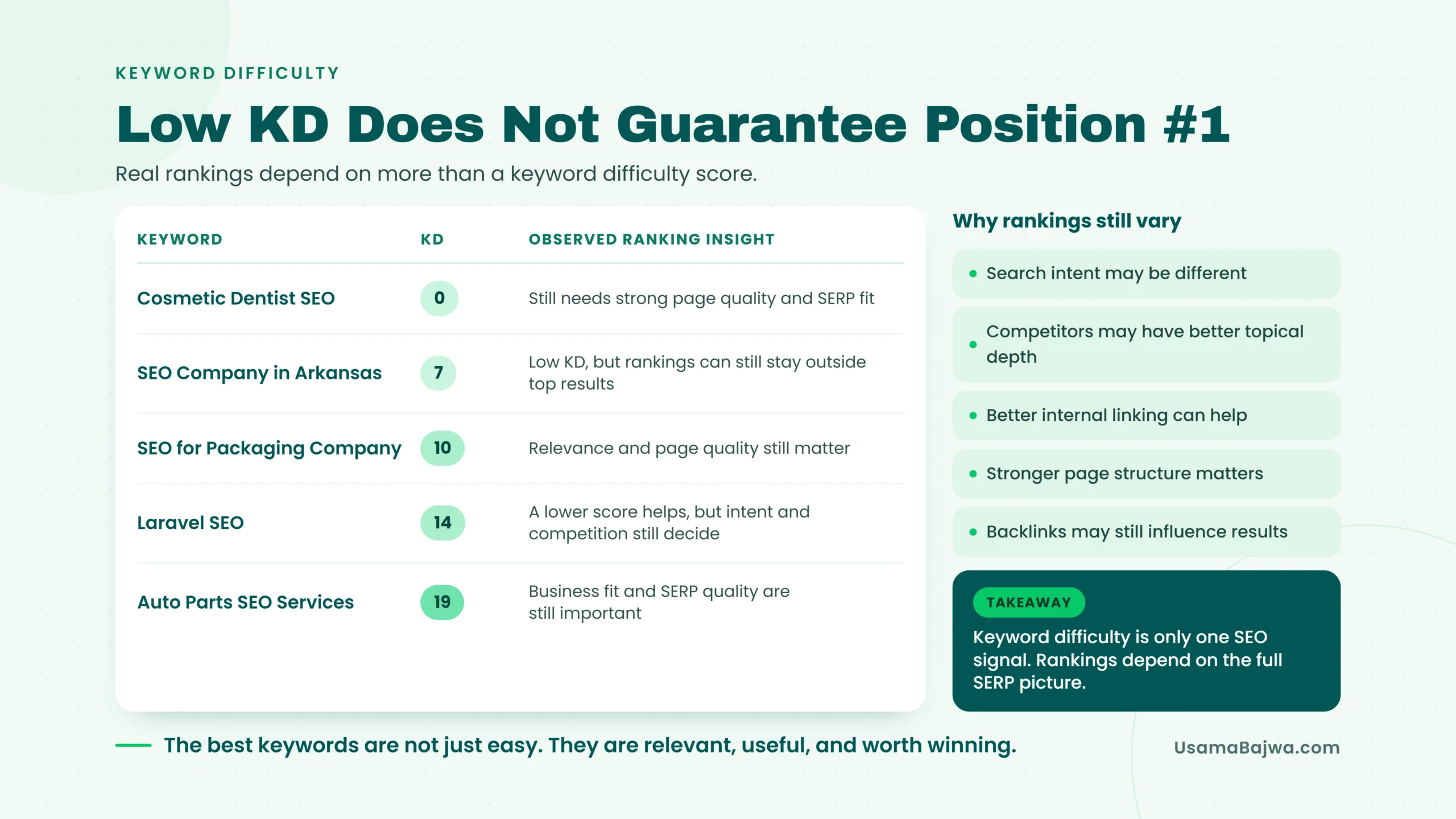
Low difficulty can create a false sense of confidence.
Real ranking data shows why.
A Semrush snapshot of UsamaBajwa.com showed examples like these:
| Keyword | KD | Observed Position |
|---|---|---|
| Cosmetic Dentist SEO | 0 | Around 26 |
| SEO Company in Arkansas | 7 | Around 49 |
| SEO for Packaging Company | 10 | Around 23 |
| Laravel SEO | 14 | Around 26 |
| Auto Parts SEO Services | 19 | Around 15 |
Positions were observed during September 2026 research.
Rankings can change.
Third-party metrics can also change.
Still, the pattern teaches something useful.
Low KD did not automatically create a top-three ranking.
Other signals still mattered.
Those included:
- Search intent
- Page relevance
- Competition
- Internal linking
- Backlinks
- Content quality
- Site strength
This is why “KD 0” should never mean “guaranteed ranking.”
Why Can a Low-KD Keyword Still Be Hard?
Several problems can make an easy-looking keyword difficult.
Search Intent Mismatch
Your article may answer the wrong question.
Google may prefer service pages instead.
Or the SERP may favor tools.
Intent comes first.
Wrong Page Type
Suppose Google ranks ecommerce category pages.
A blog article may struggle there.
The content format should match the SERP.
Weak Topical Relevance
Your website may have no established coverage around the subject.
A competitor may have dozens of supporting pages.
That gives them stronger topical context.
Weak Internal Linking
Important pages need crawlable contextual links.
Google recommends making links crawlable for discovery.
Strong internal linking also helps users find related information.
Read the guide to internal linking for the full process.
Strong Individual Competitors
A low average score can hide several difficult results.
Always inspect each top-ranking page.
Better Content Already Exists
“Longer” does not automatically mean “better.”
The existing page may simply satisfy the user better.
Google specifically says there is no preferred word count.
Can a High-KD Keyword Still Be Worth Targeting?
Yes.
High difficulty does not automatically mean “avoid.”
Some difficult keywords are strategically important.
Consider targeting them when:
- The keyword closely matches your service.
- Commercial value is strong.
- The topic is central to your expertise.
- You can support it with a topic cluster.
- Your website already has relevant authority.
- The page can attract links naturally.
- Long-term visibility justifies the investment.
You may not rank immediately.
The content can still support your wider SEO architecture.
Keyword Difficulty vs Search Volume
These metrics answer different questions.
Search volume asks:
How often is this keyword searched?
Keyword difficulty asks:
How competitive may the organic SERP be?
Neither metric should work alone.
Consider this example:
| Keyword | Volume | KD | Decision |
|---|---|---|---|
| Keyword A | 10,000 | 80 | Investigate carefully |
| Keyword B | 1,000 | 20 | Possibly accessible |
| Keyword C | 300 | 10 | May still lack business value |
Keyword B is not automatically best.
Keyword C is not automatically useless.
Intent and value still matter.
Keyword Difficulty vs Long-Tail Keywords
Long-tail keywords and low-difficulty keywords are not the same thing.
A long-tail query is usually more specific.
That does not guarantee weak competition.
Some long-tail keywords have strong commercial value.
Strong businesses may compete heavily for them.
Likewise, some shorter keywords can have weak SERPs.
Use specificity and KD as separate signals.
Read What Are Long-Tail Keywords? for deeper research methods.
Keyword Difficulty vs Search Intent
KD tells you about competition.
Search intent tells you what the user expects.
Intent usually comes first.
Suppose a keyword has KD 15.
Google ranks only product pages.
You create a 4,000-word informational guide.
The low KD will not fix the mismatch.
Always inspect what Google currently rewards.
Then create the correct page type.
How to Check Keyword Difficulty Properly
A tool can show the score quickly.
The real research starts afterwards.
Step 1: Enter the Keyword
Use your preferred SEO research platform.
Select the correct country.
Difficulty changes with location.
Step 2: Record the Basic Metrics
Capture:
- Keyword Difficulty
- Search volume
- Intent
- CPC
- SERP features
These metrics create initial context.
Step 3: Open the SERP
Do not judge the keyword from the dashboard alone.
Inspect actual ranking pages.
Step 4: Identify the Dominant Page Type
Look for:
- Blog posts
- Product pages
- Category pages
- Service pages
- Tools
- Forums
- Videos
- Local results
The dominant format is an important clue.
Step 5: Evaluate Ranking Domains
Check whether results are dominated by major brands.
Also look for smaller websites.
Smaller successful sites can reveal accessible openings.
Step 6: Inspect Page-Level Strength
Domain strength is not enough.
Analyze each ranking URL.
Look at:
- Referring domains
- Content relevance
- Internal links
- Depth
- Freshness
- Page experience
Step 7: Find Content Gaps
Ask what existing pages fail to explain.
Look for:
- Unanswered questions
- Weak examples
- Outdated explanations
- Confusing terminology
- Missing comparisons
- Missing first-hand data
Do not rewrite competitor articles.
Add information they do not provide.
Step 8: Compare the Keyword With Your Website
Look at your existing rankings.
Find the difficulty ranges where you already compete.
Your own data can become a useful benchmark.
Step 9: Check Business Value
Ask what happens after you rank.
Will the visitor:
- Become a lead?
- Read another guide?
- Explore a service?
- Join your audience?
- Remember your brand?
Traffic without purpose can become a vanity metric.
Use Your Existing Rankings as a Personal KD Benchmark
This is one of the most practical ways to use difficulty data.
Open your organic keyword report.
Filter for non-branded queries.
Then review:
- KD
- Ranking position
- Topic
- Page type
- Search intent
Look for patterns.
Suppose your site consistently reaches page one around KD 15–25.
That gives you real evidence.
Your next targets can stretch slightly beyond that range.
This is more useful than copying another website's arbitrary KD threshold.
Your website has its own competitive history.
Use it.
When Should You Ignore the KD Score?
Do not literally ignore KD.
But reduce its influence in certain situations.
When the Keyword Is Essential to Your Business
A core service keyword may deserve content despite high competition.
When the SERP Contains Weak Pages
The tool may show high difficulty.
Manual inspection may reveal poor relevance or outdated content.
When Your Site Has Strong Topical Authority
General KD may overstate the practical difficulty for your domain.
When Business Value Is Exceptional
A difficult commercial query can justify a long-term investment.
When You Are Building a Topic Cluster
Supporting content can strengthen a broader content ecosystem.
Read the guide to SEO topic clusters for that strategy.
When Should You Be More Careful Than KD Suggests?
Low KD can also underestimate the real challenge.
Be cautious when:
- The SERP intent does not match your planned page.
- Local results dominate the query.
- Google prefers tools or interactive experiences.
- Strong brands occupy most positions.
- Results contain highly specialized expertise.
- Your site has no topical history.
- Search demand is tiny.
- The keyword has little business relevance.
This is why manual analysis remains necessary.
Ahrefs also recommends examining the actual SERP beyond its KD metric.
The 6-Point Keyword Difficulty Reality Check
Before approving a keyword, score these six areas mentally.
| Check | Question |
|---|---|
| KD | How competitive does the tool estimate this SERP? |
| Intent | Can I satisfy what the searcher wants? |
| SERP | Can I compete with the current pages? |
| Authority | Does my site have enough strength? |
| Relevance | Does this topic belong on my website? |
| Value | Is this keyword worth winning? |
Do not make the decision from one column.
Look at the complete picture.
How Keyword Mapping Helps
A good keyword can still fail with poor page targeting.
Every keyword cluster needs a clear URL owner.
That helps prevent:
- Duplicate pages
- Cannibalization
- Conflicting intent
- Weak internal architecture
Use keyword mapping before creating multiple pages around related terms.
Use keyword clustering to group closely related searches first.
Does Keyword Difficulty Change?
Yes.
Search results change.
Backlinks change.
Competitors publish new pages.
SERP features also change.
Semrush says it recalculates difficulty as ranking pages and SERP conditions change.
So KD should be treated as a current estimate.
It is not a permanent property of a keyword.
Can Two Locations Have Different Keyword Difficulty?
Yes.
SERPs can differ by country or region.
Different competitors may rank.
Search demand may also vary.
Semrush includes regional calibration in its current difficulty methodology.
Always research the market you actually want to target.
Do not use U.S. KD blindly for another country.
Does Better Content Reduce Keyword Difficulty?
Not literally.
The tool's KD score does not fall because your article is better.
But stronger content can improve your ability to compete.
That distinction matters.
Useful content can improve:
- Intent satisfaction
- Topic coverage
- Linkability
- Internal linking opportunities
- User experience
Google recommends original information, substantial value, and people-first content.
So create better content for users.
Do not create extra words simply to beat competitor word counts.
Keyword Difficulty and AI Overviews
AI Overviews change how some informational SERPs behave.
They do not create a separate SEO rulebook.
Google says the same foundational SEO practices apply to AI features.
Pages must also be indexed and eligible for normal search snippets.
Google also recommends unique and useful content for generative search experiences.
For a topic like Keyword Difficulty, that means adding real value.
Useful additions include:
- Clear definitions
- Accurate sourcing
- Tool methodology comparisons
- First-party observations
- Original frameworks
- Useful tables
- Real examples
- Direct answers
Simply rewriting existing definitions adds little value.
Can Helpful Content Improve Visibility in LLMs?
There is no guaranteed formula for LLM citations.
Different systems use different retrieval methods.
However, clear and well-sourced information benefits both users and machines.
Useful publishing practices include:
- Answer questions directly.
- Define important terms clearly.
- Use descriptive headings.
- Support claims with reliable sources.
- Include original observations.
- Keep tables simple.
- Avoid unsupported statistics.
- Maintain accurate author information.
- Keep pages crawlable and indexable.
These practices are useful even without an AI citation.
The primary goal should remain helping the reader.
Common Keyword Difficulty Mistakes
Mistake 1: Choosing Only Low-KD Keywords
Easy does not mean valuable.
Start with relevance and purpose.
Mistake 2: Avoiding Every High-KD Keyword
Some difficult keywords are strategically essential.
Think long term.
Mistake 3: Comparing Scores Across Tools
Different tools use different formulas.
Do not assume equal numbers mean equal difficulty.
Mistake 4: Ignoring Search Intent
A low score cannot rescue the wrong page type.
Mistake 5: Ignoring the Top 10
Your competitors are inside the SERP.
Study them.
Mistake 6: Treating KD as a Google Metric
Google does not publish KD.
SEO platforms estimate it.
Mistake 7: Assuming Low KD Means Fast Rankings
Indexing, authority, relevance, and competition still matter.
Mistake 8: Looking Only at Domain Authority
Page-level competition matters too.
Mistake 9: Ignoring Your Own Ranking History
Your website already contains useful competitive data.
Learn from it.
Mistake 10: Chasing Volume Without Business Value
Traffic is not the same as growth.
Choose useful traffic.
A Simple Keyword Difficulty Workflow
Use this process for every important keyword.
1. Find the keyword.
Start with real search demand.
2. Check KD.
Record the score.
3. Check search intent.
Understand the expected answer.
4. Inspect Google manually.
Study the current top results.
5. Compare competitors.
Look at page and domain strength.
6. Find content gaps.
Identify information users still need.
7. Compare with your website.
Use your existing rankings as evidence.
8. Check business value.
Make sure the traffic matters.
9. Map the keyword.
Choose the correct URL.
10. Create the best useful page you can.
Then improve it using real performance data.
Turn Keyword Research Into a Clear SEO Plan
Explore SEO services, review the Technical SEO service, or discuss a strategy built around your website.
Frequently Asked Questions
What is keyword difficulty?
Keyword difficulty estimates how competitive an organic search query may be.
Most SEO tools show it on a 0–100 scale.
Higher scores usually indicate stronger competition.
What is keyword difficulty in SEO?
In SEO, Keyword Difficulty helps marketers compare ranking opportunities.
It is mainly used during keyword research and prioritization.
Is Keyword Difficulty a Google metric?
No.
Google does not publish an official KD score.
Third-party SEO tools calculate their own estimates.
What is a good Keyword Difficulty?
There is no universal good score.
A useful score depends on your website's authority, relevance, and competitors.
Is KD 0 easy to rank for?
It may indicate weak measured competition.
It does not guarantee rankings.
Search intent and content quality still matter.
Is KD 50 too difficult?
Not automatically.
Semrush labels KD 50–69 as “Difficult.”
Your actual opportunity still depends on the SERP and your website.
Why do Ahrefs and Semrush show different KD scores?
Their formulas are different.
Ahrefs emphasizes referring domains.
Semrush uses a broader combination of SERP and keyword signals.
How do I check Keyword Difficulty?
Enter your target keyword into an SEO research tool.
Then select the correct country.
Review KD alongside the actual top-ranking pages.
Should a new website target high-KD keywords?
Not as its only strategy.
Lower-competition opportunities can help establish early visibility.
Core high-KD topics can still support long-term growth.
Does Keyword Difficulty change?
Yes.
Competitors, backlinks, and search results change over time.
Difficulty estimates can change with them.
Are long-tail keywords always low difficulty?
No.
Long-tail describes query specificity.
It does not guarantee low organic competition.
Which matters more, KD or search intent?
They answer different questions.
However, intent should usually be checked before creating the page.
A low KD cannot fix intent mismatch.
Final Takeaway
Keyword Difficulty is useful.
It is also easy to misuse.
Do not ask only:
“How low is the KD?”
Ask:
“Can my website realistically create the page this SERP deserves?”
Then check:
- Keyword difficulty
- Search intent
- Current competitors
- Website strength
- Topical relevance
- Business value
Use KD to narrow opportunities.
Use the SERP to understand the real competition.
Use your own ranking history to understand your capabilities.
Then create content that genuinely helps the searcher.
That is a stronger keyword strategy than chasing easy-looking numbers.
And it is much closer to how real SEO decisions should be made.