

A local business does not need visitors from everywhere.
It needs visibility in the places it serves.
A dentist needs nearby patients.
A plumber needs calls from the correct service area.
A restaurant needs customers looking for somewhere to eat nearby.
A law firm needs enquiries from people in the jurisdictions it serves.
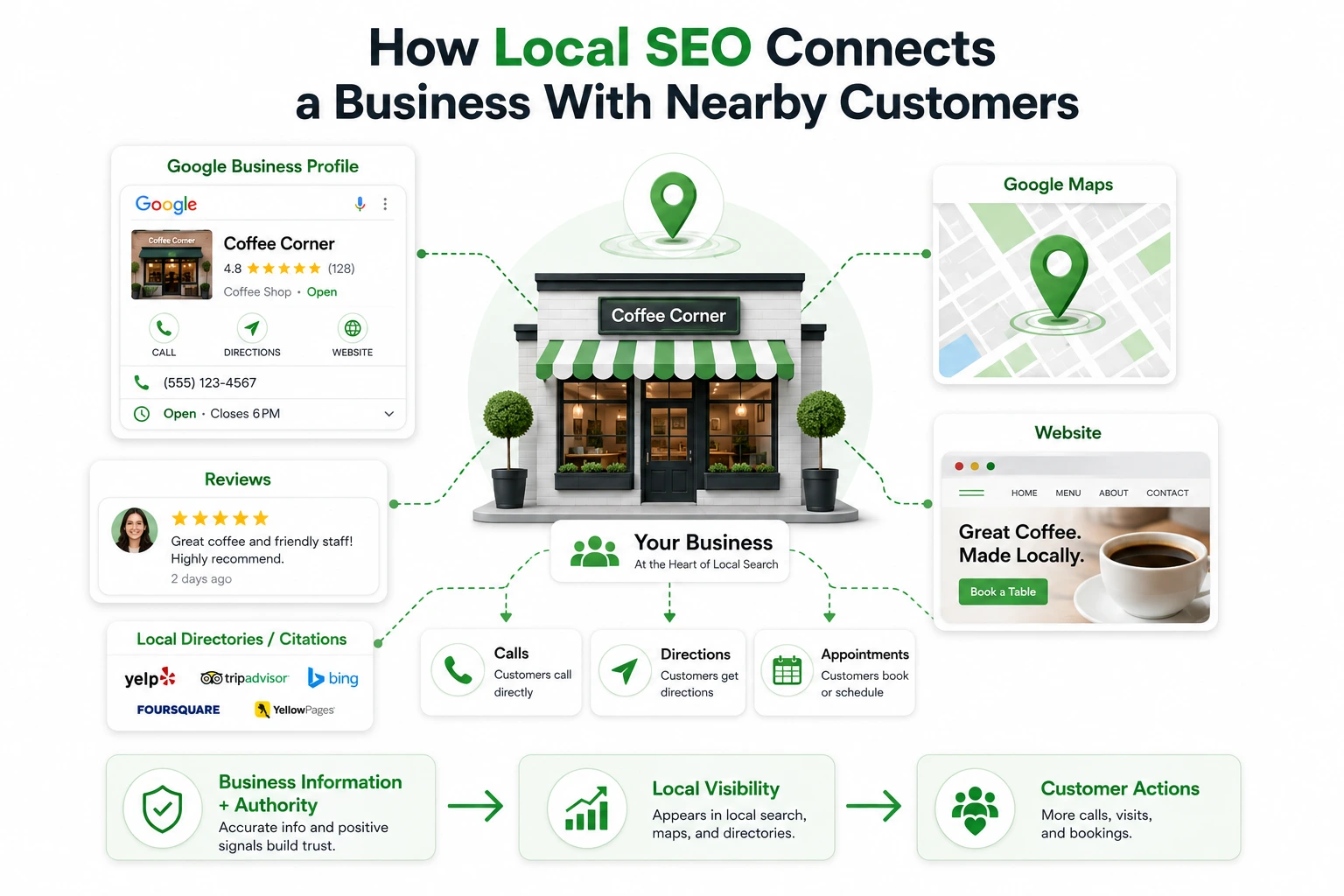
Local SEO helps these businesses appear when customers search on Google Search and Google Maps.
It connects a business with people who have:
- A specific need
- Local intent
- A preferred location
- A reason to act
The goal is not simply to rank higher.
The goal is to generate:
This guide explains how local SEO for small business works, what to prioritize, and how to measure its real business impact.
Quick answer: Local SEO improves a business’s visibility in Google Maps, the local pack, and location-based organic results. It combines Google Business Profile optimization, local website pages, reviews, citations, relevant backlinks, accurate business information, and conversion tracking.
What Is Local SEO for Small Businesses?
Local SEO is the process of improving a business’s visibility for searches connected to a geographical area.
Examples include:
These searches are different from broad informational searches.
A person searching for “how does plumbing work?” may only want information.
A person searching for “emergency plumber near me” probably needs immediate help.
That difference is important.
Local SEO focuses on matching the business with people searching for its services in the areas it genuinely serves.
Local SEO vs. Traditional SEO
Traditional SEO may target:
- National searches
- International searches
- Broad informational topics
- Ecommerce products
- Software queries
- Industry-wide terms
Local SEO focuses on:
- Cities
- Towns
- Neighbourhoods
- Service areas
- Nearby providers
- Physical business locations
- Geographically relevant services
A local business often needs both.
For example, a dental clinic may use traditional SEO to publish educational guides about dental treatments.
It may use local SEO to appear for:
- Dental implants in Chicago
- Emergency dentist near me
- Family dentist in Chicago
Local SEO is therefore one part of a broader small business SEO strategy.
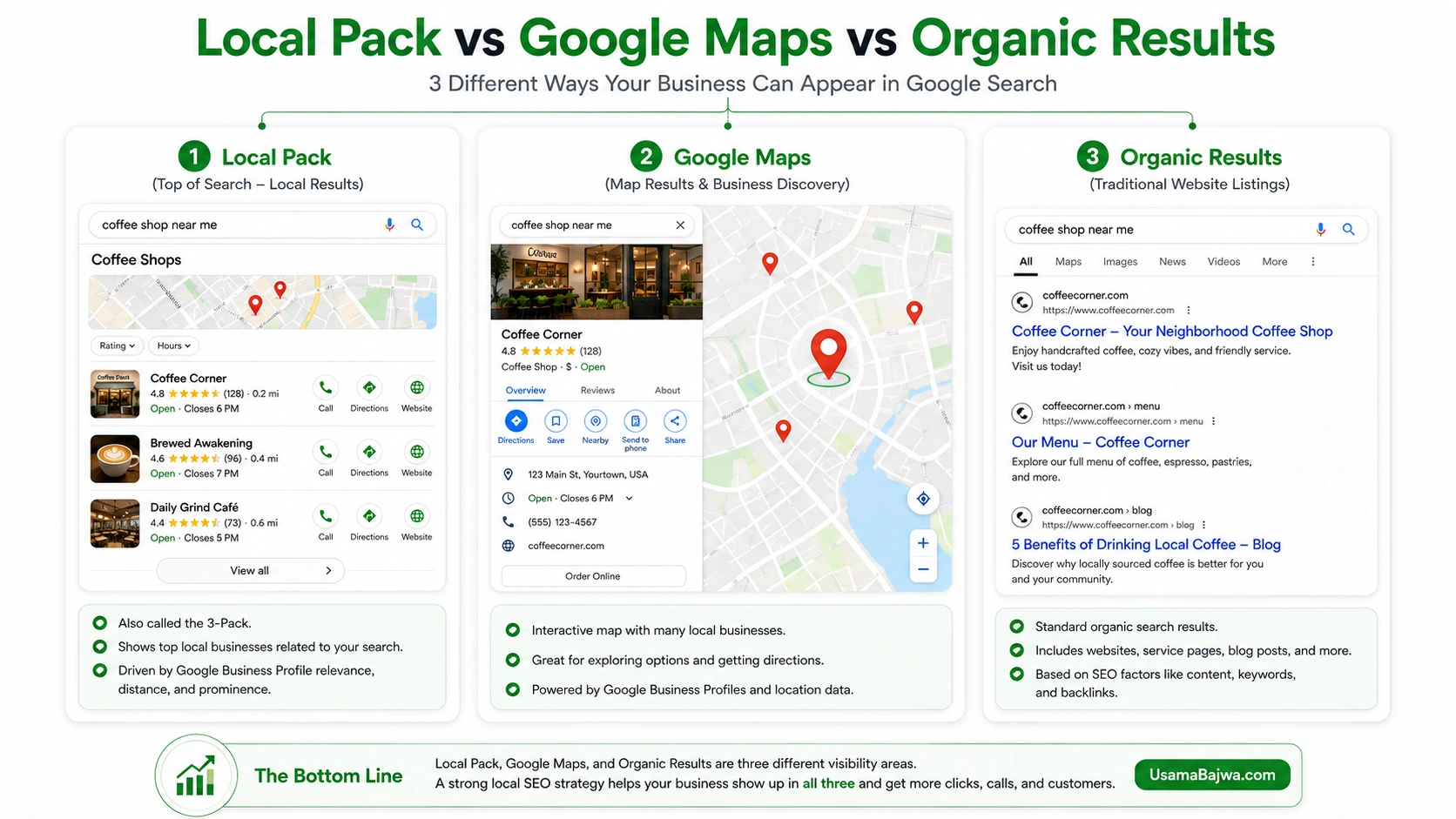
Local Pack, Google Maps, and Organic Results
Local visibility can appear in several parts of the search results.
Google Local Pack
The local pack is the map-based group of business listings shown for many local searches.
It may display:
- Business names
- Ratings
- Review counts
- Hours
- Addresses
- Service information
- Photos
- Directions
- Call buttons
Google Maps Results
Customers can also search directly inside Google Maps.
They may compare businesses based on:
- Distance
- Categories
- Reviews
- Opening hours
- Photos
- Services
- Website information
Local Organic Results
These are normal website results connected to local intent.
They may include:
- Homepage results
- Service pages
- Location pages
- Local guides
- Contact pages
- Directory listings
A strong local SEO strategy does not depend on only one of these areas.
The Business Profile and website should support each other.
Who Needs Local SEO?
Local SEO is relevant to businesses that interact with customers in person.
Google distinguishes between storefront, service-area, and hybrid businesses. A service-area business travels to customers but does not serve them at its address. A hybrid business serves customers at its location and also travels or delivers to them.
When Local SEO May Not Be the Main Priority
Local SEO may be less important for:
- Online-only businesses
- National ecommerce stores
- Software companies without local demand
- Digital products sold worldwide
- Businesses that never meet customers in person
These companies may need traditional, ecommerce SEO, SaaS SEO, or international SEO instead.
Why Local SEO Matters for Small Businesses
Local SEO places a business in front of people who are already looking for a nearby solution.
That makes the traffic more relevant.
Reach Customers With Local Buying Intent
Local searches often contain a clear need.
- “Plumber near me” shows a service need.
- “Dentist open now” shows urgency.
- “Accountant in Dallas” shows location preference.
- “Roof repair company” shows commercial intent.
These users are not browsing randomly.
They are looking for a business they may contact, visit, or hire.
Generate Calls, Visits, and Enquiries
A customer does not always need to visit the website first.
They may act directly from the Business Profile by:
- Calling
- Requesting directions
- Opening the website
- Checking hours
- Viewing services
- Making a booking
- Reading reviews
Build Trust Before the Customer Contacts You
Customers often evaluate a business before making contact.
They may check:
- Average rating
- Number of reviews
- Recent feedback
- Owner responses
- Photos
- Business hours
- Services
- Website quality
- Contact information
Accurate information reduces uncertainty.
Useful reviews provide social proof.
Professional responses show that the business values customer feedback.
Compete With Larger Businesses Locally
A small business may not compete nationally with a large brand.
It can still become highly relevant within its local market.
Local competition is influenced by factors such as:
- Business relevance
- Location
- Reviews
- Categories
- Website quality
- Links
- Local authority
- Information accuracy
A smaller company can therefore build meaningful visibility within the areas it serves.
Reduce Dependence on Paid Advertising
Paid advertising can generate visibility quickly.
Local SEO usually takes longer.
However, a strong local presence can continue generating discovery without paying for every individual click.
The two channels can also work together.
Paid campaigns can support immediate lead generation.
Local SEO can build a longer-term acquisition channel.
How Google Determines Local Rankings
Google explains that local results are mainly based on:
No business can pay Google to improve its organic local ranking.
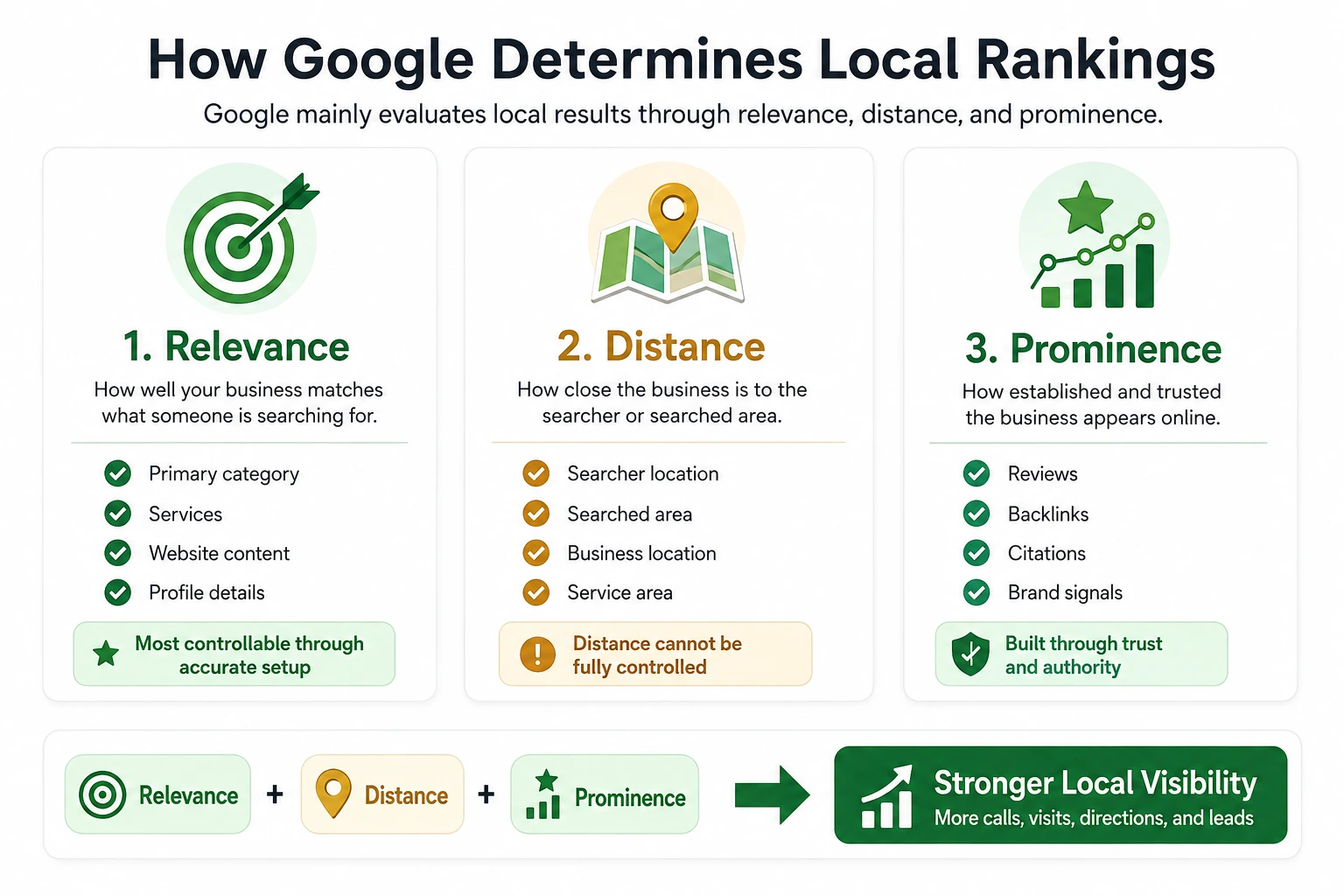
Relevance
Relevance describes how closely the business matches the search.
Google needs to understand:
- What the business is
- Which services it provides
- Where it operates
- Which customers it serves
Relevant signals may come from:
- Primary category
- Secondary categories
- Services
- Business description
- Website content
- Page titles
- Service pages
- Location information
Complete and accurate information helps Google understand the business and match it with suitable searches.
Distance
Distance refers to how far the business is from the searcher or the location included in the query.
A business cannot fully control this factor.
It should not try to manipulate proximity through:
- Fake addresses
- Virtual offices
- Unstaffed locations
- Duplicate profiles
- Ineligible coworking spaces
Google requires businesses to use accurate real-world locations or service areas.
Prominence
Prominence reflects how established or well known a business appears.
Possible signals include:
- Customer reviews
- Ratings
- Website links
- Brand mentions
- Citations
- Business history
- Offline recognition
- Website authority
Local Pack Signals vs. Local Organic Signals
The local pack and organic website results overlap, but they are not identical.
| Local pack signals | Local organic signals |
|---|---|
| Business Profile categories | Website relevance |
| Business information | On-page SEO |
| Reviews | Internal links |
| Distance | Backlinks |
| Profile completeness | Technical SEO |
| Prominence | Content quality |
| Services and attributes | Page structure |
A complete strategy should improve both the Business Profile and the website.
Choose the Correct Strategy for Your Business Type
Different business models need different local SEO priorities.
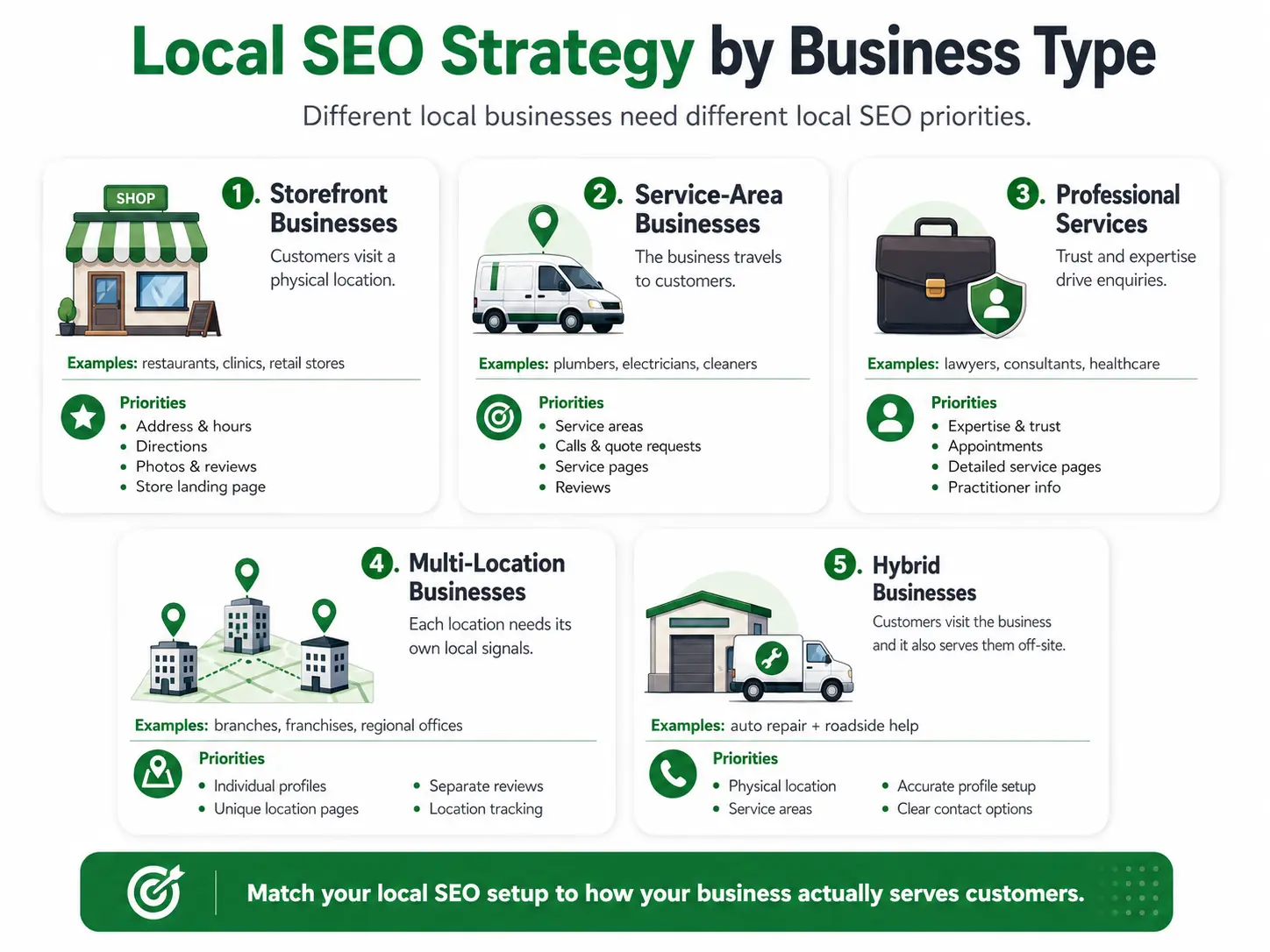
Storefront Businesses
Storefront businesses serve customers at a physical location.
Examples include:
- Restaurants
- Shops
- Salons
- Dental clinics
- Auto-repair shops
Their priorities include:
- Accurate address
- Opening hours
- Directions
- Categories
- Photos
- Reviews
- Products or services
- Store-specific landing pages
Service-Area Businesses
Service-area businesses travel to customers.
Examples include:
- Plumbers
- Electricians
- Cleaning companies
- Landscapers
- Mobile repair services
Their priorities include:
- Correct service-area configuration
- Hidden address when customers are not served there
- Strong service pages
- Legitimate city relevance
- Phone-call tracking
- Quote-request forms
- Customer reviews
Professional Service Businesses
Examples include:
- Lawyers
- Accountants
- Consultants
- Healthcare professionals
- Financial advisers
Their priorities include:
- Expertise
- Qualifications
- Practitioner information
- Detailed service pages
- Reviews
- Appointment paths
- Trust signals
- Clear contact options
Multi-Location Businesses
Multi-location businesses need a controlled structure.
Each eligible location should have:
- Its own accurate profile
- Unique location information
- Relevant landing page
- Correct phone number
- Correct hours
- Location-specific reviews
- Separate performance tracking
Do not create several profiles for one location simply to target more keywords.
Hybrid Businesses
A hybrid business serves customers at its premises and also travels to customers.
An auto-repair shop offering roadside assistance is one example.
Its profile and website should accurately represent both activities.
How to Do Local SEO for a Small Business
A successful local SEO campaign starts with the foundation.
Do not change everything without first identifying the actual gaps.
1. Audit Your Current Local Visibility
Review the business’s existing position before making changes.
Check:
- Is the Business Profile verified?
- Is the information accurate?
- Are duplicate profiles present?
- Is the address eligible?
- Are the categories correct?
- Are services complete?
- Are reviews being monitored?
- Does the website target local intent?
- Are important pages indexed?
- Are calls and forms tracked?
Also search for the business by:
- Business name
- Main service
- Service and city
- Category
- Phone number
- Address
This helps reveal inaccurate listings, duplicates, weak pages, and missed opportunities.
2. Claim and Verify the Google Business Profile
Claiming and verifying the profile gives the business control over how its information appears.
A verified profile can help customers find the company on Search and Maps.
Use the real business information.
Do not add:
- Marketing taglines
- City names that are not part of the real name
- Service keywords
- Phone numbers
- Website URLs
- Opening-hour information
The profile name should match how the business is represented in the real world.
3. Select Accurate Business Categories
The primary category should describe the business’s main activity.
Use this test:
“This business is a…”
For example:
- This business is a plumber.
- This business is a dental clinic.
- This business is an accountant.
- This business is a roofing contractor.
Do not choose categories merely because they contain attractive keywords.
Use the fewest categories needed to describe the core business and select the most specific available option.
4. Complete Every Relevant Profile Element
A complete profile gives customers the information they need to make a decision.
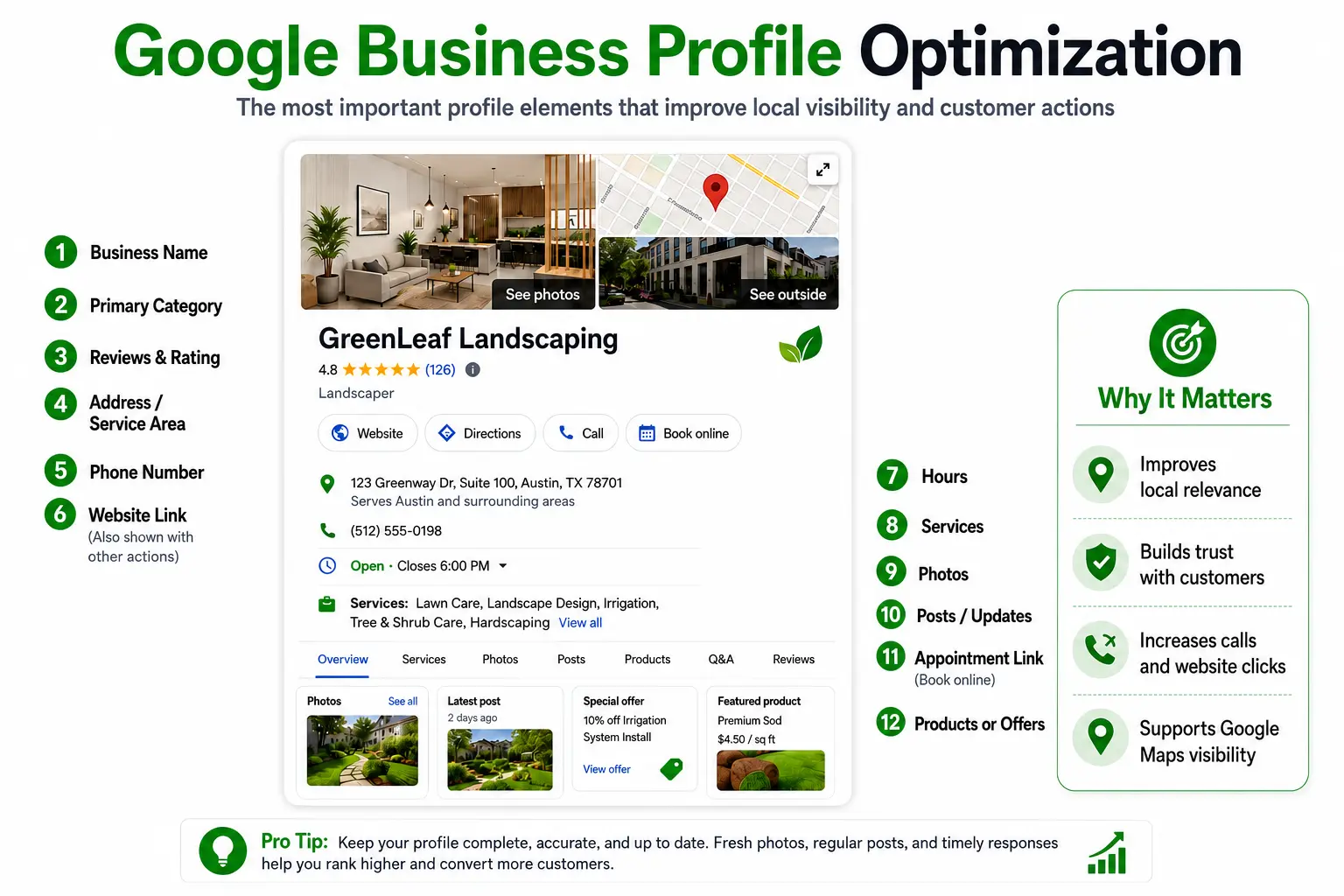
Business Description
Explain:
- What the business does
- Who it serves
- Where it operates
- What makes it different
Keep it factual.
Do not add links or fill the description with promotions and keyword repetition.
Services
Add the actual services offered.
Group them clearly where the feature allows it.
Google may highlight relevant services when customers search for an offering provided by the business.
Business Hours
Keep regular and special hours accurate.
Customers should know:
- When the business opens
- When it closes
- Whether appointments are required
- Whether holiday hours are different
Website and Action Links
Link users to the most relevant destination.
| Profile action | Best destination |
|---|---|
| Main profile | Relevant homepage |
| Service-specific action | Service page |
| Appointment action | Booking page |
| Product action | Product or category page |
| Consultation action | Contact page |
Do not send every user to a generic homepage when a more relevant page exists.
Photos and Videos
Use real media whenever possible.
Posts
Posts can share updates, events, offers, announcements, photos, videos, and action links directly through the profile.
Use posts to support customers.
Do not treat them as a place for keyword stuffing.
5. Research Local Keywords by Intent
Local keyword research should identify what customers need and where they need it.
Start with four groups.
Service Keywords
- Emergency plumbing
- Dental implants
- Tax preparation
- Roof repair
Service-and-Location Keywords
- Plumber in Dallas
- Dental implants in Chicago
- Accountant in Houston
- Roof repair in Austin
Near-Me Keywords
- Dentist near me
- Electrician nearby
- Accountant near me
Do not force “near me” repeatedly into the page. Google can use the searcher’s location.
Problem-Based Keywords
- Water heater leaking
- Tooth pain dentist open now
- Roof damaged after storm
- Business tax help near me
These searches may reveal stronger urgency than broad service names.
6. Map Keywords to the Correct Pages
Do not target every keyword with a blog post.
| Keyword type | Best destination |
|---|---|
| Main service | Service page |
| Service plus city | Relevant local landing page |
| Business name | Homepage or Business Profile |
| Local question | Blog post or guide |
| Branch query | Location page |
| Appointment search | Booking or service page |
| Contact search | Contact page |
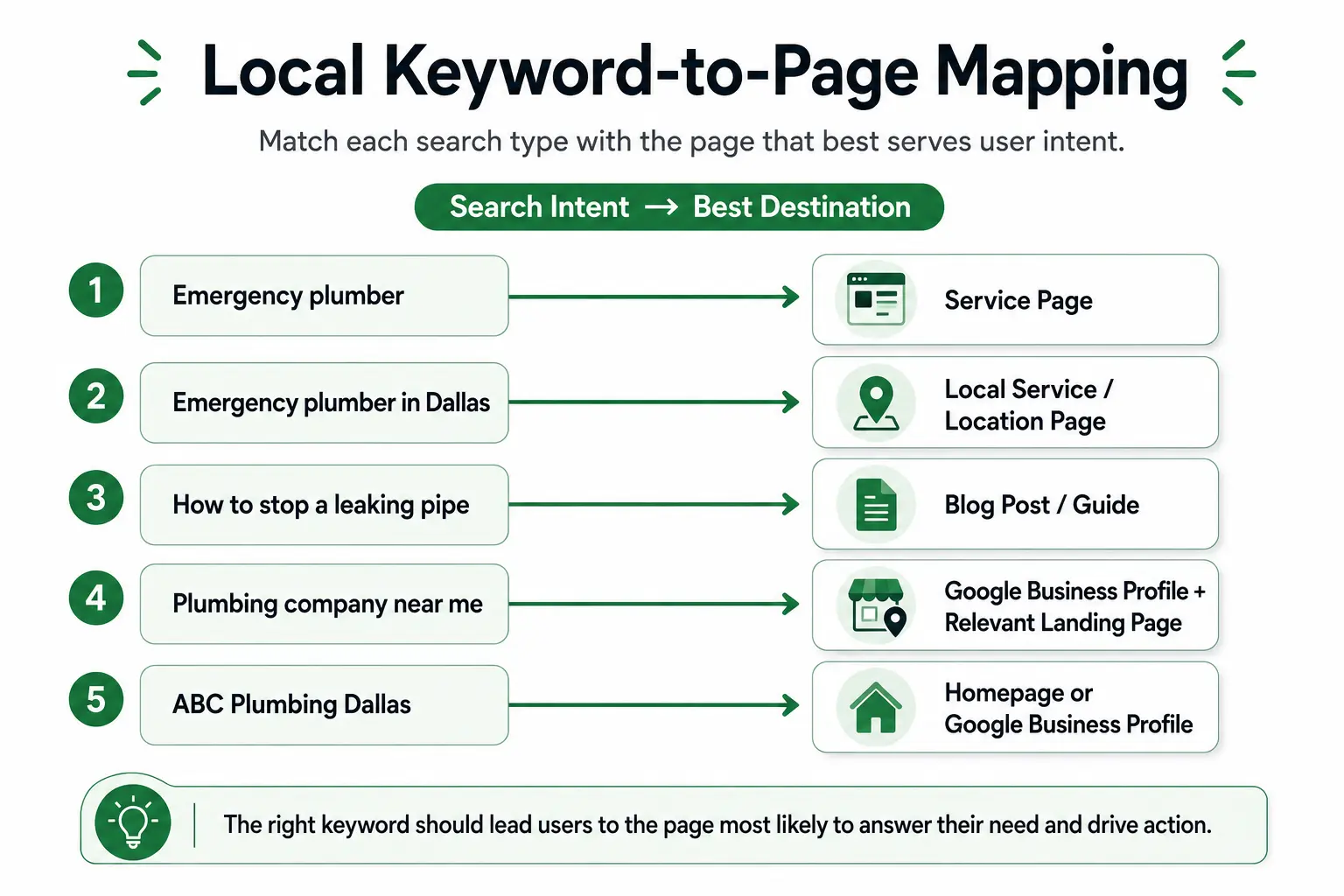
Each page should have one clear purpose.
7. Build a Clear Local Website Structure
A local service business may use:
Important pages should be easy to reach.
Use internal links to connect:
- Homepage to services
- Services to genuine locations
- Blogs to commercial pages
- Location pages to relevant services
- Service pages to Contact Us
- Case studies to related services
8. Optimize Service and Location Pages
A local landing page should answer:
- What service is provided?
- Where is it available?
- Who is it for?
- What problem does it solve?
- What is included?
- Why should the customer trust the business?
- What should the customer do next?
Optimize:
- Title tag
- Meta description
- H1
- Supporting headings
- Opening paragraph
- Service details
- Local information
- Internal links
- Images
- Calls to action
Add genuine local proof where available:
- Customer testimonials
- Completed projects
- Local case studies
- Team information
- Certifications
- Service coverage
- Office or store details
Do not duplicate the same page for multiple cities by changing only the location name.
9. Maintain Accurate NAP Information
NAP means:
- Name
- Address
- Phone number
These details should remain accurate across important platforms.
Review:
- Google Business Profile
- Website
- Contact page
- Social profiles
- Industry directories
- Local directories
- Professional associations
- Major business platforms
Fix:
- Previous addresses
- Old phone numbers
- Misspelled business names
- Duplicate listings
- Incorrect hours
- Wrong website links
Quality matters more than the number of citations. A relevant industry directory is usually more useful than dozens of low-quality listing sites.
10. Build a Sustainable Review Process
Reviews affect trust.
They can also support local prominence.
Ask for reviews after a genuine customer experience, such as:
- A completed project
- A successful appointment
- A delivered product
- Positive customer feedback
- A resolved service issue
Make the process simple.
Use a direct review link where appropriate.
Never use:
- Fake reviews
- Employee reviews presented as customer feedback
- Review exchanges
- Review gating
- Purchased reviews
- Location manipulation
Respond to both positive and negative feedback.
A useful response should be:
- Professional
- Specific
- Calm
- Helpful
- Privacy-conscious
11. Create Locally Relevant Content
Local content should provide information that generic national competitors cannot easily reproduce.
Useful formats include:
- Local service guides
- Local customer questions
- Community updates
- Event information
- Local case studies
- Seasonal advice
- Area-specific regulations
- Local partnerships
- Service availability updates
Avoid generic articles with a city name inserted repeatedly.
A strong local case study may explain:
- The customer’s problem
- The area served
- The service provided
- The process
- The result
- The next step
12. Earn Relevant Local Links and Mentions
Local backlinks can strengthen authority and prominence.
Potential sources include:
- Local partnerships
- Suppliers
- Manufacturers
- Professional associations
- Chambers of commerce
- Local publications
- Community organizations
- Sponsorships
- Industry resources
- Expert contributions
Focus on legitimate relationships.
Avoid websites created only to sell links.
A relevant local mention can be more valuable than an unrelated high-volume placement.
13. Use Appropriate Local Structured Data
LocalBusiness structured data can provide Google with explicit information about a business, such as its name, address, hours, and business type.
Use the most specific appropriate subtype.
Examples may include:
- Dentist
- Electrician
- Restaurant
- LegalService
- AutoRepair
Structured data should:
- Match visible content
- Use accurate information
- Represent a real entity
- Follow Google’s guidelines
- Be tested before publication
Do not add information that users cannot verify on the page.
14. Improve Mobile Experience and Conversions
Many local customers search from a phone.
They may need to act quickly.
Make sure the website provides:
- Clickable phone numbers
- Short contact forms
- Clear business hours
- Visible address or service area
- Easy directions
- Fast-loading pages
- Large buttons
- Clear calls to action
- Simple navigation
Use action-focused CTAs:
The CTA should match the page and customer need.
15. Prepare for AI Search and Zero-Click Discovery
AI Overviews and AI Mode do not require special AI markup.
The same core practices used for normal search remain important:
- Make pages crawlable
- Keep important information in text
- Use internal links
- Provide a good page experience
- Keep structured data consistent with visible content
- Maintain accurate Business Profile information
- Create helpful, reliable content for people
Make information easy to understand.
Use:
- Direct answers
- Descriptive headings
- Short paragraphs
- Useful bullet points
- Original examples
- Clear definitions
- Accurate business details
- First-hand knowledge
Do not create pages only to attract AI citations.
Create content that genuinely helps customers make better decisions.
16. Track Local SEO Performance and Leads
Rankings alone do not show business impact.
Measure local SEO at three levels.
Visibility
Search impressions, local keyword positions, Business Profile visibility, landing-page impressions, and branded versus non-branded searches.
Engagement
Website clicks, phone clicks, direction requests, profile interactions, time on page, and form starts.
Business Results
Completed calls, form submissions, appointments, quotes, store visits, purchases, and revenue.
Use UTM parameters on suitable Business Profile links.
This helps separate profile traffic from other sources.
A Practical 30-Day Local SEO Plan
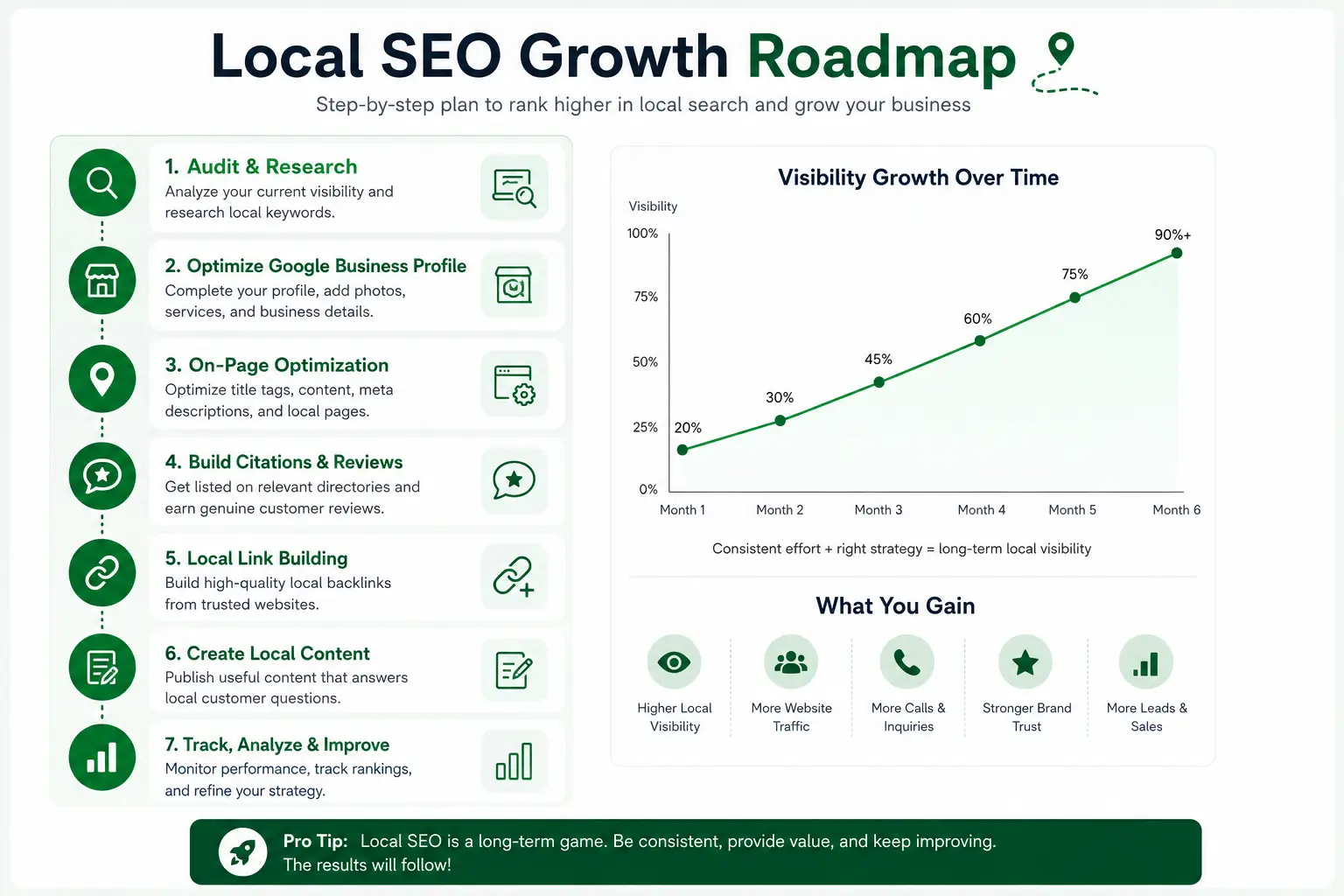
Week 1: Audit and Correct the Foundation
- Verify profile ownership
- Review business eligibility
- Correct business information
- Find duplicate profiles
- Review categories
- Check website indexing
- Set up conversion tracking
- Record current rankings and interactions
Week 2: Optimize the Profile and Website
- Complete profile fields
- Add relevant services
- Update hours
- Add real photos
- Research local keywords
- Improve main service pages
- Optimize the contact page
- Add internal links
Week 3: Build Trust and Consistency
- Correct important citations
- Create a review-request process
- Respond to existing reviews
- Add local proof to website pages
- Test forms and call buttons
- Review mobile usability
Week 4: Build Growth Assets
- Publish one useful local article
- Create one local case study
- Begin relevant outreach
- Add appropriate structured data
- Improve CTA placement
- Review the first month’s performance
Local SEO Checklist for Small Businesses
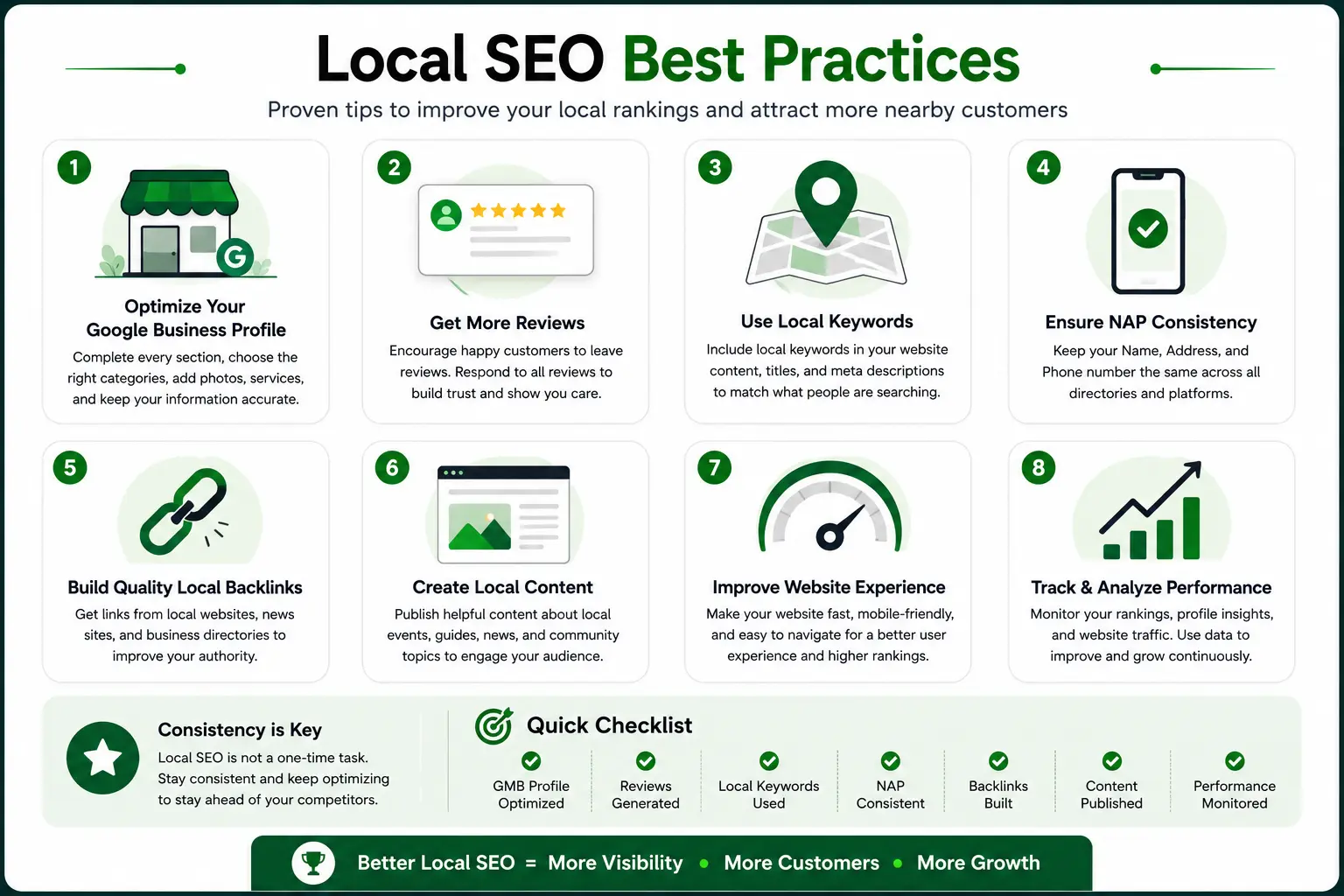
Google Business Profile
- Profile claimed and verified
- Real business name used
- Correct primary category selected
- Relevant secondary categories added
- Address or service area accurate
- Phone number correct
- Business hours current
- Services completed
- Website link correct
- Appointment link relevant
- Photos uploaded
- Reviews monitored
- Duplicate profiles addressed
Website
- Homepage explains the business clearly
- Main services have dedicated pages
- Genuine location pages are available
- Contact page contains accurate details
- Phone numbers are clickable
- Forms work correctly
- Pages are mobile-friendly
- Important pages are indexable
- Internal links connect related pages
- CTAs lead to clear next steps
Authority
- Important citations are accurate
- Reviews are requested ethically
- Local partnerships are explored
- Relevant industry listings exist
- Local links and mentions are monitored
Measurement
- Search Console is configured
- Analytics is configured
- Calls are tracked
- Forms are tracked
- Bookings are tracked
- Business Profile links use appropriate UTMs
- Leads are reviewed regularly
Common Local SEO Mistakes
Keyword-Stuffing the Business Name
Use the real-world business name. Do not add city names or services unless they are genuinely part of the recognized name.
Choosing Too Many Categories
Categories should describe what the business is. They should not become a list of every product or service.
Using an Ineligible Address
Do not use virtual offices, PO boxes, mailboxes, unstaffed locations, or fake branches.
Creating Duplicate Profiles
One eligible business location should normally have one profile. Duplicates can confuse users and create management problems.
Publishing Thin City Pages
Do not duplicate the same content across dozens of locations. Each location page should provide genuine value.
Buying Fake Reviews
Fake reviews create policy and trust risks. Build a real customer-feedback process instead.
Ignoring Negative Feedback
A calm, helpful response can demonstrate professionalism and reveal operational problems that need attention.
Building Low-Quality Citations
More listings do not automatically mean better results. Prioritize relevant, trustworthy platforms.
Sending Every Visitor to the Homepage
Use the most relevant page for the user’s action. A customer seeking one service should not have to search the website again.
Tracking Rankings but Not Leads
A ranking without calls, forms, appointments, or sales may have limited business value.
How Long Does Local SEO Take?
There is no fixed timeline.
Results depend on:
- Competition
- Business location
- Website condition
- Existing authority
- Review strength
- Profile accuracy
- Implementation speed
- Business history
| Period | Main focus |
|---|---|
| First month | Corrections, setup, optimization, and tracking |
| Months 2–3 | Improved visibility and engagement signals |
| Months 3–6 | Clearer ranking and lead trends |
| Ongoing | Reviews, content, links, and conversion improvement |
These periods are not guarantees.
Some businesses may see movement sooner.
Others may need more time.
How Much Does Local SEO Cost?
The cost depends on the scope of work.
Important factors include:
- Number of locations
- Competition
- Website size
- Profile condition
- Citation problems
- Content requirements
- Review processes
- Tracking setup
- Technical issues
- Link-building needs
DIY Local SEO
The direct financial cost may be low. The main investment is time. The owner must learn, implement, monitor, and maintain the work.
Freelancer Support
A freelancer may support audits, strategy, profile optimization, page improvements, citation work, reporting, and ongoing implementation.
Agency Support
An agency may be appropriate for multi-location businesses, competitive markets, large websites, ongoing content, technical implementation, and broader campaigns.
Do not choose only by price.
Evaluate:
- Scope
- Priorities
- Experience
- Implementation
- Reporting
- Transparency
- Business value
Should You Do Local SEO Yourself?
DIY local SEO may work when:
- The business has one location
- The website is small
- Competition is moderate
- Technical problems are limited
- The owner has time to learn
- The profile is in good standing
Professional support may be more appropriate when:
- The profile is suspended
- Duplicate listings exist
- Rankings have declined
- The website has indexing problems
- Several locations are involved
- Previous SEO work caused problems
- Local search is important to revenue
- The team lacks time or technical expertise
Before hiring a provider, ask:
- How will success be measured?
- What will be prioritized first?
- How will calls and forms be tracked?
- How will reviews be handled?
- Which citation platforms will be used?
- How will website changes be implemented?
- What link-building methods will be used?
- What reporting will be provided?
Avoid anyone guaranteeing a specific ranking position.
Frequently Asked Questions
Is Local SEO Worth It for a Small Business?
Local SEO can be valuable when customers use Google Search or Maps to find nearby providers. It can support calls, website visits, appointments, direction requests, and store visits. Its value depends on local demand, competition, business margins, website quality, and the company’s ability to handle leads.
What Is the Difference Between Google Maps SEO and Website SEO?
Google Maps SEO focuses heavily on the Business Profile, categories, reviews, distance, accuracy, and prominence. Website SEO focuses on page relevance, content, technical health, internal links, and backlinks. The two areas overlap and should support each other.
Can a Service-Area Business Rank Without Showing Its Address?
Yes. An eligible service-area business can hide its address when it travels to customers and does not serve them at that location. The profile should use accurate service areas and follow Google’s eligibility guidelines.
How Many Google Reviews Does a Business Need?
There is no universal number. The competitive level differs by industry and location. Focus on receiving genuine, recent reviews consistently rather than chasing an arbitrary total.
Do Google Business Profile Posts Improve Rankings?
Google provides posts to share updates, offers, events, photos, videos, and action links with customers. Google does not state that posting frequency directly guarantees higher rankings. Use posts to improve communication and customer experience rather than as a ranking shortcut.
Are Local Citations Still Important?
Accurate citations can help maintain consistent business information and provide customers with reliable details. Focus on important, relevant platforms rather than submitting the business to every directory available.
Can a Business Rank in Several Cities?
A business may gain visibility in several legitimate service areas, but distance still affects local results. Create useful location content only for areas genuinely served. Do not create fake profiles or addresses to manipulate proximity.
Does LocalBusiness Schema Improve Google Maps Rankings?
LocalBusiness schema helps Google understand business information. It does not guarantee a higher Google Maps position or a rich result. The markup must accurately reflect visible page content.
Can AI Tools Manage Local SEO?
AI tools can support research, organization, drafting, and analysis. They should not replace business knowledge, policy checks, customer understanding, or expert review.
How Often Should Local SEO Be Updated?
Business details should be updated whenever something changes. Reviews, profile information, services, hours, content, citations, and performance should also be monitored regularly. Local SEO is an ongoing process rather than a one-time setup.
Start With the Actions That Matter Most
Local SEO does not require doing everything at once.
Start with the foundation:
The objective is not simply to appear in more searches.
The objective is to help the right local customers:
- Discover the business
- Understand its services
- Trust its information
- Contact the team
- Become customers
Find the Local SEO Gaps Limiting Your Visibility
Your business may already appear on Google.
But incomplete profile information, weak local pages, inconsistent citations, limited reviews, or untracked conversions may prevent that visibility from producing qualified enquiries.
A professional local SEO audit can identify:
- Business Profile gaps
- Category issues
- Local keyword opportunities
- Website problems
- Citation inconsistencies
- Review weaknesses
- Conversion-tracking gaps