

What Are Keywords in SEO?
A keyword in SEO is a word or phrase used to represent a search topic or opportunity that you want a relevant webpage to satisfy.
For example:
local SEO audit
Someone searching around this topic may use queries such as:
- local SEO audit
- how to audit local SEO
- local SEO audit checklist
- Google Maps SEO audit
- how to check local SEO performance
These searches are not identical.
But some of them may represent the same underlying need and can potentially be satisfied by one useful page.
That is an important difference between modern SEO and older keyword-focused approaches.
You are not optimizing a page only for one exact phrase.
You are trying to create the best page for the topic and search intent represented by that keyword and its relevant variations.
A Simple SEO Keyword Example
Suppose someone searches:
Their likely goal is to find a practical list of checks they can perform.
An appropriate result may include:
The keyword helps us understand the topic.
The SERP helps us understand what type of page users expect.
And the content must satisfy the actual problem behind the query.
Keyword vs Search Query: What Is the Difference?
These terms are often used interchangeably, but they are not exactly the same.
| Keyword | Search Query |
|---|---|
| A term used for SEO research and targeting | The actual words entered by a searcher |
| Represents a topic or search opportunity | Represents one real search |
| May represent many variations | Can be highly specific or conversational |
| Used to organize SEO strategy | Generated by users |
For example:
Your SEO keyword may be:
local SEO
But real users may search:
- how can I rank my business higher on Google Maps
- why is my business not showing in local search
- local SEO tips for a small business
- how to improve Google Business Profile rankings
The wording changes.
The underlying topic remains related.
How Do SEO Keywords Work in Modern Search?
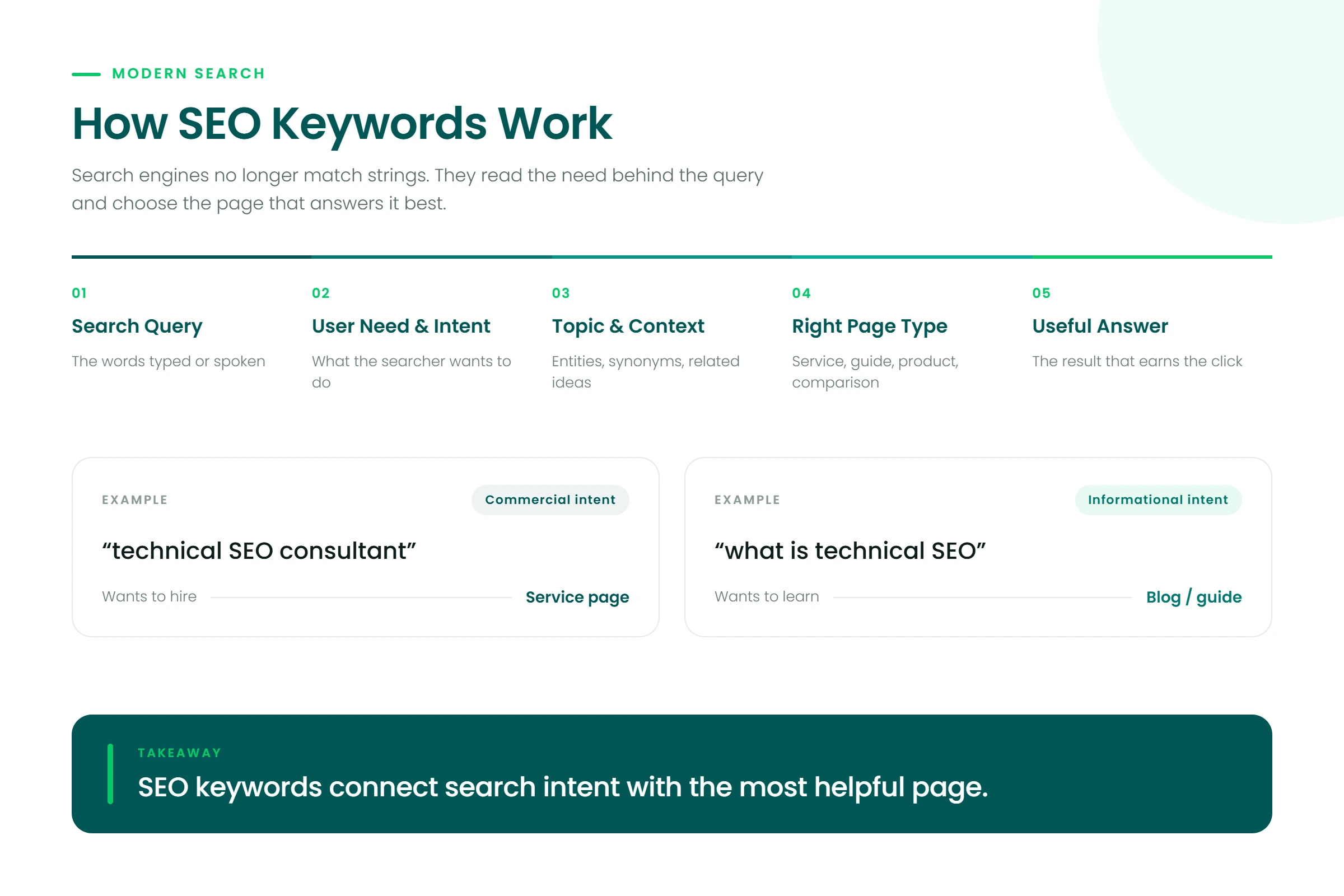
Keywords help connect three things:
A simple model is:
Search engines are much better at understanding language than they were years ago.
That means you do not need to write every possible variation of a keyword into your content.
For example, a useful page about:
keyword mapping
may naturally become relevant to searches involving:
- SEO keyword mapping
- keyword map
- mapping keywords to URLs
- how to map keywords
- keyword mapping for SEO
if the page genuinely satisfies those related needs.
The goal is not to force every variation into the copy.
The goal is to make the page clear, useful, and comprehensive.
Do Exact-Match Keywords Still Matter?
Exact-match keywords can still be useful.
If the exact phrase fits naturally in:
- Your title
- H1
- Introduction
- Relevant heading
- Main copy
there is no reason to avoid it.
But you should not damage readability just to use an exact phrase.
Natural:
This guide explains what are keywords in SEO, how they are classified, and how to use them.
Unnatural:
What are keywords in SEO keywords types SEO are important for SEO keywords ranking.
If you are learning what are keywords in SEO and how different keyword types work, start by understanding the search need behind the phrase.
That does not help the reader.
And repeating a phrase mechanically does not make the page more useful.
Important
Optimize for the meaning and intent behind a keyword first. Use exact wording where it reads naturally.
How Do Keywords Work With AI Search and Conversational Queries?
Search behavior is becoming more conversational.
A traditional search might be:
A more conversational query could be:
How do I decide which existing page should target a keyword cluster without creating cannibalization?
The wording is very different.
But the underlying concepts are still:
- Keyword mapping
- Search intent
- URL ownership
- Cannibalization
- Existing pages
This is why topic coverage matters.
AI-powered search experiences can also help users ask longer, more specific questions.
So SEO increasingly needs to understand:
- Topics
- Subtopics
- Entities
- Questions
- User problems
- Intent relationships
rather than depend on one exact search phrase.
Current Search Fact
Google reported in 2025 that queries beginning with “How do I…” reached an all-time high, increasing 25% year over year. Search is becoming increasingly conversational and problem-focused.
There is no separate category of magical “AI keywords.”
The fundamentals remain the same:
Why Are Keywords Important for SEO?
Keywords remain useful because they turn search behavior into something you can research, organize, and act on.
1. Keywords Show What Your Audience Wants
Keyword research can reveal:
Without understanding search demand, content planning becomes guesswork.
2. Keywords Help You Understand Search Intent
Compare:
Both involve technical SEO.
But the first user wants information.
The second may want a service provider.
The correct content and page type can therefore be completely different.
3. Keywords Help Decide What Type of Page You Need
Different keyword patterns often require different experiences.
| Search Need | Common Page Type |
|---|---|
| Learn something | Blog / guide |
| Find a service | Service page |
| Compare options | Comparison page |
| Buy something | Product page |
| Browse products | Category page |
| Find local help | Location/service page |
| Find a particular brand | Brand destination |
A keyword should influence the page strategy.
It should not simply be inserted into an existing page because the term has search volume.
4. Keywords Help Build Site Architecture
Keyword research can reveal relationships between:
- Main topics
- Supporting topics
- Commercial services
- Categories
- Products
- Locations
- Blog content
Those relationships can later become:
5. Keywords Help Prioritize SEO Opportunities
A useful keyword can be evaluated based on:
- Relevance
- Search intent
- Search demand
- Competition
- Existing rankings
- Business value
- Trend
- Existing website coverage
Search volume alone does not tell you whether a keyword deserves attention.
How Many Types of Keywords Are There in SEO?
There is no universally fixed number of keyword types in SEO.
The number changes depending on how keywords are classified.
A keyword can be classified by:
This is why saying:
“There are exactly nine types of SEO keywords.”
is usually too simplistic.
A better model is to think of every keyword as having a keyword profile.
The SEO Keyword Classification Framework
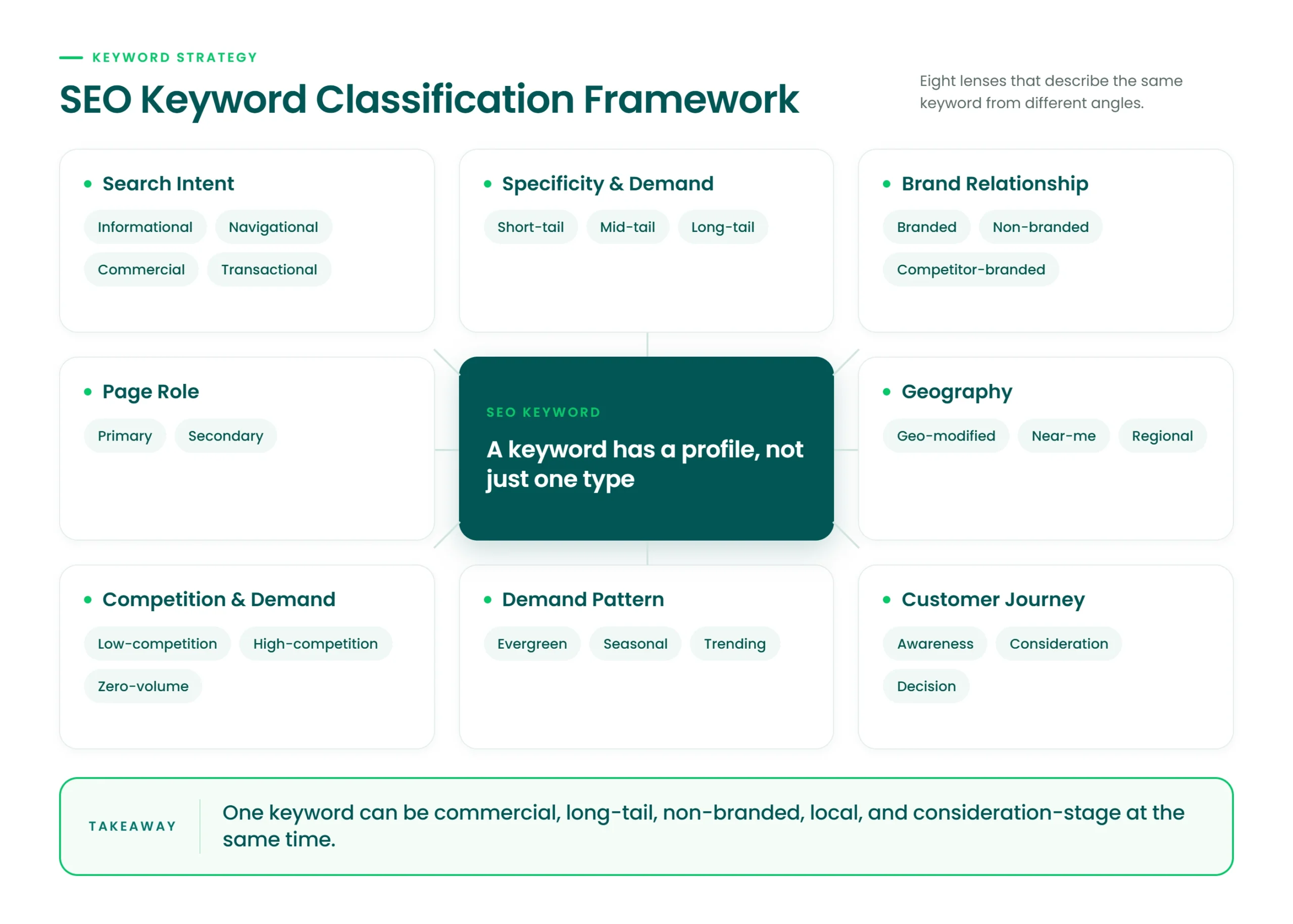
| Classification | Common Types |
|---|---|
| Search Intent | Informational, Navigational, Commercial, Transactional |
| Specificity & Demand | Short-tail, Mid-tail, Long-tail |
| Brand Relationship | Branded, Non-branded, Competitor-branded |
| Page Role | Primary, Secondary |
| Research Role | Seed, Competitor, Question |
| Geography | Geo-modified, Near-me, Regional |
| Competition & Demand | Low-competition, High-competition, Zero-volume |
| Demand Pattern | Evergreen, Seasonal, Trending |
| Customer Journey | Awareness, Consideration, Decision |
| Query Pattern | Question, Comparison, Product, Service, Problem/Solution |
1. Keyword Types by Search Intent
Search intent describes what the user is trying to achieve with the search.
Four categories are commonly used.
Informational Keywords
The user wants information.
- what are keywords in SEO
- how does technical SEO work
- why is my website not indexing
- how to improve local SEO
Navigational Keywords
The searcher wants a specific website, brand, platform, or page.
- Semrush login
- Google Search Console
- Usama Bajwa SEO
- Ahrefs dashboard
Commercial Keywords
The user is researching options before making a decision.
- best SEO tools
- Semrush vs Ahrefs
- best ecommerce SEO consultant
- SEO agency reviews
Transactional Keywords
The user wants to take an action.
- hire SEO consultant
- buy SEO audit
- book SEO consultation
- purchase SEO software
Typical informational content includes:
- Guides
- Tutorials
- Definitions
- Checklists
- Educational articles
The user may eventually become a customer.
But their immediate need is to learn or solve a problem.
The user usually already knows where they want to go when performing a navigational search.
Your job is not necessarily to create another informational article around these queries. The intended brand or destination often has the strongest relevance.
Commercial search often includes:
- Comparing
- Evaluating
- Checking prices
- Reviewing features
- Looking for recommendations
Common page types include:
- Comparison pages
- Reviews
- Best-of lists
- Commercial guides
- Service evaluation pages
The action does not always need to be a purchase.
It can also be:
- Booking
- Registering
- Downloading
- Signing up
- Requesting a quote
Commercial and transactional intent can overlap.
The difference is usually how close the user is to taking action.
What About Local Search Intent?
Local intent deserves special attention.
But it is useful to think of local as an additional geographic characteristic rather than always calling it a completely separate universal intent.
For example:
can be:
- Commercial
- Potentially transactional
- Local
Another example:
best dentist in Toronto
can be:
- Commercial
- Local
- Comparison-oriented
One search can therefore contain multiple signals.
Can a Keyword Have Mixed Search Intent?
Yes.
Real SERPs are not always clean.
A keyword may produce:
- Informational articles
- Product pages
- Category pages
- Commercial landing pages
on the same search results page.
This is called mixed or fractured intent.
It means the search engine sees more than one reasonable interpretation of the query.
When that happens:
- Review the ranking page types.
- Identify the dominant pattern.
- Look at what the highest-ranking pages actually satisfy.
- Decide whether your intended page fits that need.
The live SERP is stronger evidence.
2. Keyword Types by Specificity and Search Demand
Keywords can also be classified by how broad or specific their demand is.
Short-Tail or Head Keywords
Short-tail keywords represent broad topics.
Examples:
They often have:
- High search demand
- Broad intent
- Strong competition
- Many possible interpretations
But the number of words alone does not define the category perfectly.
Mid-Tail Keywords
Mid-tail is a useful practical label for terms that sit between very broad and highly specific searches.
Examples:
- SEO audit services
- local SEO tools
- running shoes men
They generally contain more context than a head term.
But there is no universal rule saying that a keyword with exactly two or three words is automatically “mid-tail.”
Treat the term as a practical description, not a strict mathematical category.
Long-Tail Keywords
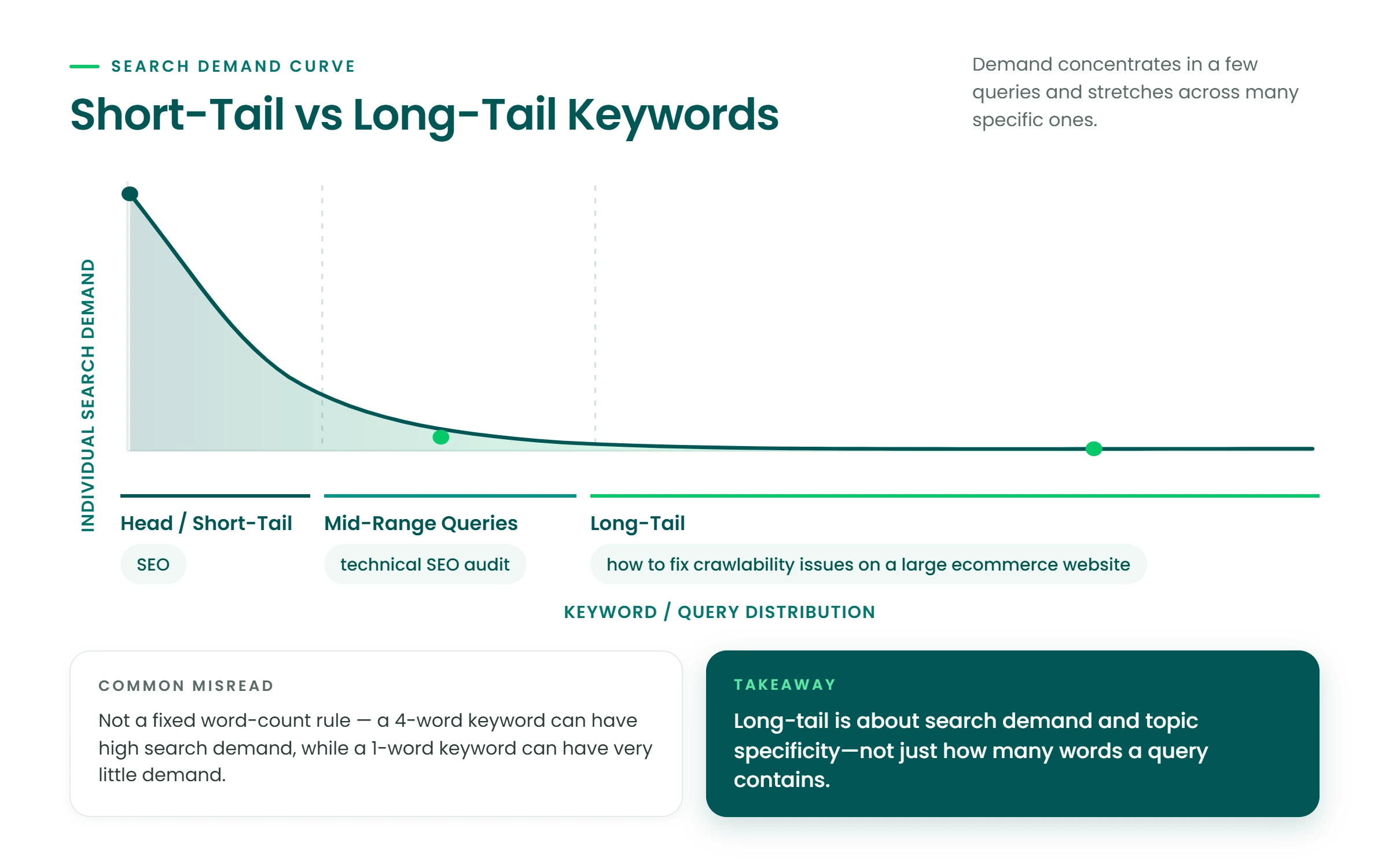
Long-tail keywords are often described as:
Keywords containing three or more words.
That definition is incomplete.
Long-tail originally refers to searches located in the long tail of the search-demand curve.
They tend to receive relatively low individual search demand compared with popular head terms.
They are often more specific.
But length alone does not determine whether a keyword is long-tail.
For example:
A five-word search could still receive enormous demand.
A one-word search can have almost no demand.
technical SEO audit for ecommerce websites
Topical Long-Tail Keywords
A topical long-tail keyword represents a sufficiently distinct search need that may deserve dedicated content.
Example:
how to fix crawl budget issues on ecommerce sites
If the SERP shows specialized pages solving that specific problem, dedicated content may make sense.
Supporting Long-Tail Keywords
Supporting long-tail keywords are alternative or more specific ways people search for a broader topic.
Suppose your main topic is:
keyword mapping
Supporting searches could include:
- how to create a keyword map
- how to assign keywords to pages
- keyword URL mapping
- SEO keyword mapping process
They may not each need their own page.
One strong page may satisfy the whole cluster.
Do You Know?
In Ahrefs' May 2026 U.S. keyword database, about 93% of tracked keywords had fewer than 10 monthly searches. That statistic describes Ahrefs' database—not every Google query—but it illustrates just how large the low-demand “tail” of search is.
Why “Three or More Words = Long-Tail” Is an Oversimplification
The number of words can make a query more specific.
But it does not define search demand.
So don't ask only:
How many words does this keyword contain?
Also ask:
- How much demand does it have?
- Is it a distinct topic?
- Does the SERP differ from the broader term?
- Can another page already satisfy it?
That decision is more useful for SEO.
3. Keywords by Brand Relationship
Another useful classification is whether the search mentions a brand.
Branded Keywords
Branded keywords contain the name of:
- Company
- Product
- Platform
- Person
- Organization
Examples: Semrush keyword tool, Nike running shoes, Usama Bajwa SEO, HubSpot CRM pricing.
Non-Branded Keywords
Non-branded searches describe the need without naming a specific brand.
Examples:
- keyword research tool
- SEO consultant
- running shoes
- CRM software
Competitor-Branded Keywords
These mention another company or product.
- Semrush alternatives
- Ahrefs vs Semrush
- alternatives to Shopify
- HubSpot competitors
Branded search usually indicates existing brand awareness.
Non-branded SEO is important for reaching people who do not already know your business.
Competitor-branded searches can reveal strong commercial investigation intent.
They can also be useful for:
- Competitor research
- Comparison pages
- Alternatives content
But only create such content when you can provide an honest and genuinely useful comparison.
4. Keywords by Their Role on a Page
Keywords can also have different roles within your own SEO strategy.
Primary Keywords
A primary keyword represents the main topic or search opportunity assigned to the page.
For this article, for example:
what are keywords in SEO
is a primary search target.
But a primary keyword should not be interpreted as:
The exact phrase I must repeat 20 times.
It represents the main topic the page needs to satisfy.
Secondary or Supporting Keywords
These are closely related searches that support the same page.
For example, a page about:
keyword mapping
could naturally cover:
- SEO keyword mapping
- keyword map
- how to do keyword mapping
- keyword URL mapping
- mapping keywords to pages
If these searches share compatible intent, they may belong together.
This is where keyword clustering becomes important.
You should not create separate pages just because the wording changes.
Can One Page Target Multiple Keywords?
Yes.
A good page can rank for many relevant queries.
The real question is:
Can one page satisfy those searches without forcing unrelated intent together?
If yes, cluster them.
If no, separate page ownership may be needed.
That is exactly what keyword mapping helps you decide.
5. Keywords by Their Role in Keyword Research
Some keyword labels describe where a query comes from or how it is used during research.
Seed Keywords
Seed keywords are starting points.
Examples:
A seed keyword helps you discover more specific opportunities.
For example:
SEO
could expand into:
- technical SEO
- local SEO
- ecommerce SEO
- SEO audit
- SEO consultant
- keyword research
- internal linking
A seed keyword does not necessarily need to become the final target.
It starts the research process.
Competitor Keywords
Competitor keywords are queries another website already ranks for.
They can help identify:
- Content gaps
- Commercial opportunities
- Topic gaps
- Search-demand patterns
- Pages competitors use to attract traffic
But competitor keywords should not be copied blindly.
Does this search matter to my audience and business?
A competitor ranking for something does not automatically make it a good opportunity for you.
Question Keywords
Question searches often contain terms such as:
Examples:
- what are keywords in SEO
- how does keyword mapping work
- why is my website not ranking
- can SEO work without backlinks
Question keywords can reveal specific problems users need solved.
They are particularly useful for:
- Tutorials
- Guides
- FAQs
- Troubleshooting content
- AI-search-friendly question coverage
Related Terms, Concepts, and Entities
A complete page naturally discusses concepts connected with its topic.
For an SEO keyword article, related concepts may include:
- Search intent
- Search queries
- SERPs
- Search volume
- Topics
- Entities
- Keyword clusters
- Page types
These are not automatically separate keywords you need to repeat.
They are part of explaining the topic properly.
6. Keywords by Geographic Target
Geographic keywords indicate that location matters.
Geo-Modified Keywords
These explicitly mention a location.
- SEO consultant Toronto
- dentist Mississauga
- plumber New York
- SEO services Canada
Near-Me Keywords
These rely heavily on proximity.
- dentist near me
- SEO consultant near me
- coffee shop near me
The actual results can vary based on the searcher's location.
Regional or National Keywords
These target a broader geography.
- SEO services Canada
- SEO consultant USA
- ecommerce SEO UK
Geography can overlap with intent.
For example:
hire SEO consultant Toronto
can simultaneously be:
- Transactional
- Local
- Non-branded
- Service-focused
Again, one keyword can have multiple classifications.
7. Keywords by Competition and Search Demand
Some labels describe how attractive or difficult an opportunity may be.
Low-Competition Keywords
Low-competition keywords appear easier to compete for relative to other opportunities.
Keyword difficulty is a third-party estimate.
You still need to inspect:
- Actual ranking pages
- Search intent
- Content quality
- Page-level authority
- SERP features
- Business relevance
High-Competition Keywords
These often have SERPs dominated by:
- Established brands
- Strong pages
- Authoritative domains
- High-quality content
- Strong backlink profiles
That does not automatically mean you should avoid them.
Some high-competition terms may be strategically important enough to pursue over time.
Zero-Volume Keywords
SEO tools sometimes show:
0 monthly searches
That does not always mean no one will ever search the query.
Reasons can include:
- Very niche demand
- New terminology
- Poor measurement
- Highly specific searches
- Many unique conversational variations
Google has long reported that a meaningful share of the searches it handles each day are queries it has not seen before.
So zero reported volume should not automatically equal:
No value.
Evaluate the real problem, audience, and business relevance.
Emerging Keywords
Emerging keywords represent new or growing demand.
They may appear around:
- New technology
- New regulations
- Product releases
- New platforms
- New terminology
- Industry changes
Traditional keyword tools can take time to reflect new demand.
That is where trend analysis becomes useful.
8. Keywords by Search-Demand Pattern
Not all search demand behaves the same way over time.
Evergreen Keywords
Evergreen demand remains useful across long periods.
Examples: what is technical SEO, how to write a title tag, keyword research.
Seasonal Keywords
Seasonal demand returns during predictable periods.
Examples: Black Friday marketing, Christmas gift searches, tax filing queries, summer travel, Ramadan offers.
Trending or Event-Driven Keywords
Trending searches can grow rapidly because of news, product launches, public events, platform updates, algorithm changes, or new technologies.
Interest may rise and fall.
But the underlying problem remains relevant.
Timing matters.
Publishing seasonal content after demand peaks can waste the opportunity.
But a spike does not always become lasting demand.
This is why you need to distinguish:
How to Use Google Trends for Keyword Research
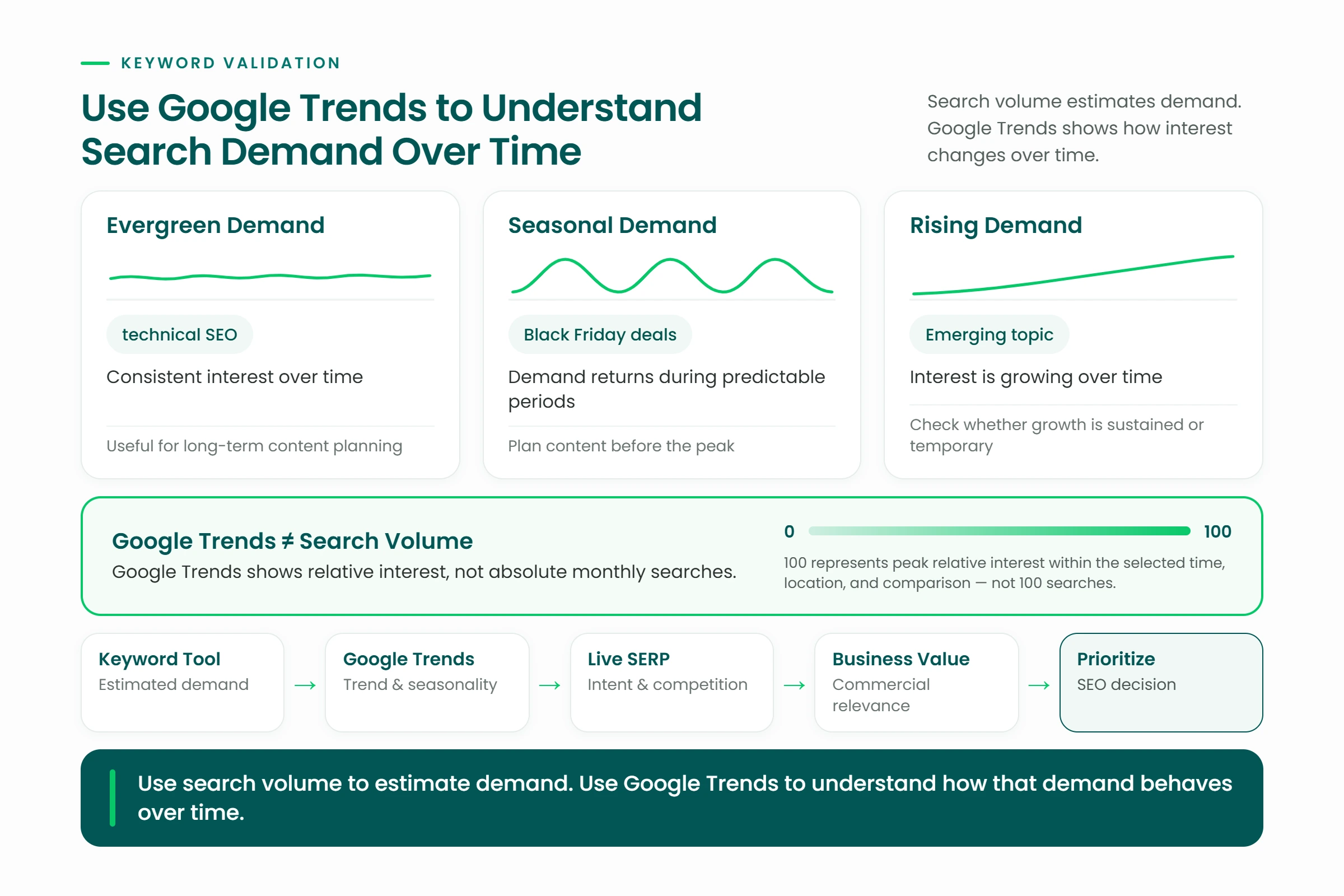
Google Trends can help determine whether interest in a term is:
- Stable
- Increasing
- Declining
- Seasonal
- Temporarily spiking
You can also use it to:
- Compare terms
- Review regional interest
- Check historical patterns
- Identify rising topics
Its interest data is normalized.
The values are scaled between:
where 100 represents the highest relative interest within the selected comparison, location, and time period.
So use Google Trends together with keyword tools.
Not instead of them.
Example workflow
Suppose two keyword tools show opportunities for:
Keyword A
and:
Keyword B
Before prioritizing them:
- Compare both in Google Trends.
- Review the last 12 months.
- Extend to five years.
- Check seasonality.
- Compare your target country.
- Look for sustained growth or decline.
- Then combine that information with volume, SERP difficulty, and business value.
9. Keywords by Customer Journey
Search intent and customer journey are related.
But they are not exactly the same thing.
Awareness Keywords
The user is learning about a problem.
Consideration Keywords
The user understands the problem and is evaluating possible solutions.
Decision Keywords
The user may be close to taking action.
Awareness examples:
- why is my website not ranking
- what is local SEO
- what are keywords in SEO
Consideration examples:
- best SEO tools
- SEO agency vs freelancer
- Semrush vs Ahrefs
Decision examples:
- hire technical SEO consultant
- SEO audit pricing
- book SEO consultation
Search Intent vs Funnel Stage: What Is the Difference?
| Search Intent | Customer Journey |
|---|---|
| Describes what the user wants right now | Describes where the user is in the buying journey |
| Informational, commercial, transactional, navigational | Awareness, consideration, decision |
| Usually validated through SERP behavior | Depends partly on business/customer context |
| Search-focused | Marketing-focused |
A commercial keyword is often middle or bottom funnel.
But not always.
10. Keywords by Query Pattern or Use Case
These labels are useful for organizing opportunities.
They are not necessarily separate universal “keyword types.”
Question Keywords
how to perform an SEO audit
what are SEO keywords
Comparison Keywords
Ahrefs vs Semrush
Shopify vs WooCommerce
SEO agency vs freelancer
Product Keywords
men's leather shoes
CRM software
wireless headphones
Service Keywords
technical SEO services
local SEO consultant
ecommerce SEO agency
Problem/Solution Keywords
website not appearing on Google
pages crawled but not indexed
Google Business Profile not ranking
Audience-Specific Keywords
SEO for dentists
SEO for lawyers
accounting software for freelancers
Industry-Specific Keywords
packaging SEO
healthcare SEO
real estate SEO
Platform-Specific Keywords
Shopify SEO services
WordPress SEO
React SEO
These can combine platform knowledge with another intent such as commercial or informational.
Can One Keyword Belong to More Than One Type?
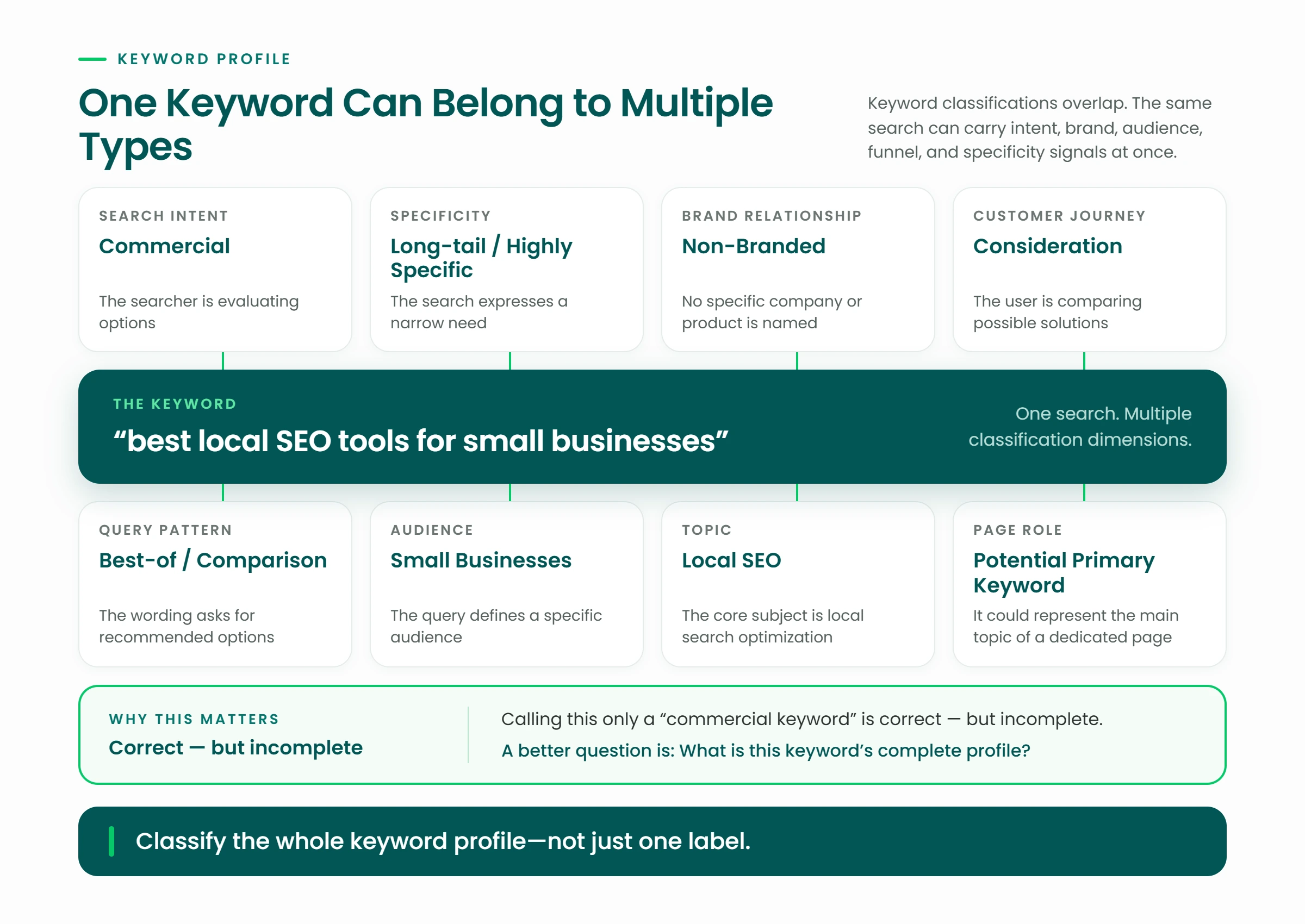
Yes.
And this is one of the most important things to understand about keyword classification.
Take:
Its keyword profile could be:
| Dimension | Classification |
|---|---|
| Search Intent | Commercial |
| Specificity | Long-tail / highly specific |
| Brand Relationship | Non-branded |
| Funnel Stage | Consideration |
| Query Pattern | Best-of / comparison |
| Audience | Small businesses |
| Topic | Local SEO |
| Page Role | Could be a primary keyword |
Calling it only a:
“commercial keyword”
is technically true.
But incomplete.
Another Example: Semrush pricing
| Dimension | Classification |
|---|---|
| Search Intent | Commercial / potentially transactional |
| Brand Relationship | Branded |
| Customer Journey | Decision |
| Query Pattern | Pricing |
| Specificity | Highly specific |
This explains why different SEO articles produce different lists of keyword types.
They are measuring different dimensions.
Do You Know?
Instead of asking “What type is this keyword?”, a better SEO question is: “What is this keyword's complete profile?”
SEO Keyword Types vs Google Ads Keyword Match Types
Another common source of confusion is mixing organic SEO classifications with Google Ads terminology.
Google Ads concepts include:
- Broad match
- Phrase match
- Exact match
- Negative keywords
These describe how paid advertising keywords can trigger ads.
They are not the same thing as organic SEO classifications such as:
- Informational
- Long-tail
- Branded
- Primary
- Local
| Organic SEO Classification | Google Ads Concept |
|---|---|
| Search intent | Broad match |
| Specificity | Phrase match |
| Brand relationship | Exact match |
| Page role | Negative keyword |
| Geographic intent | Paid targeting logic |
Do not put both into one flat “types of SEO keywords” list without explaining the difference.
Keyword Terms That Are Often Misunderstood
Some common SEO terms create unnecessary confusion.
Are LSI Keywords a Real SEO Keyword Type?
No.
“LSI keywords” has become an SEO-industry term for words supposedly related semantically to a main keyword.
But treating them as a special keyword list you must insert into content is not a useful modern SEO approach.
Instead focus on:
- Relevant concepts
- Entities
- Subtopics
- Questions
- Natural terminology
- Context
If you fully explain a topic, many related terms will appear naturally.
Are Meta Keywords Still Important for SEO?
No.
The old:
<meta name="keywords">
tag is not used by Google for web-search ranking.
That does not mean keywords are irrelevant.
It means the historical meta keywords tag is irrelevant to Google ranking.
Do not confuse:
SEO keyword research
with:
meta keywords
They are completely different things.
Is Keyword Density a Ranking Formula?
Keyword density simply measures how frequently a word appears relative to the total content.
It is not a universal SEO formula.
There is no useful rule such as:
Every keyword must appear exactly 1.5% of the time.
Trying to hit arbitrary percentages can make content repetitive and unnatural.
Instead ask:
- Did I answer the user's question?
- Is the primary topic obvious?
- Did I cover necessary subtopics?
- Is the wording natural?
- Does the page match intent?
Are Exact-Match Keywords Required?
No.
Exact terms can be useful when they fit naturally.
But you do not need to make every sentence match keyword-tool wording.
Searchers phrase the same idea differently.
Search engines can understand many of those relationships.
Write clearly.
Are Keywords and Entities the Same Thing?
No.
A keyword represents a search topic or query opportunity.
An entity is an identifiable thing or concept such as:
- Person
- Company
- Place
- Product
- Organization
- Concept
For example:
Semrush
can be an entity.
Semrush keyword research tool
can be a keyword/query.
Entities can be part of a keyword. But they are not the same concept.
Are Synonyms Separate Keywords?
Not automatically.
Examples:
attorney
lawyer
may describe highly similar concepts.
But whether they should be handled together depends on:
- Context
- Geography
- Search intent
- SERP similarity
- Page type
Do not create a new page for every synonym.
Validate the search results first.
Which Types of Keywords Should You Target?
There is no universally “best” keyword type.
Choose based on your SEO goal.
| Goal | Useful Keyword Characteristics |
|---|---|
| Build awareness | Informational + non-branded |
| Educate an audience | Questions + informational |
| Capture comparison searches | Commercial + comparison |
| Generate service leads | Commercial + transactional |
| Protect brand demand | Branded |
| Generate local leads | Geo-modified + commercial/transactional |
| Find realistic opportunities | Relevant low-competition |
| Build topical authority | Primary + supporting clusters |
| Sell ecommerce products | Product/category + transactional |
| Run seasonal campaigns | Seasonal + commercial/transactional |
| Capture competitor evaluation | Competitor-branded + comparison |
The best SEO keyword is not automatically the one with:
- Highest volume
- Lowest KD
- Most words
- Highest CPC
A stronger framework is:
How to Evaluate an SEO Keyword Before Targeting It
Before building a page around a keyword, check six things.
Does this search genuinely matter to my audience or business?
What does the searcher actually want?
Review estimated search volume.
Look at who actually ranks.
Is interest growing, stable, declining, seasonal, or temporarily spiking?
What does this visitor mean to the business?
Traffic from irrelevant users has little value.
Then inspect the SERP.
Look at:
- Ranking page types
- Titles
- Content formats
- SERP features
- Commercial vs informational patterns
Keyword tools provide estimates.
Treat volume as one signal.
Not the entire decision.
Evaluate:
- Page quality
- Relevance
- Backlinks
- Brand strength
- Content depth
- Page type
- Search-intent alignment
Do not decide purely from KD.
Use Google Trends where appropriate.
Ask:
- Is interest growing?
- Stable?
- Declining?
- Seasonal?
- Temporarily spiking?
Potential outcomes can include:
- Sale
- Lead
- Consultation
- Signup
- Brand exposure
- Product discovery
- Internal progression to a commercial page
7. Existing Website Coverage
Before creating a new page, ask:
Do I already have a URL that should own this intent?
This can prevent:
- Duplicate content
- Overlapping targeting
- Keyword cannibalization
- Unnecessary pages
How to Use Keywords in Content Without Keyword Stuffing
Good keyword optimization should feel natural to the reader.
Use the primary topic where appropriate in:
- SEO title
- H1
- Introduction
- Relevant headings
- Main content
- URL
- Internal anchor text
- Image alt text when genuinely descriptive
But do not force every variation into every location.
Write for the Topic, Not a Keyword Density Percentage
Suppose the target is:
what are keywords in SEO
A useful article should naturally answer related questions such as:
- What does a keyword mean?
- What is a search query?
- Why do keywords matter?
- How many keyword types exist?
- What is search intent?
- What are branded keywords?
- What is a primary keyword?
- What is long-tail?
- Which keywords should I target?
That is useful topic coverage.
Repeating:
what are keywords in SEO
twenty times is not.
Avoid Creating One Page for Every Keyword Variation
These may all potentially belong together:
- keyword mapping
- SEO keyword mapping
- keyword map
- how to map keywords
- mapping keywords to URLs
Creating five near-identical pages could make your website worse.
First determine which keywords genuinely share intent.
Then cluster them.
What Happens After You Find the Right Keywords?
Understanding keyword types is only the beginning.
A practical SEO workflow continues through several stages.
Find Real Opportunities
Do not choose keywords only because a tool labels them “easy.” Evaluate search intent, SERP competition, demand, and business relevance.
Group Keywords That Belong Together
Once you have a keyword list, organize searches around shared intent and SERP similarity.
Assign Each Cluster to the Right Page
Next decide which existing or new URL should own this search intent.
Optimize the Correct Page
Once ownership is clear, improve search-intent alignment, title, headings, main content, internal links, metadata, and supporting topics.
Connect Related Pages
Relevant pages should not exist as isolated islands. Use internal links to connect main topics, supporting guides, commercial pages, and related solutions.
That process is called keyword clustering .
Read: Keyword Clustering: How to Group Keywords by Search Intent & SERP Similarity
That is keyword mapping.
Read: Keyword Mapping: How to Assign Keyword Clusters to the Right Pages
This is where a structured on-page SEO strategy becomes useful.
Relevant pages should not exist as isolated islands.
Use internal links to help users move between:
- Main topics
- Supporting guides
- Commercial pages
- Related solutions
That strengthens the overall information architecture.
A Simple SEO Keyword Decision Framework
Use this workflow instead of choosing keywords randomly:
Discover
Find relevant search opportunities.
Classify
Understand:
- Intent
- Specificity
- Brand relationship
- Location
- Journey stage
- Demand pattern
Validate
Check the real SERP.
Cluster
Group searches that can be satisfied together.
Map
Assign each cluster to the correct URL.
Optimize
Build or improve the page around the user's need.
Measure
Track:
- Rankings
- Queries
- Impressions
- Clicks
- Leads/conversions
- Ranking URL
Then refine the strategy using real performance data.
Common SEO Keyword Mistakes
Understanding what not to do is as important as understanding keyword types.
Assuming There Is One Fixed Number of Keyword Types
There isn't.
Better approach: Use dimensions.
Creating One Page for Every Keyword
Different wording does not always mean different intent.
Better approach: Cluster compatible searches.
Choosing Keywords Only by Search Volume
A large keyword can still be too broad, irrelevant, wrong intent, or poor business value.
Better approach: Balance demand with relevance and value.
Choosing Keywords Only by KD
Difficulty metrics are useful estimates. They are not Google ranking scores.
Better approach: Inspect the live SERP.
Ignoring Search Intent
A keyword may look perfect in a spreadsheet but require a completely different type of page.
Better approach: Determine what is already satisfying searchers.
Treating Every Long Phrase as Long-Tail
Word count is not the definition.
Better approach: Consider search demand and whether the query represents a distinct topic.
Forcing Exact-Match Keywords
This creates unnatural copy.
Better approach: Use the topic and its relevant terminology naturally.
Using LSI Keywords as a Checklist
You do not need a mysterious list of “LSI keywords.”
Better approach: Cover relevant concepts, subtopics, entities, and questions.
Confusing Google Ads Match Types With SEO Keyword Types
Broad, phrase, exact, and negative match belong to paid-search mechanics.
Better approach: Keep PPC match logic separate from organic SEO classification.
Ignoring Existing Pages
Creating more content is not automatically better.
Better approach: Audit existing URLs before publishing another page.
Frequently Asked Questions About SEO Keywords
What are keywords in SEO?
Keywords in SEO are words or phrases used to represent search topics and opportunities that relevant webpages are designed to satisfy. They help connect search demand, user intent, and page strategy.
How many types of keywords in SEO are there?
There is no universally fixed number. Keywords can be classified by intent, specificity, brand relationship, geography, page role, competition, seasonality, customer journey, and other characteristics.
What Are the Four Main Keyword Types by Search Intent?
- Informational
- Navigational
- Commercial
- Transactional
A keyword may also contain other signals such as local intent or brand awareness.
What Is an Example of an SEO Keyword?
technical SEO audit is an SEO keyword. It represents a search topic around evaluating technical website issues such as crawling, indexing, canonicals, redirects, and site performance.
What Is the Difference Between Primary and Secondary Keywords?
A primary keyword represents the main topic assigned to a page. Secondary keywords are closely related terms and supporting searches that can naturally be satisfied by the same page.
Can One Keyword Belong to Multiple Types?
Yes. For example, best SEO consultant in Toronto can be commercial, local, non-branded, service-related, highly specific, and close to the consideration or decision stage at the same time.
How Many Keywords Should One Page Target?
There is no ideal fixed number. A page can target a cluster of relevant keywords when they share compatible search intent and can be satisfied by the same useful content.
Are Long-Tail Keywords Always Three or More Words?
No. Long-tail primarily relates to position in the search-demand curve, not a fixed word count. Longer phrases are often more specific, but word length alone does not define long-tail demand.
Are Meta Keywords Still Used by Google?
Google does not use the historical meta keywords tag for web-search ranking. Keyword research is still important. The old meta keywords field is not.
What Is the Difference Between Branded and Non-Branded Keywords?
Branded keywords contain a specific brand, product, company, or person name. Non-branded keywords describe the product, service, or need without naming a specific brand.
Which Keywords Are Best for SEO?
The strongest opportunities usually combine Relevance + Correct Intent + Meaningful Demand + Realistic Competition + Business Value. There is no single keyword type that is always best.
Final Takeaway
SEO keywords are not simply phrases you insert into content.
A useful keyword helps you understand:
- What people are searching for
- Why they are searching
- How specific the need is
- Whether a brand is involved
- Whether location matters
- Where the searcher sits in the customer journey
- What kind of page may satisfy the query
- How the search relates to other keywords
- Whether the opportunity makes sense for the business
And there is no single fixed answer to how many types of keywords in SEO exist.
A keyword can belong to several classifications at the same time.
That is why a better SEO process is:
Don't start by asking:
How many times should I use this keyword?
Start by asking:
What does this search tell me about the user, and what is the most useful page I can create or improve for that need?
That question leads to better SEO decisions.
Want a Clearer Keyword Strategy?
If you have hundreds of keywords but are unsure which ones matter, which should be grouped together, or which pages should target them, Usama Bajwa can help turn the keyword list into a structured SEO plan.
Contact Usama Bajwa